Professional Bottle Filling Machine Supplier

When looking to buy a vacuum emulsifying mixer, many businesses may ask what the best way is to keep the machine in good shape. This short series breaks down a few simple and common ways to maintain an emulsifier machine in excellent condition.

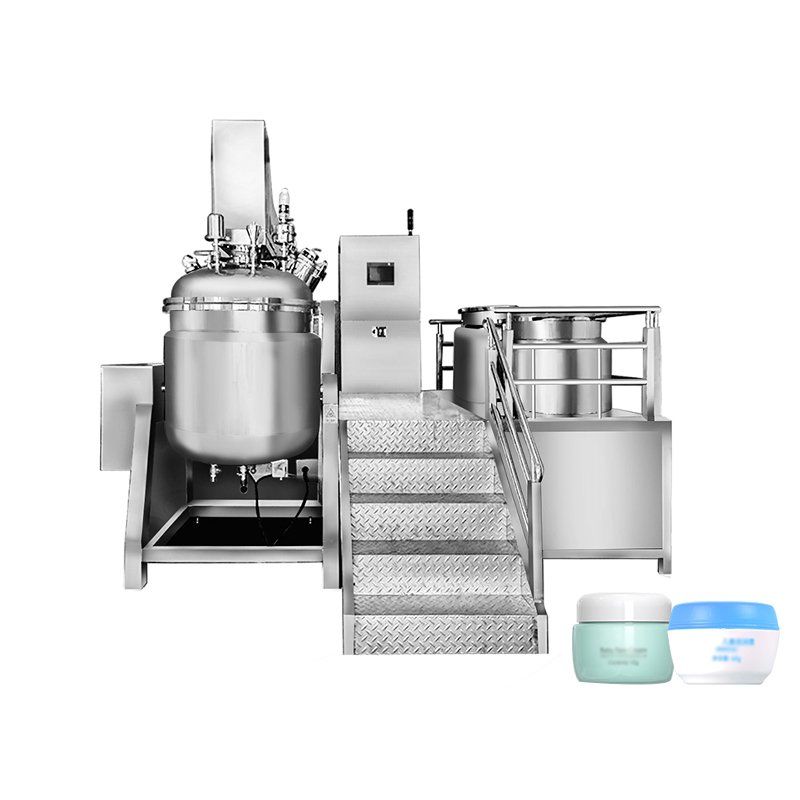
Vacuum Emulsifying Mixer for cream

1. After use, the vacuum emulsifying mixer must be thoroughly cleaned to preserve the rotor’s functionality and safeguard the emulsifying machine’s secret seal. Create and place a cleaning cycle device close to the perimeter, if required

2. After the emulsifier checks that the sealing cooling water is connected, turn on the motor and ensure that the motor’s steering is in line with the spindle’s steering mark before it works. Never let it go in the opposite direction!

3. If liquid leaks out of the shaft while the machine is running, the pressure of the machine seal must be changed after the machine has stopped.

4. Depending on how operators use them, the import and export filters need to be cleaned regularly so that they don’t cut down on the amount of feed and threaten the efficiency of production. The material that goes into the working chamber must be liquid . Do not put dry powder or lumps of material directly into the machine. If you do, the machine will get clogged up, and the emulsifier will be damaged.

5. Metal scraps or other hard and hard sundries should never be introduced into the emulsifying machine’s operating chamber; doing so may severely harm the stator, rotor, and other components.

6. To protect the safety of workers and equipment, the related safety production operating procedures must be developed prior to the construction of the vacuum emulsifying mixer. Users should install a safety protection system in their electrical control system, as well as a solid and dependable electric motor grounding system.

7. Checking the emulsification machine’s stator and rotor on a regular basis is essential. If it is determined that wear is excessive, the related parts must be replaced immediately in order to maintain the desired dispersion and emulsification effects.

8. The liquid material has to be continuously fed into the emulsification machine or maintained at a certain volume in the container. Avoid running empty machines so as not to solidify the material during high-temperature or crystallization processes and harm the machinery!

9. If the vacuum emulsifying mixer makes a strange sound or has other problems, it should be stopped right away for inspection. Once the problem has been fixed, the machine can be turned back on. When the machine is turned off, the working space, the stator, and the rotor should be cleaned.

To get the most out of these different types of e-liquid filling machine s, no matter if you have a small business or a large one, it’s essential to know how to use them. An incorrect operation can lead to production problems, as well as eventually financial losses. Now, let’s find out how to properly operate an e-liquid filler:

E-liquid Filling Machine Pre-Start up Guidelines

Perform basic tests before running the e-liquid filling machine to get the best results and services and prevent any possible faults resulting in time loss and financial losses. Below are pre-start-up points:

  1. Double-check the electrical in and out connections of the e-liquid filling machine. All connections should be tight since loose connections could cause the unit to malfunction.

  2. The machine’s MCB should be turned on.

  3. Check and keep up the air pressure. The air pressure in the pneumatic unit should be between 5 and 6 bar.

  4. Fill the product tank with the product you wish to fill it with.

  5. Check and tighten each of the connections. The pipes that pull in the air should be submerged in the liquid.

  6. E-liquid filling machinery has two safety mechanisms and alarm systems. Press the emergency STOP button if the alarm goes off. Once the cause is gone, the alarm will be turned off. Go ahead and turn off the emergency STOP button.

E-liquid Filling Machine Start-Up Guidelines

  1. To start the e-liquid bottle filling machine, turn on the main power supply. When turned on, power is sent to the control panel. To turn on the control panel, move the main switch on the board to the ON position. This machine is now ready to go.

  2. After the control panel, the next point to turn on is the conveyor unit. First, turn on the conveyor unit, then the filling unit, and finally, the capping unit. Three different green push START buttons turn on all three phases.

  3. Once the switch is turned on, the conveyor belt moves and brings the bottles to the filling station. Automatic sensors turn on the filling unit when the bottle is in the right place. At the end of the nozzle, the pneumatic unit stops the bottles. The distribution tub brings the liquid to the nozzle. And the product is put into one bottle at a time. After bottle filling, they are moved to a capping station with the conveyor belt. The crowns are brought to the chute by vibrations. The crowns go on the necks of bottles, which are held in place by the arms of the wheel.

E-liquid Filling Machine Stopping Guidelines

  1. To stop the e-liquid filler, you must press the red STOP button, which is different for each unit. Follow the exact order you did when you turned on the machine. That is, start with the conveyor unit, the filling unit , and the capping unit.

  2. Turn off the control panel by flipping the main switch to OFF.

  3. Lastly, turn off the E-liquid filling machine’s main power source.

How To Fix The E-Liquid Filling Machine On A Basic Level?

  1. Conveyor. Check the main power supply if the machine and conveyor system won’t turn on. Turning on the main power supply will most of the time, start the machine. Check the machine’s MCB to see if it is on. Check the button that says “START.”

  2. Stopper. If the bottles don’t stop, check the air pressure, which should be between 5 and 6 bar. Check the limit switches to see how to change the limit.

  3. Check the distance between the nozzles and bottleneck if the product is being filled into the bottles improperly. Adjust the distance.

  4. Bowl feeder: Check the pneumatic unit if the bottle caps don’t fit right. The air pressure should be between 5 and 6 bar. Adjust the pressure according to the manual. The distance between the bottles and the unit that puts the caps on them often makes it hard to get them on the right. Change how high the capping unit is.

Need help with your e-liquid filling machine ? Or are you looking for an e-liquid bottle filling machine for sale? Fear not; you are in good hands! Come check out our website and send us a message now! We’re only an email away if you need any support!

As with almost any other product, making equipment to package jams, sauces, or preserves can present some unique challenges. These products often have chunks or pieces of fruit in them. Food products may have a short shelf life and must be packaged cleanly. Getting the fruit into the container for filling and keeping the fruit from sinking to the bottom of the supply tank can be challenging.

jam packaging line

Here’s where the jam filling line comes in. Jam packaging machines effectively fill and pack jams and sauces into various container types. Let’s look at what equipment is included in a jam packaging line.

1.Cleaning Equipment 

When working with food products, equipment is essential to clean containers to keep the food from getting dirty. Rinsing machines can clean dust and debris from jars and other containers before filling them. This reduces the risk of making contaminated products or shortening the shelf life of a batch. Different machines for cleaning containers can be used to rinse with clean air, water, or another cleaning solution.

2.Jam Filling Machine

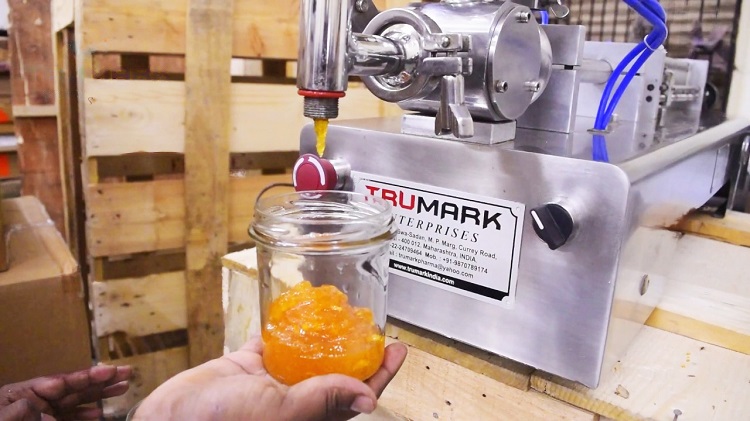
Usually, jam filling machines have either a pump filler or a piston filler. These fillers work better with thicker products and products with small pieces, like seeds or chunks of fruit. Jams that are too thick to flow through a filling machine may be too thick. In these situations, the jam can often be heated to make it less thick and more liquid so it can be put through the machine. The entire path from the supply tank through the tubes down to the fill nozzles must be kept at the same temperature. In this way, products flow evenly, and the same level of reliability can be achieved over and over again.

Another difficulty filling jam products is when small particles get into the jam. These particles could be strawberry seeds or small pieces of strawberries, apricots, apples, or other foods. When the parts are filled into the filling machine, they tend to settle at the bottom of the supply tank or product supply. Thus, containers are still filled without the particles or products they should contain. Product agitators can be added to supply tanks to keep product and particulates from settling. This lets the filling machine pull both product and particulates from the tank.

3.Capping Device and Cooling Conveyors 

For jams, the type of capping machine used will depend on the type of container and cap used to package the products. Once the filling part of the packaging process is done, jams are capped, labeled, and packaged with special care.

But if the fill is heated to speed up the flow of the product, it may be necessary to put a cooling conveyor between the filling and capping machine.  The cooling conveyor can look like anything from a serpentine conveyor with many levels to a simple long conveyor. These conveyor systems let the product cool down before it goes to the capping machine. This ensures that the cap is put on correctly and consistently, and you don’t have to worry about the product or container getting damaged or expanding when you cap a hot product. If not, jam containers can be sealed with spindle, chuck cappers, or snap capping machines.

4.Labeling Device

Labeling equipment for jams generally won’t need any particular changes, as the capping machines did. Labeling machines can apply labels to the front, front, and back, wrapped around containers, or any other configuration required. Once again, hot products would be the sole issue. To prevent creases or the label from pulling off, containers should be chilled before attaching the label. 

Jam Filling Line Benefits

If you want to buy a jam filling machine, you should look for one that fits your needs. These machines can measure out single portions of a wide range of jams. Our machines are perfect for jam packaging because they load the film onto a machine and heat it to the right temperature. Then, the film is shaped into a particular shape, and the product is put into blisters. The film is then cut into blisters and sealed.

The jam sauce filling machine is run by a PLC, an electronic optical fiber sensor, and a computer touch screen. This machine can record outputs accurately from one day to one month. It can also handle liquids that are both thin and thick. The pistons that fill the tank can move up and down, which makes the machine lighter and uses less energy. The design of the servo system lets layers be filled on the neck or on the surface. The servo system is easy to clean and meets all GMP standards.

This jam sauce bottle filler is used in food, personal care, chemical, and other industries. Because it is easy to use, it can be used to fill a wide range of products, from liquids to thick pastes. The machine’s rotor pump filler can be used for various products, from heavy sauces to skin creams. Unlike the manual fill, this machine is reliable and makes it easy to change the amount and consistency.

When the emulsifying machine  is brought to your workplace, factory, or plant, the water, electricity, and gas should also be set up. Here’s how a vacuum emulsifying mixer will be configured:

1. Check to see if each valve and switch is doing its one and intended purpose.
2. Check to see if the homogeneous, sweep wall stirrer’s rotation path is in place and working right and if the rotation function could be significant.
3. Check for water within the heating interlayer; do not turn it on when the liquid stage is below the heating rod. If you wish to use steam heating, ensure that the connecting pipes and valves between the steam generator and the vacuum emulsifier mixer are properly linked .
4. Check that the voltage, meters, lights, etc., are all working appropriately.
5. To operate, the cloth must be heated and stirred at the same time, based on your system and the way it is made.
6. When there’s fine fabric in the pot, the homogenizer can be turned on, and the sweeping wall can be mixed simultaneously. The sweep wall stirring speed needs adjustment from the slowest to the fastest or from 0 to the preferred rate.
7. If the homogenizer stops working, the power must be turned off quickly, and the parts must be taken apart and fixed. When the vacuum pump is turned on, the vacuum control switch must be pulled out before the vacuum pipeline valve can be turned on. First, close the vacuum valve, and when you’re done, turn off the power supply. When the vacuum pressure reaches – 0.05 MPa to – 0.06 MPa, open the feed valve to pull the materials in the water pot and oil pot into the vacuum. And check the filter regularly to ensure it doesn’t let any dirt into the emulsifying pot. This will keep the homogenizer working correctly. The vacuum inside the emulsifying pot must stay low. Usually, it needs to be maintained between -0.05 MPa and -0.6 MPa to avoid boiling water.
8. While machines are running, they need to be taken care of. Stop operating before leaving the working place.
9. Before the system stops running, the frequency converter must be set back to 0, and the stirring stop button must be pressed.
10. Close the water valves, turn off the electrical transmission, and open the vacuum exhaust valve.
11. After unloading the products and keeping the pot clean, use hot water to clean out what’s left in the pot.

vacuum emulsifying mixer

Vacuum Emulsifying Mixer Manufacturing Process: How to Troubleshoot Common Problems?

During the vacuum emulsifying mixing, you may run into some problems or issues. Here are some of them:

1. You might find it hard to mix powder that doesn’t dissolve easily in water.
2. Getting a uniform product from two-phased emulsification could be difficult.
3. In the emulsification pot, bottom sediments can be a major issue.
4. Some materials that stick together are hard for agitators to break up.

An  emulsifier machine  is simple and can be at the same a complex piece of equipment. The natural, technical design and application of each system component, as well as the proper operations and consumer protection, resulting in its successful performance. Device failure is commonly caused by the vacuum emulsification machine operating improperly. Let’s say you want to keep your failed device from causing wrong manufacturing losses. In that case, operators need to be good at learning how the vacuum emulsifier works and how to use it, and they should also know how to fix common problems.

1. Check to see if the vacuum pipe on the emulsifier is open or closed and if the seal is leaking.
2. Check to see if the vacuum valve is open, the vacuum pump is refueled, the vacuum pump’s water tank is full, and the vacuum pump is turning in the right direction.
3. Check to see if the power is coming in smoothly and if the cord is leaking.
4. Check to see if the motor is working well and if the blades are turning smoothly.
5. Determine whether the homogeneous head is sturdy and if any additional frame interacts with the homogeneous head.
6. Check if the relay in the electrical controls cabinet turns off and the limit switch is freed.
7. Check if the stirring shaft turns and if the scraper is a little bit worn.
8. Check to see if any outside frame is stuck in the scraper wall and shouldn’t be turned too quickly.

The fully automatic shampoo filling machine can automatically do tasks such as measuring, making bags, filling, sealing, cutting, counting, heat-print codes, etc., during the packaging process. All the work, the design uses a unique embedded sealing, an improved heat sealing mechanism, an intelligent temperature controller, and an excellent heat balance so that it can work with all kinds of packaging materials. The sealed performance is silent, the texture is clear, and the seal is strong. You can do a zigzag cut, a pattern cut, or a zigzag joint cut through the replacement. This makes the cutter stable and reliable when cutting bags and keeps it from getting stuck. The process is easy to follow.

automatic shampoo filling machine

Our shampoo filling machine is a new kind of automatic filling machine that can fill shampoo at a speed, feed rate, and weight that can be adjusted. It uses the idea of ​​mechanical shaping, faster cutting, and grinding, which makes it easy to use and excellent for a wide range of liquid and powder product materials.

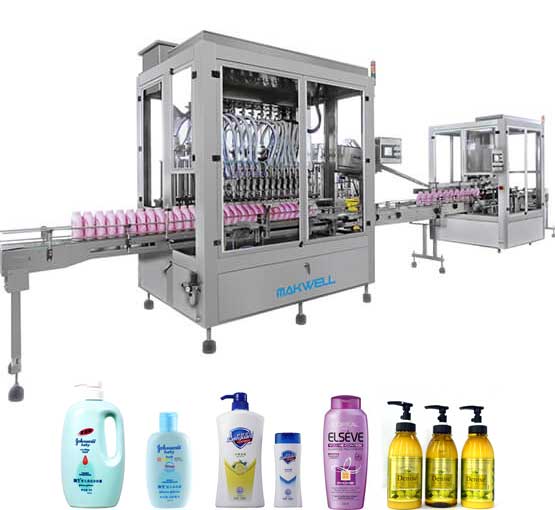
MAKWELL Shampoo Filling Machine 

Characteristics

1. This filling machine is a piston type with excellent filling accuracy.
2. Popularly used to pack cleaning products for personal care.
3. With high filling accuracy, high speed, and a wider filling range, viscous liquids can be packed in many different sizes.
4. It is made to GMP standards, so it is safe, clean, and good for the environment. It is also beautiful and can be used in different kinds of workplaces.
5. When switching products for packaging, the filling machine may be quickly cleaned.
6. Filling speed of 30 to 60 bottles per minute (customizable) with ±1% measurement accuracy.
7. Filling range of 10ml up to 1000ml, customizable to meet filling targets.
8. Combining a bottle unscrambler, a capping machine, a labeling machine, and other machines, a shampoo filling machine can automatically unscramble, fill, cap, seal, label, add a QR code, unpack, pack, seal, and stack the bottles. It also has an environmental protection cover built in. It meets safety, environmental, and intelligent three-levelization standards, and the production process is automatically coordinated, making it stable and effective.

Configurations

1. Use of high-quality imported PLC to intelligently control each part of the shampoo filling machine. Set the bag length, bag stop, cumulative production amount, display production amount, and set total output shutdown. Photoelectric can be changed to open or close at will, a new type of intelligent automatic filling machine.
2. The temperature of both the horizontal and vertical sealing bodies can be controlled by an intelligent temperature controller.
3. Smart photoelectric positioning, light motion, dark movement arbitrary converter, powerful anti-interference, and alert for an abnormal stop after three consecutive bags of cursor movement.
4. The speed of packing can be changed without shutting down the machine.
5. High level of bag-making accuracy. Simple to use and maintain.
6. In keeping with national measuring standards, use piston pump type measurement for precise measurement of packed materials with consistent density.

Filling System : Piston Filling Head

The shampoo goes into the material cylinder, and the piston pushes the shampoo into the measuring cylinder. The piston then moves up to send the shampoo to the pipe that fills up the bottle. As the bottle moves the conveyor belt into the filling machine, the filling head moves down to start filling. Once the bottle is full, the conveyor belt will send it to the capping station. Filling process without drip leakage, the number of filling heads can be changed based on your needs.

✅ Conveyor Belt

When the bottles are put on the conveyor belt, the bottles are taken to the filling machine, and the filling process begins. After filling, they are then sent out. Different bottle sizes can fit on this conveyor belt. The space between the two pipes can be changed to fit your container. This ensures that the bottle moves smoothly and safely along the conveyor belt. On the side of the conveyor are sensors that can automatically tell when a bottle needs to go out or send a signal to the screw cap filling station.

Measuring Cylinder

The main function of the measuring cylinder is to measure the amount of filling. Using it can improve the accuracy of your filling. It is powered by a servo motor, which controls the movement of the piston rod. When the piston moves down, it moves the material from the material cylinder into the measuring cylinder. When the piston moves up, it moves the dose of the material from the measuring cylinder into the filling pipeline. You can change the size of the doing cylinder to fit your needs.

Makwell Designs and Creates Filling Machines and Packaging Equipment for Shampoo

The shampoo is one of many liquid products that our machines can fill and package. Almost any shampoo packaging facility can use complete systems of shampoo filling machinery, labelers, cappers, and conveyors to meet its needs.

Our filling machine for shampoo is made to adapt to the changing needs of the shampoo business. We make the equipment you need to fill shampoo bottles and satisfy your production targets.

The shampoo packing machines are a technological masterpiece with a modern design, high efficiency, high quality, and high reliability. These machines can make high-quality products that work well and don’t cost much. We manufacture them to fit many different needs, so you can get solutions that are just right for you.

As a top shampoo filling machines manufacturer, we provide a broad range of premium filling and packaging equipment at reasonable prices. Our company offers consumers after-sale care and products of the highest quality. Additionally, to guarantee smooth operations, our assist technical expertise throughout the manufacturing process. 

We have come up with many ways to package shampoo. Whether you want to package your shampoo in a bottle, a pouch, or a 3/4-sealing sachet, we can create a solution that fits your specifications.

If you’re looking for a shampoo filling machine semi-automatic, fully automatic, or a shampoo packaging line, we’d love to hear from you! Visit our website and send us a message today!


A jam is a product made from ripe, fresh, dehydrated, frozen, or previously packed fruits, such as fruit juices, pulp, fruit juice concentrate, or dry fruit. The processes of jam making starts with boiling its pieces, pulp, or puree with nutritive sweeteners like sugar, dextrose , invert sugar, or liquid glucose until it has the right consistency. It could also have fruit pieces and other ingredients that go well with the product. It can be made from any suitable fruits, alone or with others. It should taste like the original fruit without burnt, unpleasant, or crystallization.

Jam Making Processes/Stages

jam packaging line


1. Inspect

Ripe, firm fruits for jam making are selected and graded based on color and sensory appeal. The rotten fruits are removed from the harvest. Hand-picking and color sorters may be used to do this.

Wash
200 ppm of chlorine can be added to water to clean fruits well. The pH and temperature should be kept at the same level to keep fruits from getting damaged or bruised. In industries, dump washers and spray washers can be used.
Peel
Fruits can be peeled by hand, like an orange or an apple. In most industries, peeling is done with mechanical peelers and automated peeling machines with blades. Some fruits don’t require peeling. Some fruits with hard stones inside need to be pitted.

2. Pulp

By pulping, the seed and middle part are taken out. Fruits like mangoes, peaches, tomatoes, bananas, draw berries, and more can be pulped with several different machines. The space between the sieve and the rotor can be changed to fit materials of different sizes and qualities that need to be pulsed.

3. Add Sugar

The pulp or juice of the fruit is mixed with the right amount of sugar and pectin. If you need to, you can add water. Sugar sticks to the water molecules, which lets the pectin chains move around and make their network. The jam gets firmer when you add more pectin, and when you add more sugar, it gets sticky.

4. Boil

The most essential step in processing of jam making is boiling, which takes a lot more time. After putting the mixture on the stove, we must wait until the sugar dissolves. Slowly, the fruity smell will fill the room, and a foamy network of pectins may form on the surface of the jam. This is normal, and you can get rid of it by adding a little butter (about 20g) to break the surface tension or by skimming it off with a spoon while the mixture cools.

5. Add Citric Acid

During the boiling process, a certain amount of citric acid is added. For jam to set properly, we heat the mixture to 105°C or 68–70%TSS. To check for jams, you can also do a sheet test.

Sheet test:  Take a small amount of jam on a spoon, cook it a bit, and let it drop. If it falls as a sheet or flakes, the jam is done. If not, boiling continues.

6. Fill Process

By using piston pump fillers, hot jam is put into sterilized jars. The jars are then vacuum-capped with metal lids, sent through a cooling tunnel, and their labels are put on. Getting the jam jars ready to be passed out. Either sell their jams directly to customers or to retailers.

Our jam filling machine  is made of stainless steel and according to food product regulations. The PLC system works with it. While the main tank makes the right amount. It can hold between 100 ml and 5000 ml. The filling range can be changed to fit the desired basis weight.

The jam filling line  includes all the equipment necessary to get your jam packaging machines  up and running. From 10 to 50 bottles may be bottled each minute using this machine.

Automatic volumetric mechanical piston-action dosing and filling machines are perfect for liquid and pastry in glass, metal, or plastic containers and jam and mixed products with pieces.

7. Storage

Keep the filled jam in a cool, dry place out of the sun. About a year is how long a jam can will last. Now it’s finished! This mix of sugar and fruit can taste great, making any dull recipe into something extraordinary.

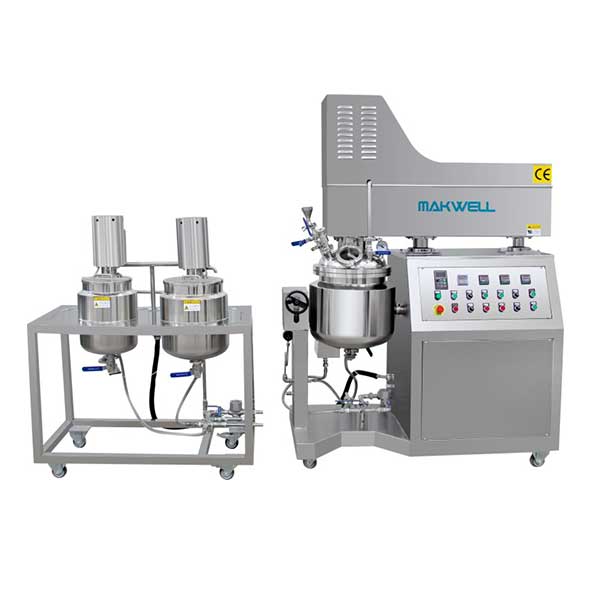
A vacuum emulsifying mixer or emulsifier machine is used to mix, disperse, homogenize, emulsify, and aspirate materials that are very thick. This machine has a heating and cooling system as well as a vacuum system. It is widely used to mix creams, lotions, ointments, liquid creams, etc.

Depending on production needs, this emulsifier machine  can be semi-automatic or fully automatic. Now, what is the difference between them?

Semi-Automatic Vacuum Emulsifying Mixer

A semi-automatic emulsifier mixer  needs both human and machine input to work. The materials are put into the pots by hand, and the machine is set to run. This machine does emulsifying work, and the finished product must be taken out of the tank by hand. Also, it has to be cleaned and sanitized by hand. This is because CIP and SIP are not built into the semi-automatic emulsifying mixer.

Water and oil containers, a vacuum system, a hydraulic lifting system, and a tilting mechanism are also included in a semi-automatic. It also features a heating and cooling system, a temperature control system, and an electric control panel. It operates the same way as the automated version, but human input is necessary for the emulsification process to be effective.

Automatic Vacuum Emulsifying Mixer

Because it has a high-speed shear head , a fully automatic emulsifier machine can move at a very high speed. It has a blade mixer for mixing ingredients that are very thick and a high-speed homogenizer that makes emulsification easier.

This automatic emulsifier mixer gets rid of dead corners by using scrapers to remove all the materials stuck on the surface of the mixing tank. A downward current is made to help mix the materials and move them along in a continuous process. High speed causes pressure to change from the bottom to the top of the homo-head. This causes breaking, mixing, and emulsification. The materials pour out of the homo-head’s top, and the blade mixer’s down-force brings them back. This happens when the force going up goes down.

Low viscosity materials may be easily emulsified with this kind of equipment. The raw ingredients are automatically sucked into the mixer using a vacuum function. Vacuuming, heating, and chilling may all be done in a single process. quickly as it is automated.

It is fully automated and controlled by a touch button, a timer, and a process recorder. Stainless steel is used to make parts that don’t touch the materials. Because it works in a vacuum, it automatically stops air from getting into the chamber where the mixer is. This machine can also be set up with CIP, which helps the mixer regularly clean itself automatically.

Other Vacuum Emulsifying Mixer Efficiency Factors

Vacuum Emulsifying Mixer for cream

How do vacuum emulsifying mixers vary in efficiency?

The effectiveness of a vacuum emulsifying mixer depends on a number of factors. They can be:

◎ Material density, dispersion, wettability, stickiness, and other physical qualities all impact the vacuum mixer’s efficiency.
◎ The natural properties of the ingredients that need to be emulsified are also important. Rough things tend to stick together, which makes a perfect emulsion.
◎ For ingredients to mix well, pieces should be about the same size. Particle size variation produces unwanted effects.
◎ The shape of the ingredients is another thing that affects how well this machine works. Materials that have round shapes tend to mix well with each other. Material particles with odd shapes don’t mix well.
◎ Electrostatically charged particles that tend to stick to each other tend to move away from other materials. This makes it harder for the oil and water to mix together.
◎ The choice of vacuum emulsifying mixer is the last and most crucial factor. Choose a machine that works well, doesn’t cost too much, and works consistently to ensure excellent results.

What is the operating temperature range of the vacuum emulsifying mixer?

The temperature at which work can be done can be between 50 and 60 degrees Celsius . When the valves are closed, you press the power button to start preheating the water and oil pots. The temperature needs to go up to 50 degrees Celsius, and then it needs to be stirred to keep going up.

You not only heat the materials to the right temperature, but you also stir them. This is done to ensure that the ingredients in creams are heated to the same temperature as the mixer. The emulsifying pot is heated to the same temperature (around 60 degrees Celsius) as the water and oil pot.

But first, the heating valve must be turned on while the input and outlet valves are shut. A vacuum emulsifying mixer’s operating temperature may sometimes reach 80 degrees Celsius. However, adding a cooling system to the emulsifying pump and bearing plate may work out nice. With a single-stage emulsion pump, this works well.

If you have a three-stage emulsion pump, a high-temperature O-ring can also help. This can work well at temperatures as high as 220 degrees Celsius. For emulsification to go on all the time, you should use a machine with a cooling system. This will help the machine handle the high temperatures that will rise as it works.

A sauce is a liquid, cream, or semi-solid food that goes with other dishes or is used to make them. Most sauces aren’t meant to be eaten by themselves. Instead, they improve a meal’s taste, texture, and look. A liquid component is required for sauces. Sauces are an essential part of many different kinds of food worldwide. Dressings for salads, tomato sauce, fruit sauce, chili sauce, etc.

Because we use a certain quantity of sauce on a regular basis, we anticipate that the demand will expand even more. Sauces are essential not just at home but everywhere else in the world. A fantastic method for keeping up with demand is automating sauce packing . It will increase productivity, provide a clean working environment, reduce the amount of human labor required, and may be adjusted if there is ever an increase in the demand for sauce. The time to invest in automatic sauce bottle fillers  has never been better! get to choose whether you want the system to be semi-automatic or fully automatic!

sauce fill

Moreover, sauce filling equipment  handles various types of containers when used to fill sauces. We have many different kinds of liquid filling machines, cappers, labelers, and conveyors that can be used to fill and package sauce and other thicker liquids. We have machines that can work with liquids that are as thick as sauces or as thin as water. We can help you find the right sauce filling equipment for your needs to have a complete system.

How does the Sauce Filling Machine Actually Work?

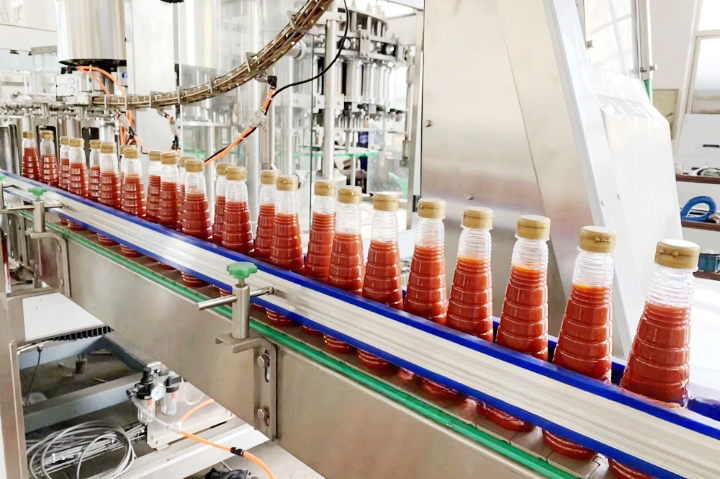
This  sauce filling machine  has a horizontal mixing hopper that ensures the liquid is the same throughout the filling process and doesn’t separate into layers. This makes sure that each bottle is filled to the right level. The automatic sauce filling machine makes the distance between the lower hopper and the filling head shorter. This makes up for the fact that materials aren’t always put in the same way during the filling process. The filling heads on this automatic filling machine can be changed to fit the customer’s needs. After the Bottles and jars are filled with liquid, the capping and sealing machines put the lids and seals on them.

The capping and sealing device provides an airtight seal and protects against sauce spilling. The product is moved through the filling and packaging procedures on a well-defined network of conveyors. To support the information and branding process, customized labels are applied in a specific manner The sauce filling process needs liquid with heavy proportion, no leakage, and intelligent information systems are added to the control panel in a clean and tidy environment. The ability to boost productivity and production efficiency is made possible by integrating quick and precise aging packing and equipment with advanced communication.

Why Choose Automatic Sauce Filling Machine?

Food products must be filled and packed with extra care and must meet all hygiene standards. Today, we manufacture a wide range of liquid filling equipment, cappers, labelers, and conveyors that can be used to fill and package sauce and other thicker, more viscous sauces. This equipment can provide:

1. The most reliable source of filling sauce.
2. Affordable when produced in large quantities.
3. Less waste is particularly beneficial if the product line is high-priced.
4. Increase the efficiency and speed of manufacturing.
5. Adaptability because the ingredients in sauces vary in how thick they are.
6. Quick tool changeovers give you more freedom.
7. Packaging to keep the sauce from leaking and to protect it from any kind of contamination. This is especially helpful if the product needs to be sent overseas or over a long distance.

About Sauce Filling Machine Manufacture

MAKWELL sauce filling equipment lets you customize the production lines for sauces and other products with similar viscosity. The rotary filling valve can be chosen based on the product’s needs and how it is made. With a complete set of reliable sauce filling products, you can make a production line that works well and gives the same results yearly. The equipment is made of high-quality, corrosion-resistant parts, and the piston pumps fill all the bottles quickly and accurately.

Providing filling and packaging machines is our specialty. These machines offer great flexibility and customization, so they can be used in sauce and ketchup bottle filling applications with different and demanding needs. Our machines are used worldwide because of how well they work and how long they last.

Investing in an automatic filling line help achieve higher accuracy levels and reduce the possibility of human mistakes. The sauces and dressing industry uses various filling methods, including hot or room temperature filling, mass, weight flow and filling technology, and doing volumetric method. The packaging line should provide a clean environment that is flexible enough for fast tool changes.


The shampoo is a hair care product for cleaning our hair. It usually comes in the form of a thick liquid. Shampoo applies to wet hair, massaging it into the scalp and then rinsing it out. Some people use hair conditioner after shampooing their hair. A shampoo filling machine packages this hair care product.

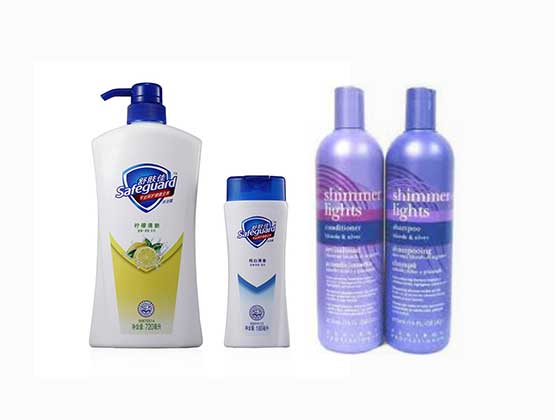
With packaging, shampoo bottles provide practical packaging for liquids and gels. Choose from PET, LDPE, HDPE, MDPE, and PVC plastic bottles. Each plastic has both distinctive features of its own and qualities in common with the others. Like PET bottles are transparent and impact-resistant. HDPE is quite flexible. When dropped, MDPE has a strong shock resistance. These are typical shampoo bottles:

The shampoo is one of many liquid products we handle. Almost any shampoo packaging facility can use complete systems of a  shampoo filling machine , labelers, cappers, and conveyors to meet its needs. Our machines can also fill and package a wide range of other liquids , from drinks to industrial liquids with low to high viscosity. Make your liquid packaging facility last as long as possible using a system of reliable equipment.

When we talk about “how to choose a filling machine”, it’s hard to ignore how thick the material can be. The shampoo has a high viscosity, so a piston filling machine is an excellent choice when selecting a shampoo filling machine. A series of piston filling heads are set up to fill the bottles with the right amount of shampoo. As the bottles move through this part of the filling line, they are filled with shampoo using the shampoo filling machine. The bottles then move to the machine that puts the caps on.

Top Shampoo Filling Machine Features

1. PLC control, touch screen operation.
2. Driven by a servo motor. The filling size on the HMI is adjustable automatically, for example. If you wish to fill 500g of liquid, enter the number 500, and the machine will adapt automatically 3.
It has a volumetric piston and a high filling accuracy.
4. Top-mounted, double-jacketed heating and mixing tanks prevent liquid crystallization during a one-day or longer break in operation.
5. Automatic liquid filling machines can also have a CIP system that connects to the users’ CIP systems.
6. The horses of the liquid filler are made especially for liquids and have no dead corners.
7. Famous brands make soft tubes or pipes on the liquid filler.
8. Rotating valve built Specifically for transferring sticky liquids.

◎ Filling Factors

automatic shampoo filling machine

Bottling Machines for Shampoos

The filling machine and the capping machine, two essential components of any bottling operation, will be more common in specific sectors than others. For instance, an overflow filler is often used in the bottled water business because of its consistent fill. Personal care industry bottling equipment provides a great example of why these general rules may not apply to every product.

  • Consistency 

Shampoos can be thick or thin. This means that, unlike bottled water, there isn’t a single type of filling machine that will be used for 95% of all shampoos. If the product to be bottled is thicker, a pump filler could also be used. The type of filler used will depend on the qualities of the soap or shampoo being put into the bottle.

  • Foaming

Some shampoos tend to foam when the bottle is filled. Different bottle fillers can stop the foam from making the fills uneven in different ways. To stop foaming, thicker products on different fillers may need to be filled from the bottom up, anti-foaming nozzle attachments, or other methods. Again, the best way to stop the foam depends on the shampoo in the bottle.

  • Cap Types

Shampoo bottle cappers won’t have much to do with the shampoo itself, but they will have everything to do with the bottle and cap. Shampoos can have simple flip-top caps, flat screw-on caps, or even pump-top caps. Most of the time, each type of cap will screw onto the used bottle. However, there are times when a cap won’t screw on. Most shampoo bottles on the market can be sealed with spindle or chuck cappers. But with pump tops and other unique lids, it may be necessary to place or insert parts in a certain way to make the seal consistently and reliably. Because of this, product features are essential for finding the best solution for each product and requirement.

◎ Filling Solutions

Integrate a Complete System of Shampoo Filling Machines

Our liquid fillers can handle a wide range of products, even thicker shampoos. We provide a wide variety of liquid packaging machines, including but not limited to shampoo filling equipment, which will allow you to fully automate your packing process, reducing the number of break and increasing productivity. We have various solutions to fulfill your application’s specific needs.

After filling bottles, capping equipment puts customized caps on different bottles to make an airtight seal that keeps the bottles from getting dirty or leaking. Labelers apply labels on containers that are clear, made of Mylar, or made of paper. Each label has its own logo, text, and images. You can use a system of conveyors with custom speed settings to ensure that your shampoo products move quickly and efficiently from the beginning to the end of the filling and packaging processes. Using all of these pieces of equipment together, You can make a production line that works well and gets the desired results.

Design a Customized Shampoo System of Machinery

Our full line of liquid packaging and filling machines is customizable to fit different needs. We offer equipment that comes in many different sizes and can be set up in a way that makes it easy to use in almost any production line. If you need help finding the best  filling machine for shampoo  and other equipment for your production line, our experts can help you choose the machines, set up the system, and install them. Using a customized liquid packaging system, you can keep breakdowns to a minimum and get the most work done over time.

Contact us right away if you want to start designing and setting up a new system for packaging and filling liquids. We specialize in liquid filling machine manufacture  and other filling and packaging equipment. Plus, our staff is knowledgeable and will help you. We offer services To improve your business and ensure you get the most out of your shampoo filling equipment.


MAKWELL Vacuum Emulsifying Mixer

what is vacuum emulsifying mixer

1. What is it?

vacuum emulsifying machine  or vacuum emulsifying mixer is a piece of multi-purpose mixing equipment that can mix, disperse, homogenize, emulsify, and aspirate very viscous materials. It features a system to avoid dead corners with scrapers to help remove materials trapped on the inner machine surface. This mixer is controlled by an electric system using oil and water from peripheral cans. It also has a vacuum, heating, and cooling system. This  emulsifier machine  combines ingredients to manufacture creams, lotions, ointments, liquid creams, and others. similar product

2. How does it work?

◎ First, heat the water and oil pots in two separate pots.
◎ Then, water and oil are sucked into the emulsifying pot using the emulsifying pump. This pot is right below the two material pots holding water and oil.
◎ The machine has a scraper that helps get materials out of the mixer that is stuck. The central mixer does the mixing when the machine is set to do so. This means that the materials are always making a new interface.
◎ The materials are cut, pressed, mixed, and blended during this process. This is made possible by a rotary vane. Using a high-speed cutting wheel and a fixed cutting cover, it is done again and again until the material is between 200nm and 2um.
◎ As the centrifugal force causes tearing and other wide-ranging effects, hundreds of thousands of hydraulic shears happen. This causes emulsification, resulting in a fine, stable, and high-quality product with no bubbles.
◎ Because the emulsifying pot is a vacuum, the air made when the ingredients are mixed immediately fills the vacuum. After that, the mixed materials settle at the bottom of the pot, and the pot is then emptied.

3. What is it used for?

◎ This is an essential piece of equipment for mixing and emulsifying various materials. It is used to combine cosmetics, emulsions, and oral medications.
◎ It can help move parts from the oil and water tank into the emulsification plant.
◎ The vacuum cleaners built into this machine also help get rid of dust. This makes it easier to clean the gear.

4. What are the applications?

◎ Cosmetic companies use this equipment to prepare body creams, lotions, lipstick, detergents, face cleanser, nutritive honey, and shampoo. It is also used to make hair gel, ponds, lip balms, shaving gel, cold creams, sunscreen, and lip glows .
◎ This machine is useful in the production line of the pharmaceutical industry. They use it to make creams, syrups, injections, latex, and emulsions.
◎ This food emulsifier machine can mix products like mayonnaise , dressings, jam, butter, and margarine. This technology also processes thick sources like cheese, baby food, oral liquids, chocolate, and sugar.
◎ When using this technology, the chemical industries have not been left behind. They emulsify polyesters and synthetic fibers with this equipment. They also use it to make latex, products for making soap, sauce, cleaning products, and coatings.
◎ Paints and synthetic resin paints are also mixed with this machine in the paint business.
◎ It is also used in paper, pesticides and fertilizers, plastics and rubber, power electronics, and petrochemical industries.
◎ Other industrial sectors used this machine to blend and emulsify goods such as color, wax, shoe cream, and coating liquids.

vacuum emulsifying mixer applications

5. What are its characteristics?

✅ This vacuum emulsifying machine is made to make creams and liquids that have different properties. These products can have different textures, shapes, particle sizes, and thicknesses.
✅ The speed of mixing and homogenizing can be adjusted with the equipment, depending on the technological process.
✅ Digital time and temperature are shown on the control cabinet, so it’s easy to determine when the machine is working and what temperature it is.
✅ This mixer can make materials very smooth and fine.
✅ The vacuum system makes it possible for the whole process to happen in a vacuum, which makes materials without bubbles.
✅ The cover of the hopper can be raised electrically to make it easier to use.
✅ The operating hopper has two walls that provide heating and cooling.
✅ It also has a mobile underframe that can be moved to a different spot if the operator wants to.
✅ 316L stainless steel is used for machine contact parts.

6. What are the benefits?

✅ This emulsifier machine is one-of-a-kind. It improves mixing performance by using several vacuum features, which results in excellent product handling and improved mixing performance.
✅ A vacuum controls the mixing environment, which helps stop aeration, which can cause the mixing blades to wear out.
✅ The controlled mixing environment also helps ensure that the end products are free of voids.
✅ It is excellent at making powdery products in small, medium, large, and very large batches. This is because it can hold between 30L and 2000L of work.
✅ This machine is handy for making creams and other liquid products like cough syrups.
✅ Using the automated equipment is a time-saver and energy because of the large energy input it delivers.
✅ The products have enhanced consistency while maintaining excellent viscosity control.
✅ It cuts down on waste during hand mixing. As a result, it generates positive returns for the processing business.
✅ The automatic units have a CIP built in, keeping the machines clean and products from getting contaminated.

7. What are the differences between a vacuum emulsifying mixer and a homogenizer?

They both mean the same. The materials are mixed quickly and even in a vacuum with a high-speed shear. This can happen in one or more phases. Strong kinetic forces help push the materials into the small space between the stator and rotor. This happens in a short amount of time in hundreds of thousands of shears. The equipment is used in both small and large industries to make thick emulsions and dispersions.


Before buying sauce packaging machines , you should consider a few factors, as different sauces have different needs for packaging. When investing in a sauce packaging machine, it’s essential to consider the following:

◎ Sauce Container Types

Sauces can be packed and stored in many different kinds of containers. Depending on how the sauce will be stored, you need to buy either a can packaging machine or a pouch packaging machine. You can change the machine to fit your needs and make unique packaging for your brand.

Sauce Container Types

Different machines can package sachets and glass bottles. The best sauce packaging machine for your product will depend on the material and shape of the packaging. Before buying a packing machine, you will also need to figure out the package size.

Sauce packaging machines should be able to quickly fill different sizes and shapes of bottles of various sizes. If you want a clear glass container, you might want to use a level filler to make the packaging bottle look nice. Some companies may wish for a small container to change the number and size of the machine’s nozzles. The packaging container will help you determine which machine is best for your sauce.

◎ Sauce Viscosity

Different types of liquid affect how the  sauce bottle filling machines  work. Some sauce packaging machines work better with thick liquids, while others work better with liquids that are easy to pour. Some machines can also specially handle both kinds of products. product is to ensure that the filler you choose can handle its thickness.

Sauce Viscosity

An overflow filler is excellent for something thin and easy to pour, like water. But if the same machine is used to fill something thick, like honey, it won’t work either. A piston filling machine is better for liquids that aren’t as thin. In the end, when buying a sauce filling machine, the sauce’s thickness should always be considered.

◎ Packaging Machine Price

It’s often believed that more expensive equipment performs better. Consider the sauce packaging machines’ efficiency and whether or not its features are worth the asking price before making a purchase. Find out what you’ll use for the machine before buying it.

Once you know what you need, you can get rid of the machines that won’t work for you and choose the ones that will help you package your product best. Get in touch with the sauce packaging machine suppliers to find out how much the machine you’re interested in costs and its features. You can also have it adjusted to accommodate your needs.

◎ Automation Level

Before you buy a sauce packaging machine, you need to know how many bottles you need to make in a day. This makes it easy to figure out how much the machine you need to buy can do per hour.

Sauce Bottle Filling Machine

The machine you choose should be able to be updated and grow as technology changes. When more nozzles are needed, they should be able to hold them.

Whether you need a manual, semi-automatic, or fully automatic sauce filling machine will depend on how much you need to make. If your production units are small, you can use a manual or semi-automatic machine. When the production rate goes up , you can switch to sauce filling equipment that does everything by itself.

◎ Technical Support

Technical support is vital for setting up the machines and ensuring the plant runs smoothly. You should guarantee that the company you buy the machine from has fast and effective tech support so that you don’t have to deal with any problems after purchasing the right equipment .

It’s hard to keep up with the technological changes for all the machines you use. That’s why getting technical support from the company where you buy your machines is important. Technology improves daily, so if your machines can be upgraded, you should stay updated on the new upgrades for better results.

Tech support will inform you about new updates and help you keep your equipment up to date. It will improve how your machine works and speed up the packaging of your products. When you get your machine set up, ensure that the tech support tells you everything You need to know about how it works to get the most out of it.

◎ Authenticity 

To ensure you get the best quality, you should buy your packaging machines from an approved company. Certificates make sure that the rules of the code of conduct are followed. If you buy a packaging machine that isn’t certified, you won’t have any guarantees about how well it will work.

When you work in the food and drink business, following the safety rules is essential to keep your customers safe. If you buy a sauce  packaging  machine  from a certified company, you’ll know that the basic rules of the food and drink industry are being followed.

◎ Warranty

Customers are the most critical part of any business, and a warranty gives both the owners and the customers’ peace of mind. Getting a machine with a more extended warranty gives you peace of mind that any repairs you need will be taken care of. The buyer will also have more faith in the product because of the warranty.

When you buy a sauce packaging machine from a company that offers a warranty, you can be sure that any unexpected costs related to the machine will be paid for by the company. You can also pay extra to get the warranty extended, but it will be worth it in the long run.

A vacuum emulsifying mixer is a machine that makes dispersion, viscous emulsion, and product suspension. The primary mechanism of the mixer is to get rid of dead or hard corners and purify emulsified products. Ointments, lotions, creams, and other liquids are products this system purifies and delivers.

For processing plants to get the best results, they need rotating mixers dealing with different materials and mixtures. When mixing impellers rotate in a batch, they put shear, or stress, on the materials to mix them. The force needed to mix the materials depends on the viscosity and other properties of liquids, as well as whether or not solids are present. The amount of shear depends on how the blade is made and how fast it spins. Depending on your needs, mixers can use either high shear mixing or low shear mixing to combine the different materials into one.


High Shear Emulsifying Mixer

Stator blenders are another name for high shear emulsifying mixers. They are usually used to make emulsions with a low to medium viscosity, up to about 10,000 cps. The typical rotor/stator blender gets its high shear properties from the interaction between a rotor whose tip is moving at speeds of up to 4,000 feet per minute and a stator.

In a parallel field, one force pushes one part of a mixture while another force pushes another part of the mixture in the opposite direction. This creates a shear force. The more shear force there is, the better the materials can mix together, even if they are solids and liquids with different viscosities.

These machines have a fast-moving rotor that pushes the mixture against a slow-moving stator to create shear. The batch is stirred and moved around by these mixers. One type of high shear mixing is called dispersion, which uses much horsepower to make even more shear. High shear forces mix the ingredients together and ensure that the materials are spread out evenly in the batch.

High shear mixers are used all over the industry to make emulsions for so many different uses. These equipment come in different styles and sizes, depending on how much mixing power the dairy care industry needs to make its products.

Low Shear Emulsifying Mixer

Most companies with low-class mixers use emulsifying mixers with low shear. But some don’t know much about how their emulsifying mixers work or how good they are. Low-shear mixers are most often used to make a different kind of coffee. It has been said that almost half of the people in the United States drink espresso and drink about 3.1 cups a day. This is equal to about 159 million people.

Low shear blending, also known as low energy blending, is the process of thoroughly combining two or more ingredients without affecting the blending cycle. Low-cost consumers or those who want to manufacture products with the least amount of energy use should choose low-shear mixers.

Low shear mixing is a method that doesn’t use as much force. This works best for materials that can mix together without a lot of energy or force. It can also handle fragile materials, like glues, polymers, food products with a specific shape, and materials with large particles that shouldn’t be broken up during mixing. When the shear rate is too high, the materials can start to break down because of the shear. In low shear mixing, the rotor blades can be made in many different ways, and the flow and turbulence in the tank helps to mix the materials.

 High Shear Emulsifying Mixer  Low Shear Emulsifying Mixer
High shear emulsifying mixers work by shearing between the rotor and the stator. Low-shear mixers are used to manufacture goods that need less energy and repair.
High shear mixers, which provide large amounts of energy to form various products, have a high pressing and mixing factor. Because the rotor has low energy, the mixer is often used to handle low-energy materials.
High shear mixers have a high speed when mixing. Using the low mixer, there is a good chance that the amount of mixing will decrease.


High and Low Shear Mixing Applications

Both high shear and low shear mixing are useful in different situations. Some uses of high shear mixing equipment are:

  • Homogenizing and emulsifying liquid-liquid mixtures.
  • Getting powders to mix with liquids.
  • Combining liquid-liquid mixtures with different levels of viscosity.
  • Adding solids to liquids and dispersing them.
  • Lowering combination particle sizes.

Low shear mixing is used for materials that need to be handled more gently or need less force to get the right result. Examples of popular uses:

  • mixing fluids and miscible liquids
  • Liquid chemical mixture. Flavoring
  • Have better results from heating mixtures
  • Keeping particle suspension

How to Choose?

Excellent emulsification professionally, homogenous equipment solves problems in the cosmetics, pharmaceutical, chemical, food, and other industries. The engine of this great mixer uses a vacuum made by a high-speed thread running between the rotor and the stator. The mechanism will speed up the blending process while keeping the consistency high.

Get High Shear and Low Shear Mixing Solutions Now

Both high shear and low shear mixing are essential parts of manufacturing products. Some mixtures might need to be homogenized, while others might need solids that stay in suspension. For high shear or very forceful mixing, high-speed impellers are used. Mixing, flow, turbulence, and rotational force are used for low shear or less forceful.

At Makwell, we specialize in designing and manufacturing emulsifying machines. Our equipment is carefully modeled to ensure it has the best shear mixing force for each customer. Getting the right mixing tools for your facility can be as easy as requesting a quote!


Mayonnaise{from wiki} is a cold emulsion used in the food market as a sauce or condiment. This condiment sauce went beyond its French-Spanish roots and became famous all over the world. Mayonnaise is made by mixing oil, water, or another liquid like vinegar with egg yolk. The egg yolk is an emulsifier to keep the oil and water from separating. Lecithin is a type of phospholipid found in large amounts in egg yolk. Because of this lecithin, the egg yolk is an emulsifier. can’t really make mayonnaise without an egg. But eggless mayonnaise sauce is also available worldwide and is widely liked by vegans. The semi-stable or semi-emulsified eggless mayonnaise sauce is made by replacing the egg yolk with vegan ingredients like mustard, li , garlic, roasted eggplant, or other vegan flavorings. A mayonnaise making machine is essential to the production of this favorite product.

Mayonnaise

Mayonnaise is used in the food industry to make things mix together. This thick and creamy sauce goes with many different kinds of food. It is served with meals and may be found on sandwiches, burgers, and salads. Mayonnaise may also be used to make different types of salad dressings. Traditional mayonnaise is a stable mixture of oil, egg yolk, lemon juice or vinegar, and many other herbs and spices. For vegans and people who are allergic to eggs, there are also options on the market that don’t Also, most of the fat in the condition is unsaturated, or “good” fat, because the edible oils used come from plants. These oils can be a source of antioxidant vitamins, which attract people who care about their health. The global mayonnaise market is also growing because more people are using mayonnaise in different kinds of food.

Mayonnaise for food industry

The mayonnaise market is growing because more people are using sauces and dressings. The mayonnaise market is likely to increase because more people are going to work and eating fast food. The main factors driving the global mayonnaise market are the growing demand for ready-to- eat foods and the ever-increasing use of mayonnaise as a salad dressing. People are paying more attention to the new mayonnaise products made with different ingredients.

The mayonnaise demand is expected to grow even more as the number of vegans who want spreads without eggs grows. The need is also increasing because more and more people want to buy products made from plants. The growth of the mayonnaise market has also been helped by the fact that it can be purchased in small, easy-to-carry packages.

Over the next six years, the mayonnaise and salad dressing market is expected to grow by more than 20% per year . The most prominent companies in the market are Fun Foods, Cremica, Del Monte, Sil, Kraft, and American Garden. Eggless mayonnaise is the most popular type of mayonnaise, while Fun Foods has been the market leader for decades. Mayonnaise and salad dressing products sell well in India’s metro cities, and sales of different kinds of these products are growing quickly among India’s upper middleise class is. A critical ingredient that is used by many well-known food chains.

India’s mayonnaise and salad dressing market grew by 2021. This is because there is a growing interest in international food. More consumers are aware of it, their disposable income is increasing, and they want more of it. Also, the number of global food chains in India is growing. In this industry, institutional food players care more about quality than prices.

The mayonnaise market is divided based on the ingredients used to make it, such as eggs, egg substitutes, and others. Mayonnaise made with eggs is the most popular on the market, but mayonnaise made without eggs is expected to grow at a fast rate. The mayonnaise market is split into gluten-free, kosher, organic, vegan, GMO-free, and other specialty foods. Organic mayonnaise is becoming more popular because more and more consumers want to buy products made from plants.

The mayonnaise market is divided into gluten-free, kosher, organic, vegan, GMO-free, and other specialty food categories. Customers’ increasing preference for plant-based foods is driving demand for organic mayonnaise.

mayonnaise machine

The mayonnaise business is also broken down into bottles, sachets, jars, and other containers based on their packaging. Bottle packaging now has most of the market share, but sachets are predicted to increase faster in the future.

Depending on the distribution route, the mayonnaise industry is divided into store-based and non-store-based. With a one-stop shopping experience, the store-based distribution channel dominates the market.

One product that has benefited from the rise in the number of favorable requests is the equipment used to make mayonnaise. As demand for mayonnaise has gone up, so has the number of the mayonnaise making machine . Mayonnaise manufacturing companies can make all processes possible with mayonnaise These machines do everything needed to make mayonnaise, like mixing the ingredients, emulsifying the mixture, heating it, filling it, putting it in packages, moving it, and so on.

A shampoo filling production line works with liquids that are thick, thin, or corrosive. It’s a part of the daily chemical filling machine line, which includes a shampoo filling machine, machines for filling laundry detergent, hand sanitizer, alcohol, and other chemicals.

This shampoo filling production line uses a linear filling, anti-corrosion materials, independent control of electrical cabinets, a unique design, better performance, and other features that are in line with the idea of international filling machinery and equipment. It consists of an automatic bottle unscrambler, shampoo filling machine, capping machine, aluminum foil sealing machine, and labeling machine.shampoo and detergent filling machine

MAKWELL shampoo filling machine is a newer, better version of a volumetric filling machine. It can be used with materials that are thick and sticky. This machine as a whole has an in-line structure, and a servo motor drives it. The principle of volumetric filling makes it possible to fill with high precision. It is run by the PLC, has an easy-to-use human interface, and is controlled by it. This filler has an electric scale with a weight feedback system that makes it easier to change the amount. It’s a good choice for the food, cosmetics, pharmaceuticals, and chemical industries. For small to medium shampoo productions, a shampoo filling machine semi automatic commonly applies.

  1. The PLC software runs this shampoo filler. The servo motor, servo driver, and volume adjustment only need the target volume to be set on the touch screen. The equipment will then automatically increase or decrease the volume to reach the target volume. Color touch displays to operate, monitor, and do other tasks.
  2. A broad application range with simple adjustments.
  3. This shampoo filling machine can be used to fill most types of bottles, especially those with different shapes, and it is easy to change the volume.
  4. It uses an anti-drip and wire-drawing filling head, an anti-high foaming product filling and lifting system, a positioning system to make sure the bottle mouth is in the right place, and a liquid level control system.
  5. The machine frame is of high-quality SUS304 stainless steel. The parts that touch the liquid material are SUS316L stainless steel.


Shampoo Filling Production Line Details

  1. Bottle Unscrambler: When a problem occurs, the primary motor speed reducer uses a torque restriction device to protect the machine.
  2. Filling: The filling section adopts anti-drip filling nozzles. It has long, specially designed SUS316L no-drop filling nozzles that protect the cylinder on top from getting damaged. Filling nozzles may be made in a variety of sizes.
  3. Servo Motor Filling Volume:The filling section has a frame made of SUS304, round pistons made of SUS316L, and an advanced servo motor control that makes it easy to change the volume. Quickly put in the filling volume you want on the touch screen.
  4. Capping Machine and Sealing Machine: The capping device is made up of separate parts that are easy to put together and take apart. It is also easy to maintain. The cap can be screwed on quickly and works well. It is safe and reliable. The standing type sealing machine is often used for fuel additives, medication bottles, sports bottles, honey jars, medicine bottles, yogurt bottles, chili sauce, and other applications.
  5. Capping: The capping part uses variable frequency speed control, as well as a mechanical capping mechanism with full functionality. The whole machine’s appearance structure is 304 stainless steel, which has high performance, simple operation, and a beautiful look.
  6. Labeling: The double-sided labeling machine is ideal for applying labels on both sides of bottles and containers of different shapes and sizes.

parameter of shampoo filling machine


Advantages

  1. Uses mainly SUS316L materials.
  2. For filling nozzles, the shampoo filling machine features a drop-proof construction. There is no leaking, and the filling accuracy is excellent.
  3. Each wire of the machine’s protective connections is labeled with a sticker.
  4. The machine’s circuit boards are neatly organized. Every electric line has a note sticker and number, making future usage and maintenance of the equipment highly convenient and safe.

A Guide to Shampoo Filling Machine Set Up

Now, automatic filling machines play a big role in food, daily chemical, medicine, oil, and other industries. The market growth potential is huge, and the quality of the machines, especially the shampoo filling machine, helps the daily chemical industry grow quickly After buying a shampoo filling machine, you will still need to change and set up the speed and accuracy of filling to fit your shampoo production. As it turns out, the process is straightforward to follow. This  shampoo filling machine  needs setting up in the following ways:

shampoo-and-detergent-filling-machine

◎ Loosen the nut on the shampoo filling machine and turn the screw to move the lower fixing rod. Then, the length of the push-pull part of the syringe is changed. To get sub-load-free conditioning, screw the conditioning clockwise for the increment. If you want to reduce the load instead, the next pointer has instructions for that.
◎ As you go, tighten the nuts so that the lower rod is firmly attached to the crank.
◎ Loosen the nut and use the different push-pull lengths of the syringe to figure out where the upper fixed rod is exactly. After adjusting the lower fixed rod, roll the crank to turn the syringe to the upper dead point. Next, lift the outer sleeve of the syringe about 2mm to avoid the broken needle tube. Finally, tighten the nut before starting the machine.
◎ When the machine is set up correctly and the switch is turned on, the machine pulls fluid from the pump by moving the syringe up and down. Adjust the speed knob to choose the right packing speed, start normal operation, and then adjust the Governor Knob . Packing in a clockwise direction is fast, and packing in a counterclockwise direction is slow.

In the past few years, our  shampoo filling machines semi-automatic  and automatic prove their reliability and efficiency. Our filling capping monoblock machine industry has also grown quickly. The technical level, the performance and quality of equipment, and many pro other factors have all im a lot. This has helped us and your businesses work more efficiently and safely.


The shampoo is a hair care product that is used to clean hair. It usually comes in the form of a thick liquid. By using a shampoo filling machine, different shampoos can be packaged in different unique packaging designs.shampoo-bottles

If you want to bottle shampoo, we have several different types of shampoo bottle filling machines  for you to choose from.

Shampoo filling machine manufacture——MAKWELL

Our shampoo filling machine is built to keep up with the evolving demands of the shampoo industry. We design and build the best shampoo filling machines to match your production needs.

automatic shampoo filling machine

The shampoo is one of many liquid products that can be filled and packaged by our equipment. Almost any shampoo packaging facility can use complete systems of shampoo filling machines, labelers, cappers, and conveyors to meet its needs. Our machines can also fill and package various other liquids, from beverages to industrial liquids with low to high viscosity. You can make your liquid packaging facility last as long as possible by using our system of reliable equipment.

Integrate A Complete System of Shampoo Filling Machines

Shampoos are one of the thick liquids our liquid filling machines can handle. In addition to the shampoo filling machine, we offer different types of liquid packaging technology to ensure that your packaging system is complete, reducing the chance of failures while increasing output. We give you several options to meet your application’s needs.

shampoo-and-detergent-filling-machine

After the bottles are filled, the capping machine attaches customized caps to make an airtight seal that keeps the bottles from getting dirty or leaking. The labeling machine applies clear labels made of Mylar or paper on containers. Each label has its own logo, text, and images. You may use a system of conveyors with custom speed settings to ensure that your shampoo products move quickly and efficiently from the beginning to the end of the filling and packaging processes. Using all of these pieces of equipment together, you can make a production line that works well and gets the desired results.

Design A Customized System of Machinery

Our full line of shampoo liquid filling machines can be customized to fit different shampoo production needs. We offer equipment that comes in many different sizes and can be set up in a way that makes it easy to use in almost any kind of production line. If you need help finding the best shampoo filling machines and other equipment for your production line, our team of experts can help you choose the machines, set up the system, and install them for you. Using a customized liquid packaging system, you can keep breakdowns to a minimum and get the most work done over time.

If you want to start designing and establishing a new system for packaging and filling liquids, give us a call today. Our skilled and experienced team will help you. We offer extra services like operator training, field service, performance improvement, field service, and leasing to help you get the most out of your shampoo filling machines, making you more productive and successful.

MAKWELL Shampoo Filling Machines

Our automatic shampoo filling machines can fill all kinds of liquids with different viscosities. This machine can also cap, label, and print on shampoo bottles. Bottles of different sizes and shapes may be directly inserted into the machine for filling and can also be used to fill bottles with odd shapes.

This shampoo bottle filling machine has a pneumatic piston booster and a volume measurement that makes filling very accurate. It is used extensively in pharmaceutical, food, cosmetics, and other industries.

Characteristics

 ✔ This shampoo filling machine combines compactness and affordability.
 ✔ Using international brands on electrical parts such as the main powered cylinder, double-action cylinder, magnetic switch, PLC, photoelectricity, and touch screen to ensure excellent quality and long-term consistency.
 ✔ Maintenance is easy and doesn’t require any tools. This machine is easy to take apart, clean, and fix.
 ✔ Filling accuracy and quantity can be adjusted and should be set within a wide range before trimming.
 ✔ We can make the filling machine fit your production needs by changing the number of filling heads and the size of the cylinders. You may choose 6 heads, 8 heads, or 10 heads. Choose a cylinder size between 25 and 250 ml, 50 and 500 ml, 100 and 1000 ml, and 250 and 2500 ml. The speed of the whole machine is adjustable.
 ✔ Because the materials have different viscosities, we set up a special filling valve that can be changed to fit different situations. We developed a descending filling lift system. We also made a horizontal bottle-aiming fixture so that the material would fall in the right place at the mouth of the bottle.
 ✔ The machine uses a weight-filling mechanism to set the flow parameter and make the machine flexible enough to handle a wide range of materials. The system makes it possible for one machine to be used for multiple uses without the need for extra parts. This reduces costs that need to be spent on equipment repeatedly.


Vacuum emulsifying mixers are mixing equipment with many uses. It can mix, disperse, homogenize, emulsify, and aspirate materials that are very thick. It has a way of keeping dead corners from happening. This is because it has scrapers that help get materials off the inside surface of the machine.


It is controlled by electricity, with oil and water in cans around the edges. It also has a vacuum system, a heating system, and a cooling system. This machine is used to mix various products, including creams, lotions, ointments, and liquid creams.

Following are the types of vacuum emulsifying mixers:

  • Vacuum Homogenizer

This vacuum homogenizer can deform, stir, and homogenize or mix materials. It is made up of a vacuum emulsifier, a platform for operating the machine, and a vacuum system and is controlled by an electric system.

vacuum emulsifying mixer

                               vacuum emulsifying mixer

This machine is used to process sources in the food industry. It is used to make gels, creams, and lotions for cosmetics. While the pharmaceutical industry also uses this technology to make ointments, oral syrups, and creams.

The oil pot, water pot, and operating platform are adjustable to fit the operator’s needs. It is made according to CGMP rules, and the parts that touch the products are made from SS316L. This vacuum homogenizer works well with materials that aren’t too thick.

  • Vacuum Planetary Mixer

This vacuum planetary mixer is used to mix very thick and sticky materials. When it starts to work, the planet carrier spins, which makes the shaft in the box that stirs also spin. This happens very quickly around the tank for emulsifying. The strong shearing and kneading of the materials caused by the fast rotation helps emulsify, spread, and mix the materials.

Inside the mixing tank of this machine is a knife-like scrapper. It helps remove materials stuck to the wall of the mixing tank. This boosts the machine’s efficiency by doing so. It can also perform reliably under vacuum and discharge water and other materials. Water or oil may be used to heat or cool the mixing tank. This machine features a double column that automatically elevates and lowers its rack, cover, and agitator through hydraulics. The planetary vacuum mixer includes an efficient and user-friendly charge and discharge mechanism.

  • Vacuum Stainless Steel Mixing Pot

This vacuum stainless steel mixing pot is the simpler option for vacuum mixers. It is made by leaving out other parts of the machine that are unnecessary. This machine is very affordable and works well for industries that only need to mix simple materials. It is used to mix chemicals for cleaning, soup, building materials, and fluids. Also called a “washing pot” because it is used to mix the chemicals used for daily washing.


What is an automatic vacuum emulsifying mixer?

Because it has a high-speed shear head, this automatic vacuum emulsifying mixer operates at a very high speed. It has a blade mixer for mixing very thick ingredients and a high-speed homogenizer that helps make emulsions. Use scrapers to get rid of materials stuck on the surface of the mixing tank to avoid dead corners.

This machine makes a downward current that helps mix the materials and move them through a continuous process. High speed causes pressure to change from the bottom to the top of the homo-head. This causes breaking, mixing, and emulsification. The materials pour out of the homo-head’s top, and the blade mixer’s down-force brings them back. This occurs if the upward pressure decreases.


This automatic vacuum emulsifying mixer is perfect for mixing materials with low viscosity. The vacuum function automatically pulls the raw materials into the mixer. Vacuuming, heating, and cooling may all be done in a single process. Because it is automated, emulsification, mixing and spreading out evenly happen in a fairly short amount of time. The control system is fully automated. It has a touch button, a timer, and a recorder for the process. Stainless steel is used to make parts that don’t touch the materials. Because it works in a vacuum, it automatically stops air from getting into the mixer’s chamber. This automatic emulsifying mixer can also be set up with CIP, which helps keep the mixer clean by triggering it to clean itself regularly.


What is a semi-automatic vacuum emulsifying mixer?

This semi-automatic vacuum emulsifying mixer works with both human and machine contributions. The materials are placed into the pots by hand, and the machine is set to run. This machine does emulsifying work, and the final product is taken out of the tank by hand. Also, it has to be cleaned and sanitized by hand. This is because CIP and SIP are not built into the semi-automatic emulsifying mixer.

This semi-automatic vacuum mixer machine has a vacuum system, water, and oil pots, a hydraulic lifting system, and a system for tilting the machine. It also has a system for heating and cooling, a system for controlling the temperature, and an electric control panel. Semi-automatic vacuum emulsifying mixers work the same as automatic ones, but the emulsification process must be done by hand for it to work.

Vacuum emulsifying mixers are mixing equipment with many uses. It can mix, disperse, homogenize, emulsify, and aspirate materials that are very thick. It has a way of keeping dead corners from happening. This is because it has scrapers that help get materials off the inside surface of the machine. It is controlled by electricity, with oil and water in cans around the edges. It also has a vacuum system, a heating system, and a cooling system. This machine is used to mix various products, including creams , lotions, ointments, and liquid creams.

Following are the types of vacuum emulsifying mixers:

◎ Vacuum Homogenizer

This vacuum homogenizer can deform, stir, and homogenize or mix materials. It is made up of a vacuum emulsifier, a platform for operating the machine, and a vacuum system and is controlled by an electric system.

This machine is used to process sources in the food industry. It is used to make gels, creams, and lotions for cosmetics. While the pharmaceutical industry also uses this technology to make ointments, oral syrups, and creams.

The oil pot, water pot, and operating platform are adjustable to fit the operator’s needs. It is made according to CGMP rules, and the parts that touch the products are made from SS316L. This vacuum homogenizer works well with materials that aren’t too thick.

◎ Vacuum Planetary Mixer

This type of vacuum emulsifying mixers are used to mix very thick and sticky materials. When it starts to work, the planet carrier spins, which makes the shaft in the box that stirs also spin. This happens very quickly around the tank for emulsifying. Strong shearing and kneading of the materials caused by the fast rotation helps emulsify, spread, and mix the materials.

Inside the mixing tank of this machine is a knife-like scrapper. It helps remove materials stuck to the wall of the mixing tank. This boosts the machine’s efficiency by doing so. It can also perform reliably under vacuum and discharge water and other materials. Water or oil may be used to heat or cool the mixing tank. This machine features a double column that automatically elevates and lowers its rack, cover, and agitator through hydraulics. The planetary vacuum mixer includes an efficient and user-friendly me charge and dismchani .

◎ Vacuum Stainless Steel Mixing Pot

This vacuum stainless steel mixing pot is the simpler option for vacuum mixers. It is made by leaving out other parts of the machine that are unnecessary. This machine is very affordable and works well for industries that only need to mix simple materials. It is used to mix chemicals for cleaning, soup, building materials, and fluids. Also called a “washing pot” because it is used to mix the chemicals used for daily washing.

vacuum mixer homogenizer

What is an automatic vacuum emulsifying mixer?

Because it has a high-speed shear head, this automatic vacuum emulsifying mixer operates at a very high speed. It has a blade mixer for mixing very thick ingredients and a high-speed homogenizer that helps make emulsions. Use scrapers to get rid of materials stuck on the surface of the mixing tank to avoid dead corners.

This machine makes a downward current that helps mix the materials and move them through a continuous process. High speed causes pressure to change from the bottom to the top of the homo-head. This causes breaking, mixing, and emulsification. The materials pour out of the homo-head’s top, and the blade mixer’s down-force brings them back. This occurs if the upward pressure decreases.

This automatic vacuum emulsifying mixer is perfect for mixing materials with low viscosity. The vacuum function automatically pulls the raw materials into the mixer. Vacuuming, heating, and cooling may all be done in a single process. Because it is automated, emulsification, mixing and spreading out evenly happen in a fairly short amount of time. The control system is fully automated. It has a touch button, a timer, and a recorder for the process. Stainless steel is used to make parts that don’t touch the materials. Because it works in a vacuum, it automatically stops air from getting into the mixer’s chamber. This automatic emulsifying mixer can also be set up with CIP, which helps keep the mixer clean by triggering it to clean itself regularly.

What is a semi-automatic vacuum emulsifying mixer?

This semi-automatic vacuum emulsifying mixer works with both human and machine contributions. The materials are placed into the pots by hand, and the machine is set to run. This machine does emulsifying work, and the final product is taken out of the tank by hand. Also, it has to be cleaned and sanitized by hand. This is because CIP and SIP are not built into the semi-automatic emulsifying mixer.

This semi-automatic  vacuum mixer machine  has a vacuum system, water, and oil pots, a hydraulic lifting system, and a system for tilting the machine. It also has a system for heating and cooling, a system for controlling the temperature, and an Electric control panel. Semi-automatic vacuum emulsifying mixers work the same as automatic ones, but the emulsification process must be done by hand for it to work.


vacuum emulsifying mixer

This vacuum emulsifier homogenizer is a full system for making a viscous emulsion, dispersion, and suspension in the cosmetic, pharmaceutical, food, and chemical industries on a small or big scale.

The vacuum emulsifier homogenizer is unique among mixers because it uses the vacuum’s many important functions to improve mixing, product handling, and mixing results. Controlling the mixing environment to make it a vacuum will not only stop aeration, which will damage the mixing blades, but also lead to mixtures with no air bubbles in them.

We manufacture all types of vacuum emulsifier homogenizers to meet the needs of our customers. An emulsifier homogenizer that works well with big batches and lots of powdery products; This kind of equipment has capacities that range from 50L to 2000L. An emulsifier homogenizer that can handle small to medium batches of the same size, but it works best with creams and other products that are more liquid. On the other hand, an emulsifier homogenizer works well with large batches of emulsions that are made in a steady stream. There are also versions of these machines that are small and inexpensive.

How does Vacuum Emulsifier Homogenizer work?

It’s easy to understand how this emulsifying mixer works. The material is first put into a tank for mixing. The emulsifying mixing tank has fixed impellers with holes that help mix everything well. During use, the blades turn forward and backward at different speeds.

Forward mixing starts fast mixing, and reverse mixing starts slow mixing. The front blade will move the material up, and the reverse blade will move it down. You can choose an emulsifying mixer based on its operating capacity and speed and how it will be used.

These two opposing forces keep loading and mixing the materials, which are then thrown out in the middle by centrifugal force. This is done repeatedly until all the parts are well mixed, spread out, and mixed. So, the heat from the jacket quickly gets to every part of the body through the inner wall.

The system works completely without air because the vacuum pump pushes air out of the mixing tank. The protective vacuum sensor will maintain normal liquid pressure. In this case, it assumes there is very little or no extra air in the system.

MAKWELL is an experienced and respected vacuum emulsifier homogenizer machine manufacturer in China. Our emulsifying mixers are used extensively in the cosmetic, pharmaceutical, food, and chemical industries to make creams, ointments, lotions, and emulsions.

A vacuum emulsifying mixer is a full system for making a viscous emulsion, dispersion, and suspension in the cosmetic, pharmaceutical, food, chemical, and other industries on a small or big scale.

What is unique about the vacuum emulsifying mixer is that it utilizes the many significant vacuum functions to improve the performance of mixing and product handling and achieve the best mixing results.

By controlling the mixing environment into a vacuum state, it will stop air from getting into the mix, which will cause the blades of the mixing tools to break down, and it will also make sure that the end products are void-free.

Now, let’s look at where vacuum emulsifying machines are used in general presently;

◎ FOOD

Providing high-quality equipment for processing is not the only concern we have. Food safety is also important to us. Some of the most difficult parts of food and beverage processing are blending liquids of different thicknesses, dissolving nutrients and sugar, and keeping physical and nutritional properties. Keeping the process clean and ensuring the overall food rheology specifications are met.

  • Brewing & Distillery
  • Meat and Poultry
  • Flavor Emulsions
  • Meat & Poultry
  • Confectionery
  • Ingredients
  • Edible Oils
  • Pet foods
  • Cereals
  • Dairy


◎ PHARMACEUTICAL 

Making pharmaceuticals needs preparation of suspensions, handling, and processing cohesive powders.

  • Assay of Pharmaceutical Products
  • Pharmaceutical Syrups
  • Ophthalmic Solutions
  • Cream & Ointments
  • Sterile Processing
  • Tablet Coatings
  • Vaccines

vacuum emulsifying mixer applications


◎ COSMETICS & TOILETRIES 

A vacuum emulsifying machine is used to prepare and process cosmetics and personal care products. It makes sure that thickening and suspending agents are properly hydrated, that the emulsion stays stable, that the process is clean, and that solids are broken down. It is also important that cosmetics have the right color, scent, and other physical properties after they are mixed.

  • Cream Emulsions and Lotions
  • Shampoos and Conditioners
  • Moisturizing Body Wash
  • Pigment Dispersion
  • Hair Dyes and Gels
  • Liquid Foundations
  • Dental Whitening
  • Cosmeceuticals
  • Antiperspirants
  • Deodorants
  • Sunscreens
  • Mouthwash
  • Toothpaste
  • Perfumes
  • Creams
  • Sprays
  • Soaps


◎ CHEMICAL 

  • Pesticides and Insecticides
  • Solvents and Lubricants
  • Mold Release Agents
  • Paints and Varnishes
  • Paints and Pigments
  • Specialty Chemicals
  • Drywall Compound
  • Asphalt Emulsions
  • Rubber Solutions
  • Fabric Coatings
  • Ink Dispersions
  • Paper Coatings
  • Printing Colors
  • Agrochemicals
  • Drilling Muds
  • Fungicides
  • Pigments
  • Lube Oils
  • Polishes
  • Biofuels
  • Toners


Vacuum Emulsifying Mixer Benefits

✔ Get Rid of Voids
Better drying process at a lower temperature.

✔ Less Waste & Better Sanitation
The vacuum mixer has a Teflon or non-stick scrapper. This material is simple to clean, resistant to chemicals, and heat resistant. The scraper collects material wastes without interrupting the operation.

✔ Less Intake of Air
Keep unwanted air out of the whole mixing system by making a loop in the system. You can prevent blade damage by reducing or eliminating the amount of air that enters the system. This improves the lifespan of the vacuum emulsifying machine.

✔ Scalability/Adaptability
We make a wide variety of mixers that are suitable for a wide range of viscosities and applications. They have a wide range of pumps and process systems that can withstand even the harshest conditions and still do a good job of metering, processing , and analyzing.

Vacuum emulsifying mixer can work directly with other types of filling machines, such as pharmaceutical filling machine, sauce filling machine, cream filling machine .etc.


Subscribe To Our Blog

[mailpoet_form id="1"]