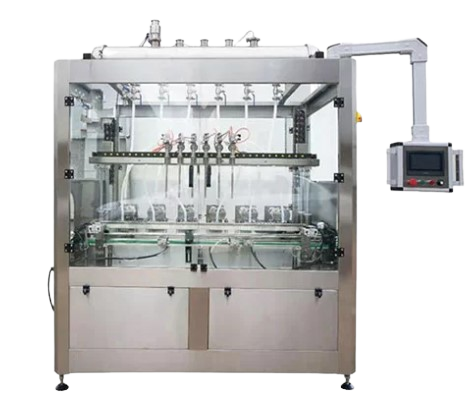
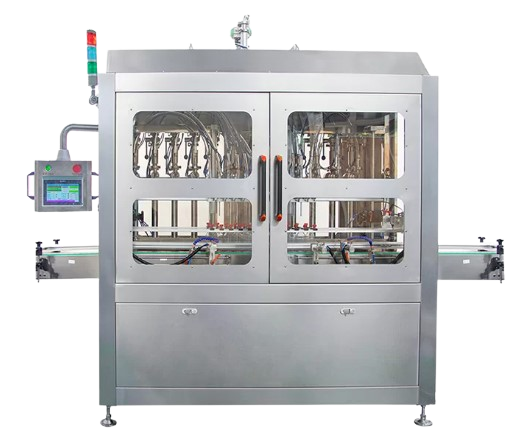
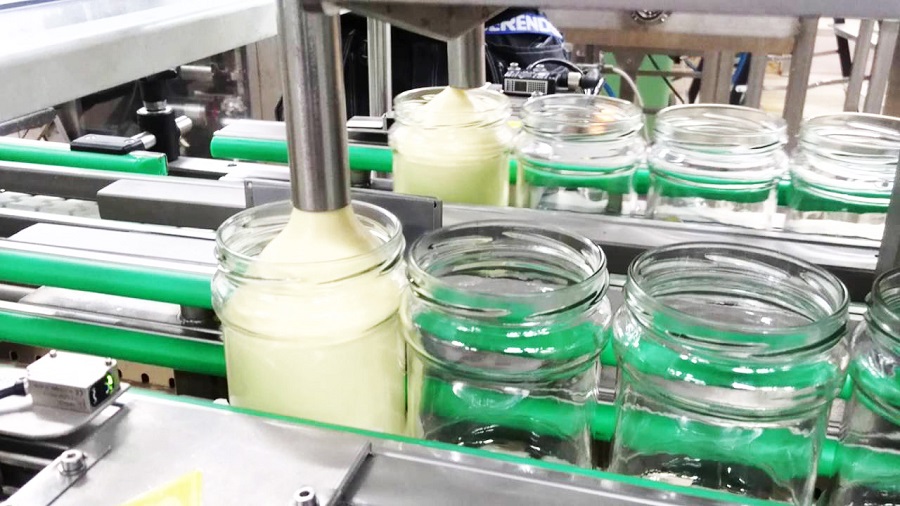
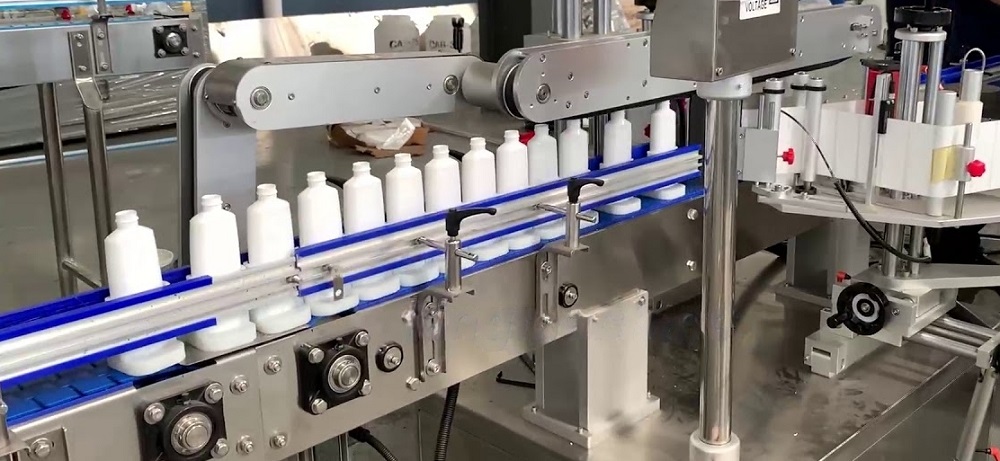
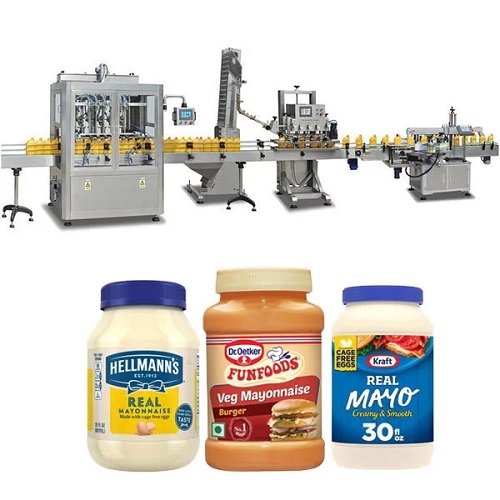
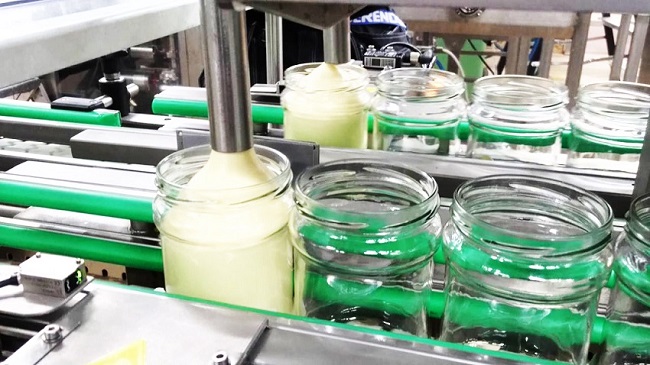
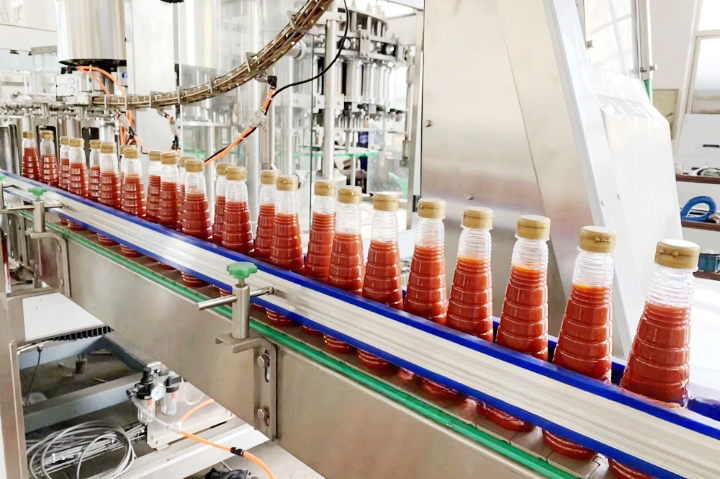
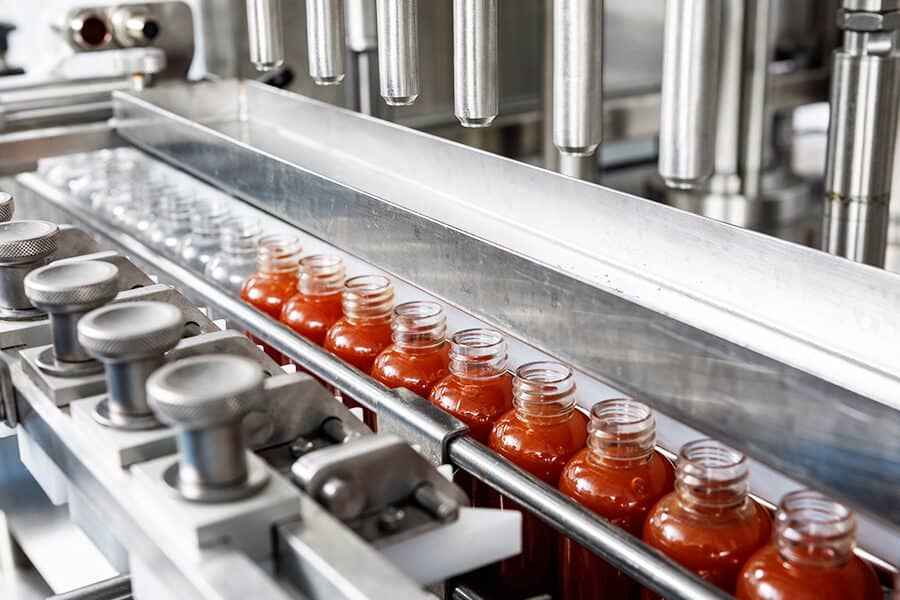
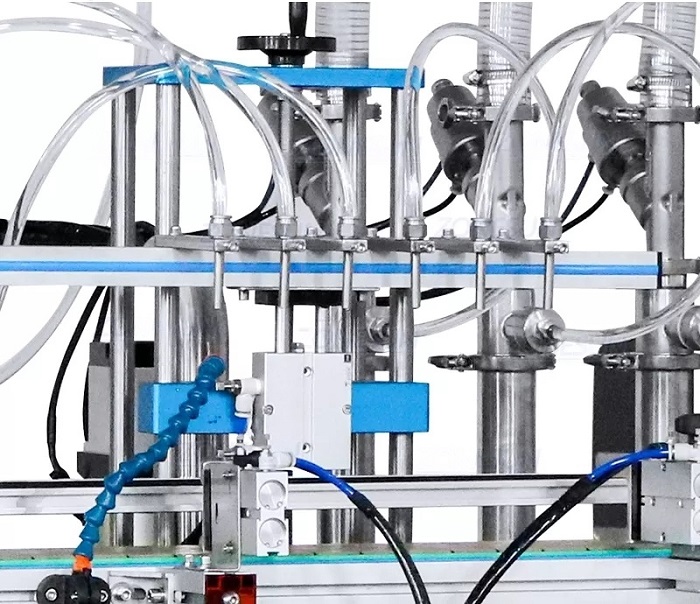
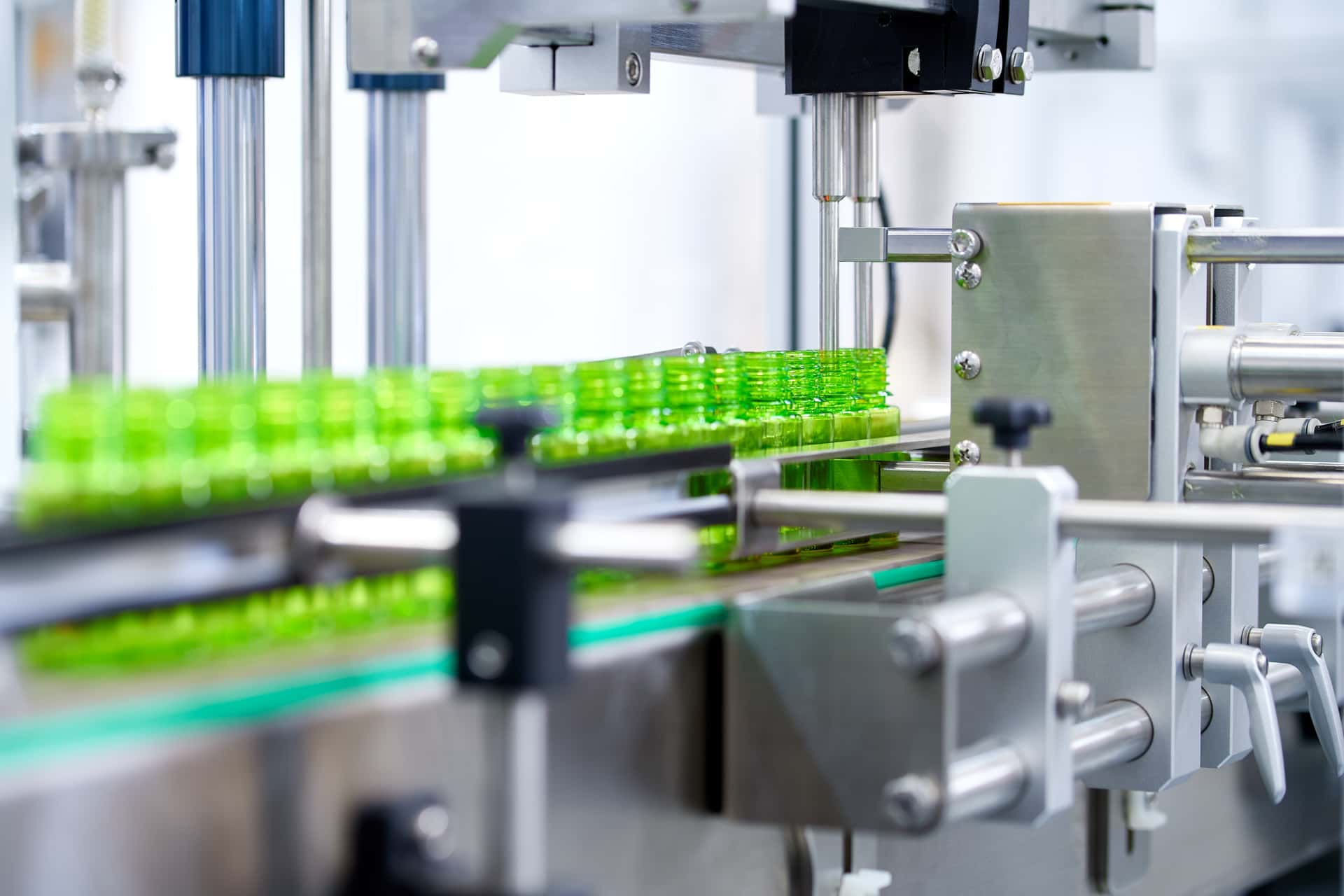
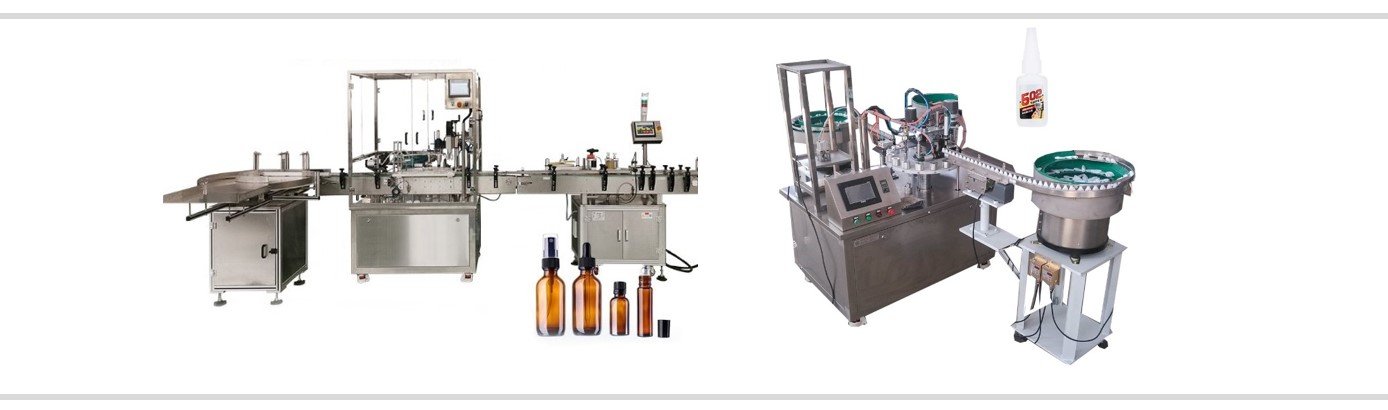
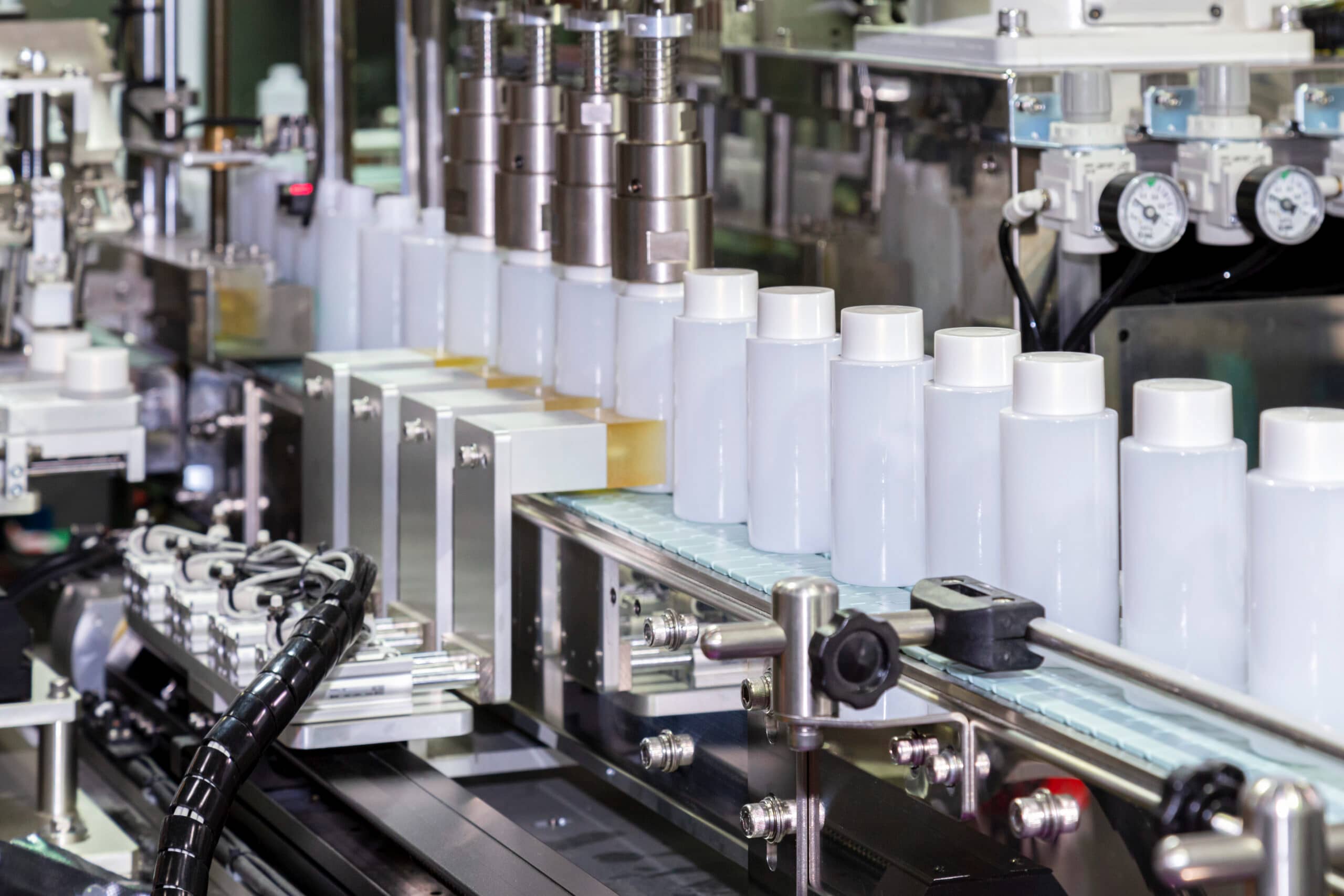
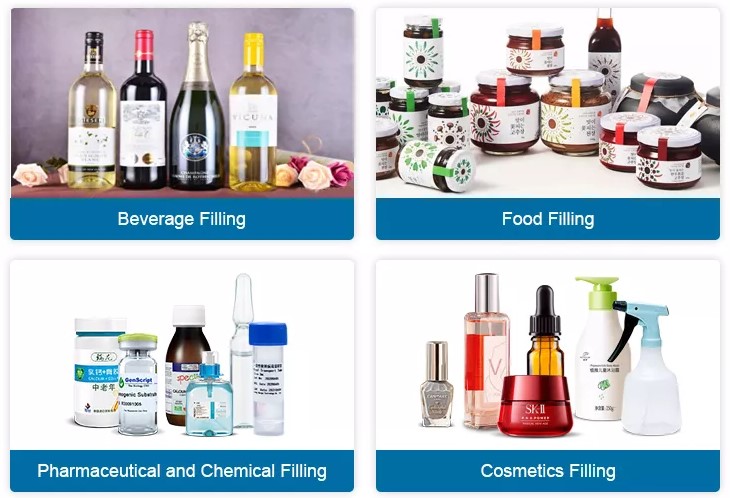
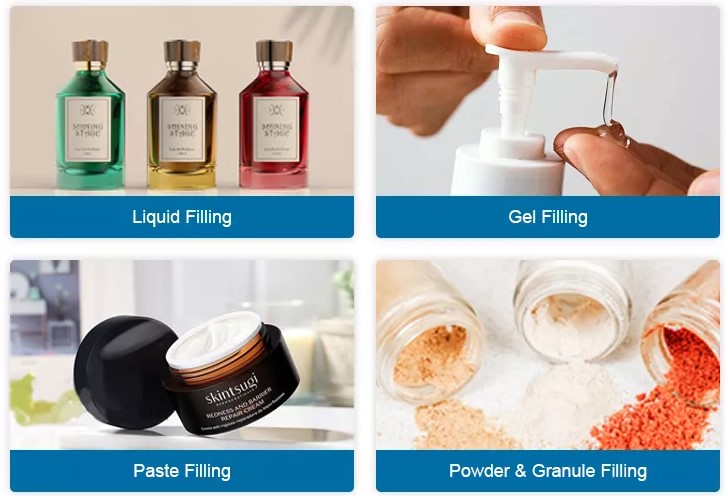
Mayonnaise, a thick, liquid food, requires specialist equipment to fill containers without spilling. Viscous liquids are compatible with our mayonnaise machine, and customizations are available to meet a range of demands. We will help you select the proper equipment for your mayo filling while keeping open space and other essential factors in mind. We also provide a number of supplementary packaging machines.
Best Mayonnaise Filling Machine Selection
☞ Automatic Rotary Lobe Pump Filling Machine
A high-precision stainless steel rotor pump measures the liquid capacity of the rotary lobe pump filling machine. With each pump’s servo motors provide precision dosing over various capacities. Practical design and ease of operation and maintenance are a bonus. The touch screen makes it simple to adjust the fill level. Its servo motor powers the valve, which allows the liquid level to be adjustable to suit the frothy material. There is nothing but stainless steel in this machine.
☞ Automatic Piston Filling Machine
Weighing and filling free-flowing items, including thin or relatively thick liquids, is a breeze with our piston fillers. Each machine has at least one volumetric piston. During the fill and release cycle intake stroke, the product is transferred from the container or hopper into the product cylinder. The downstroke begins when the product cylinder reaches the maximum fill level. With the piston forces the product out of the cylinder and into the container.
Our piston fillers provide precise filling with no messy drips. We set our piston fillers to measure the correct quantities for consistent dosing of mayonnaise, sauces, and pastes. Therefore, piston fillers and packagers boast the industry’s best fill accuracy and slight product deterioration.
Food filling lines can avoid spills, drips, or container overflows when using our piston fillers. Our mayonnaise machine only needs occasional supervision, giving you more time to concentrate on other duties. You need to enhance your process if you want to be able to focus on other, more critical tasks. Our equipment is guaranteed to operate as intended.
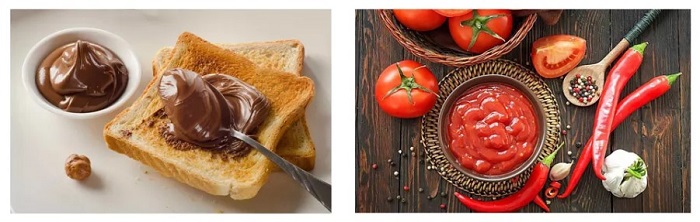
✅ In addition to filling mayonnaise, our equipment can also fill jam, thick paste, and viscous liquid. Fill peanut butter, ketchup, sauces, dressings, chocolate, paste, etc.
✅ Our mayonnaise machine is available as a fully automated system with PLC controls, a clear touch, and famous electrical and pneumatic components from companies like Siemens, Schneider, Airtac, and Omron.
✅ The touch screen makes it easy to change the amount of filling. The machines can be quickly dismantled for cleaning and maintenance thanks to quick and reliable joints.
✅ Our mayo machines can have a highly automated feeding process thanks to an automatic liquid-level control mechanism.
✅ The filling nozzles are specially made to be drip-proof so that no product will leak onto the bottles during the filling process.
✅ If you need a higher or lower-capacity filling nozzle, we can make one for you. We provide nozzle configurations with 2, 4, 6, 8, 10, or even more spray points. Highly precise dosage thanks to the use of pistons.
✅ Depending on the nature of the product, a variety of options for mixing hoppers and hot filling with a temperature-controlled system are available.
✅ All equipment consists of good-quality 304/316 stainless steel and alloy aluminum. Corrosion-resistant machines made of PVC or PP can work with products that tend to rust.
With all the essential information above, we can offer you the best mayonnaise machine available!
In general, some businesses will use bottling machines with specific characteristics more often, particularly capping and filling machines. For instance, an overflow filler will often be used in the bottled water sector because of its fill level. Examining the shampoo filling machine used in the The personal care sector clearly illustrates why these broad guidelines will only sometimes hold true. With this, we’ll look at some facts about when using a shampoo filling machine.
☞ Shampoo Consistencies (Thick and Thin)
Shampoos can have different thicknesses. So unlike bottled water, not every filling equipment will work for almost all shampoos. A pump filler is more suitable if the filling material is thicker. Note that these fillers will depend on the qualities and consistencies of the shampoo or bar of soap.
☞ Foaming
When filling shampoos, foaming can happen. Luckily, there are different ways bottle filling machines can deal with foam so that it doesn’t cause uneven fills. Bottom-up filling, anti-foaming nozzle attachments, and other ways to stop product foaming may be needed when working with thicker materials or different types of fillers. As before, the best way to stop foaming depends on the kind of shampoo in the bottle.
☞ Cap Types
The major focus of shampoo bottle cappers will be the container and cap, not the shampoo itself. Shampoo bottles may have simple flip-top tops, flat screw-on covers, or even pump-top caps. Although there are a few exceptions, most of the time, each cap type will screw onto the bottle. Most shampoo bottles on the market can be capped using spindle cappers and chuck capping machines; however, pump tops and other specialty lids may need particular positioning or insertion of components to generate the seal effectively and consistently.
☞ Shampoo Filling Machine Types
A bottle filling machine is excellent for thicker products. Where the pump speed is constant, this much space shouldn’t be between the nozzle and the surface of the liquid. It works very well for heavy items and lets the shampoo come out of the bottle evenly. Depending on the type, the shape of the bottle can be round, flat, or oval.
The rotary nozzle machine is another way to fill shampoo besides the plunger nozzle machine. You can change the nozzle while it’s in the air. The atomization process ensures that the final product is uniform and free of rough particles. A rotary capping machine has a large space for storing the product. The automatic squeeze feature makes it easy to pour any drink.
You may also choose from a range of liquid filling machines, such as the type with six nozzles for filling liquid containers. Where a screw capper secures the caps. This shampoo filling machine is capable of producing significant output. In addition, there is a fully automatic eight-head machine and a fully automated twin-head machine, both of which use a timed-flow volumetric filler.
So, we’ll look at each product’s details to ensure our suggestions fit our customers’ needs.
Shampoo Manufacturing Process
There are two steps to making shampoo. First, producing a large amount of shampoo and then filling them into individual bottles.
✅ Production/Making Process
The recipe is used to make shampoo in large quantities in a particular part of the factory. This can be up to 3,000 gallons at a time. They go into the batch tank, where they are all mixed together.
✅ Quality Control Inspection
After adding the ingredients to the batch, the Quality Control (QC) lab will need a sample. This will check the batch’s physical properties to ensure they meet the recipe’s requirements. When quality control gives the batch the all-clear, it is moved from the primary batch tank to a holding tank once the filling line is ready. After storing, the shampoo is pumped into the piston-filling heads of the shampoo filling machine.
✅ Shampoo Filling & Packaging
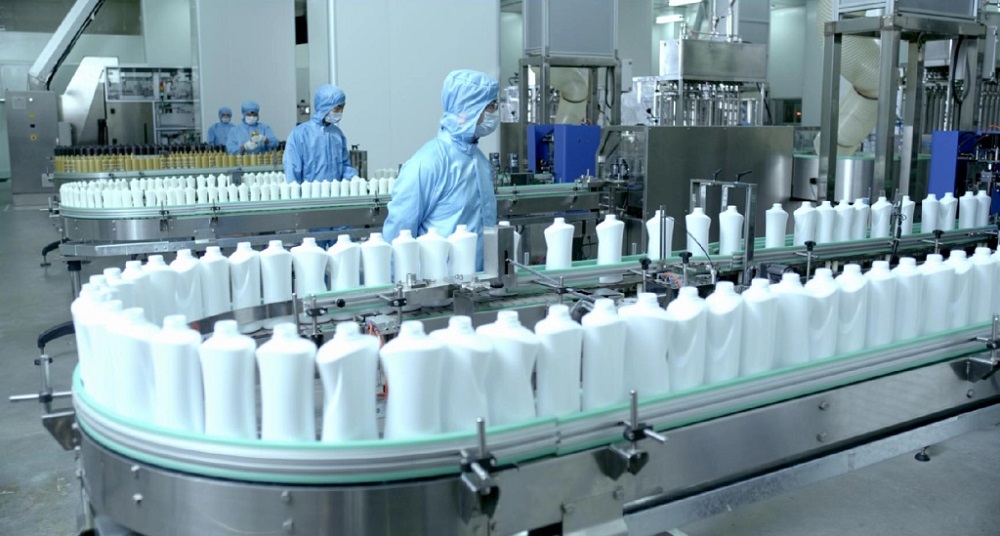
Each shampoo bottle gets the ideal amount of product thanks to a well-timed series of piston-filling heads. The shampoo is dispensed into the bottles as they go through this filling station. Here, the bottles are moved before continuing to the capping device. As the bottles go through, the caps are tightened. Bottles are transferred to labeling machines after capping.
The labeling device will apply labels as bottles pass by. After labeling, the shampoo bottles go into the boxing section, where they are packed into boxes, usually a dozen at a time. These cases are packed onto pallets and sent out to retailers by large trucks. It is possible to produce 200 bottles every minute on one of the automatic shampoo filling lines.
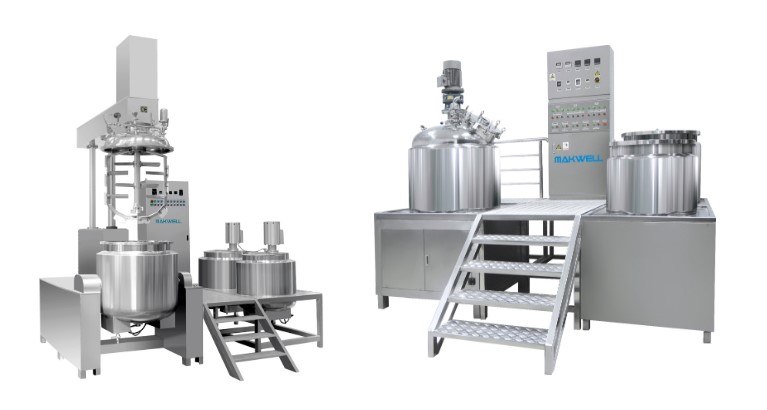
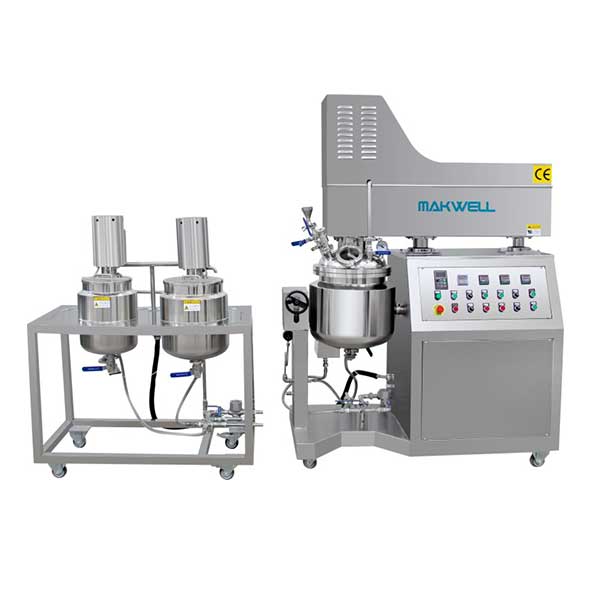
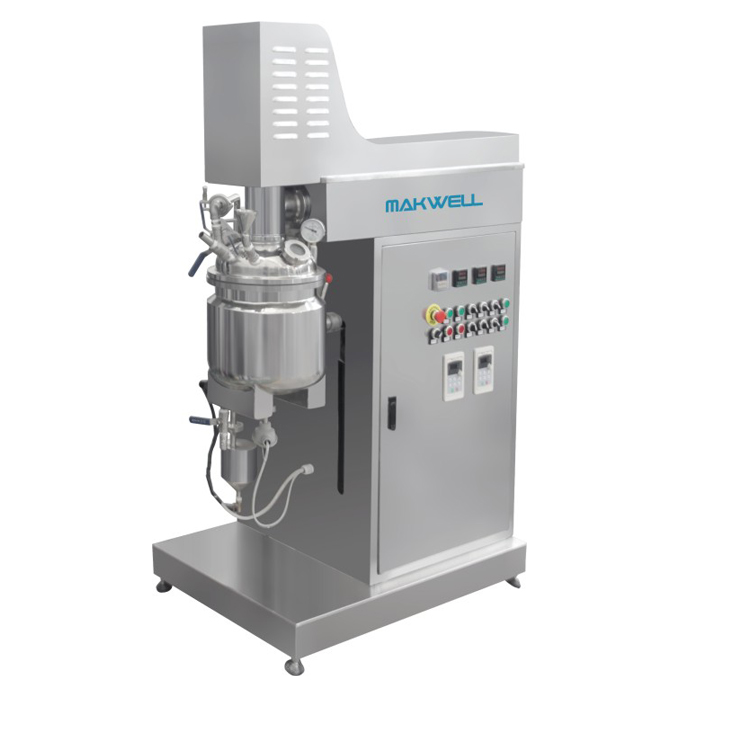
The emulsifier machine or vacuum emulsifying mixer is an emulsifier mixer machine with many functions and can mix, disperse, homogenize, emulsify, and aspirate very viscous ingredients and materials. It features a system to avoid dead corners. on the inside surface of the machine. It is operated by electricity and may also use oil and water stored in nearby containers. It also functions as a vacuum and may heat or cool its surroundings. Creams, lotions, ointments, and liquid creams may all be mixed with the help of this emulsifier mixer machine.
Emulsifier machine: What is it used for?
This emulsifier mixer machine is a crucial piece of machinery for emulsifying and mixing a variety of goods. It combines liquid creams, cosmetics, medicinal ointments, and emulsions like oral syrups.
The emulsification plant may benefit from moving components between the water and oil tank. The vacuum cleaners included in this equipment’s design serve to remove dust. Helpful for getting machinery in working order again after a cleaning.
Emulsifier machine: How does it work?
The first step is to heat the two separate containers holding the water and oil. The water and oil are sucked into the emulsifying pot by the emulsifying pump. This vessel sits right below the two containers holding the raw materials: water and oil.
The scraper helps in getting things out of the mixer. After setting up the emulsifier mixer machine, the central mixer performs the material mixing. This will result in constantly producing new interfaces between the materials.
The rotating vane helps cut, crush, mix, and blend the components or ingredients throughout this process. High cutting wheel speeds and a stationary cutting cover are used until the materials reach a thickness of 200 nm to 2 um.
As the centrifugal force causes tearing and other wide-ranging effects, hundreds of thousands of hydraulic shears happen. This causes emulsification, and the final result is fine, stable, high-quality products with no bubbles.
Air produced during mixing immediately fills the vacuum in the emulsifying pot. Then the emulsified components settle and are released.
Emulsifier machine: What are the applications?
◎ Food
This emulsifier mixer machine emulsifies mayonnaise, salad dressings, jam, butter, sauce, margarine, etc., in the food sector. Thick materials, including dairy, oral solutions, baby food, chocolate, and sugar, are processed using this approach.
◎ Cosmetics
The cosmetics industry uses this in processing body creams, lotions, lipstick, detergents, face cleanser, nourishing honey, and shampoo are all mixed in it. Hair gel, ponds, lip balms, shaving gel, cold creams, sunscreen, and lip glows are all products that may be blended with this tool.
This emulsifier mixer machine has also found use in the pharmaceutical industry. Ointments, oral syrups, latex, emulsions, and injections are some products that go through them.
This emulsifier mixer machine also applies in the paint industry to mix synthetic resin paints and other paints.
◎ Chemical
The chemical industry embraces this technique as well. It emulsifies polyesters and artificial fibers. Processing latex, saponification products, detergents, and coatings are additional common uses.
Emulsifier machine: What are the characteristics?
• This emulsifier mixer machine produces different creams and liquids. The final goods are unique in appearance, form, particle size, and viscosity, depending on the target product. The materials are very smooth and refined. • The speed of mixing and homogenizing are flexible to accommodate various technical procedures. • Because digital time and temperature include in the control cabinet, it is simple to determine the working time and temperature. • The vacuum system makes it possible for the whole process to occur in a vacuum, which makes materials without bubbles. • The operating hopper has two walls that provide heating and cooling. • For convenience, the hopper lid may be raised electrically. • The underframe is also portable, allowing users to relocate it anywhere they choose. • The contact parts of this emulsifier mixer machine are 316L stainless steel.
In addition to its application in the petrochemical industry, it also finds use in the printing and dyeing auxiliary, paper, pesticide and fertilizer, plastics and rubber, and electronics sectors.
Other sectors of production have also recognized the value of this equipment. Products like paint, wax, shoe cream and liquid coatings are just some of the things that are emulsified and mixed with this emulsifier mixer machine.
Emulsifier machine: What are the benefits?
✔ This mixer emulsifier is one of a kind. It extensively uses vacuum features to boost mixing efficiency, resulting in improved mixing and optimal product handling. ✔ The mixing environment is controlled by a vacuum, which helps avoid aeration and might lead to mixing blade damage. ✔ The regulated mixing environment also contributes to the production of void-free final products. ✔ It is excellent for making powdery products in small, medium, and large batches, holding between 30L and 2000L of work. ✔ Creams and other fluid goods like cough syrups benefit significantly from this emulsifier mixer machine. ✔ Compared to the time-consuming manual process, this is a significant time saver. The automated equipment contributes considerable energy, accelerating the whole procedure. ✔ Controlled viscosity improves product homogeneity. ✔ The automatic model integrates a CIP to maintain the machine’s cleanliness and shield production from contamination. ✔ Reduces manual mixing waste. Thus, the processing sector benefits.
Emulsifier machine: What are its main parts?
An emulsifier mixer machine has many elements. Pre-treating boiler, vacuum pump, vacuum emulsifying and blending boiler, hydraulic pump, dumping system, electric control system, and work platform are among them.
What are the emulsifier machine’s main vacuum systems?
A water ring vacuum pump, vacuum gauge, and vacuum relief valve are components of the system. Vacuum systems remove air bubbles while mixing.
What kind of material is used to fabricate an emulsifier machine?
Stainless steel is the exterior shell that will not come into touch with anything. Parts that come into contact with the product are AISI or SS316L. The silicone that is safe for food is used for seals.
What is the purpose of product emulsifying?
This is so that materials may be perfectly emulsified, creating delicate, smooth final products. Additionally, it makes mixtures without bubbles.
What effect does use a vacuum emulsifier machine have on products?
The effect of the emulsifier mixer machine is to mix two materials into one that is smooth and refined. The original two distinct products, most likely immiscible, are uniformly emulsified into a single product.
How does an emulsifier machine differ from a homogenizer?
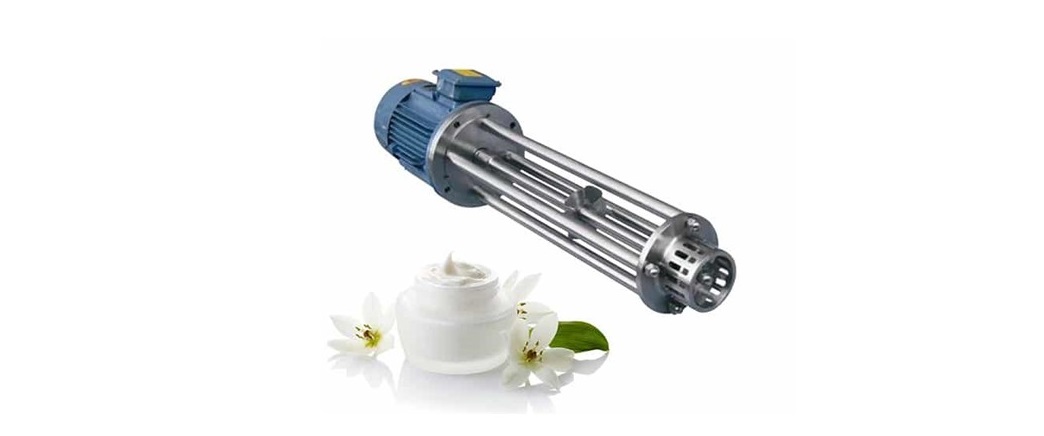
Each one delivers the same concept. Vacuum high-speed shear mixing may take place in one or more stages, mixing the components quickly and uniformly. The strong kinetic forces drive the materials into the narrow gap between the stator and rotor. It happens in seconds and includes hundreds of thousands of shears. Both large and small organizations use this emulsifier mixer machine to make viscous emulsions and dispersions.
What is low shear mixer?
The low shear mixing capability of this homogenizer is a result of its fin-type mixer and shear head combination. The rotor spins within the stator, and the fins extend outward from the shear head homogenizer. The stator with fins locks onto the rotor and rotates automatically. The rotor and stator of a high-shear mixer, on the other hand, spin in opposite directions. To get the parts to combine, you’ll need to switch the machine’s settings from low-shear mode to high-shear homogenizing mode. Changing a product’s attachments will prevent the procedure from completing successfully.
What is high shear mixer?
A homogenizer or high-shear mixer is a machine that moves and mixes incompatible materials. A rotor and stators are installed within the homogenizing tank or pipes to generate shear. In liquids, high shear rates cause the formation of emulsions, suspensions, and micro-aeration.
This machine applies in food, cosmetics, pharmaceutical, adhesives, and chemicals to emulsify, homogenize, disperse, and reduce particle size. It is driven by an electric motor that lets it rotates at high speed. This often leads to a series of rotations that end up causing shear.
Outside the diameter of the rotor, the fluid velocity is greater than that at the rotor’s center. The more significant the difference in speed, the greater the shear. The combination of a rotor and a stator is also referred to as the shear head or generator. Using these two components helps to generate a tight clearance space between the rotor and stator. This creates a very high shear zone when the materials exit the rotor.
The number of generators in the machine increases in proportion to the size of the shear head. The equipment can process batches as big as 400 US gallons and is easily maneuvered using moveable floor platforms. This type of equipment is ideal for gels, deodorant sticks, and things that get solid when they cool down.
What are the differences between a high-shear and low-shear emulsifier machine?
◎ In comparison to mild shear, emulsification occurs more quickly under high shear. ◎ Rotor solvers are for high-shear emulsification, whereas standard impellers are for low-shear emulsifying mixing. ◎ When using an emulsifying mixer, the results are optimal with high shear but subpar with low shear. Certain materials won’t dissolve in the liquid. ◎ Although, materials with a low viscosity should use the high shear machine. In contrast, low-shear ones are preferable for heat-sensitive, easily damaged, or freely flowing goods.
What are the different types of vacuum emulsifier machines?
The emulsifier mixer machine is available in the following configurations:
• Vacuum Homogenizer
This equipment can homogenize, stir, and deform and is controlled by an electric system. A vacuum emulsifier, an operating platform, and a vacuum system make up the machine.
Food processing machines like these turn basic resources or raw materials into finished products. Cosmetics companies make lotions, creams, and gels using them. Pharmaceutical ointments, oral syrups, and lotions are prepared this way.
The oil pot, water pot, and operating platform are all adjustable to your preferences. It is suitable for materials with low fluidity. Product contact components are SS316L, and production followed current good manufacturing practice guidelines.
• Vacuum Planetary Mixer
This mixes very viscous materials or ingredients. When operational, the planet carrier spins, setting the box’s stirring shaft in motion. It moves around the emulsifying tank at a very rapid pace. Emulsification, dispersion, and mixing of ingredients are made easier by the quick rotation, which puts the materials to a powerful shearing and kneading.
This device’s mixing tank has a scrapper resembling a knife—making materials sticking to the side of the mixing tank easier to remove, enhancing the machine’s performance.
It can handle water and other materials effectively and operate reliably under a vacuum. Oil and water may be used to heat or cool the mixing tank as well. The rack, lid, and agitator are hydraulically raised and lowered by a double column. This planetary vacuum mixer includes a reliable and practical charge and discharge mechanism.
• Stainless Steel Vacuum Mixing Pot
This is a more simple vacuum mixer type, excluding extraneous machine parts. This type of emulsifier mixer machine is perfect for industries that need to mix a few ingredients. Soups, fluids, and chemical building components are just some of the things that may be blended with this handy tool. It mixes daily washing chemicals, thus naming this a liquid washing pot.
Automatic vacuum emulsifier machine: What is it?
This emulsifier mixer machine contains a high-speed shear head, which allows it to run at a very high speed. It has a high-speed homogenizer for making emulsions and a blade mixer for mixing very thick substances.
Remove materials from the mixing tank’s surface using scrappers to avoid dead corners. The machine’s downward current mixes and pushes materials continuously. High-speed bottom-to-top pressure fluctuation within the homo-head breaks, mixes, and emulsifies. The contents pour out of the homo-top heads and are pulled back by the blade mixer’s downward force. When the upward pressure lessens, this occurs.
This machine is your best bet if you need to emulsify a substance with a low viscosity. The raw ingredients are automatically drawn into the mixer through a vacuum system. Vacuuming, heating and chilling may all take place in a single manufacturing phase. Because it is automated, emulsification, mixing, and homogeneous dispersion may be completed rapidly.
The automatic control system, which consists of a touch button, a timer, and a process recorder, makes it entirely hands-free. Any non-contact components are stainless steel. Its vacuum environment naturally keeps outside air out of the mixing chamber. This machine may also be equipped with CIP, which helps in regularly initiating mixer cleaning automatically.
Semi-automatic vacuum emulsifier machine: What is it?
This emulsifier mixer machine requires both manual and automated operation. The components are manually loaded into the designated vessels before starting the machines. It does the work of emulsification, and the finished product is poured out of the tank by hand. The equipment also requires manual cleaning and sterilizing as neither CIP nor SIP is included in the semi-automatic emulsifying mixer’s standard equipment.
This machine features a vacuum, hydraulic lifting, machine tilting, and water and oil pots. Heating, cooling, temperature control, and an electric control panel are also included. Like the automated one, it requires human input to emulsify.
What is a tabletop emulsifier machine?
This is a vacuum emulsifier in a tabletop configuration. It helps make viscous items like lotions, jellies, and ointments, using two mixing heads to work. Both the paddle mixer and the emulsifier operate either forward or backward. This one-of-a-kind technique results in more efficient goods.
The homogenizer’s revolving turbine is powered from above. Because it is colored, the machine features a visible control panel showing its operating capabilities.
A mechanical cover lifting feature and fully detachable vessels make cleaning the tabletop vacuum emulsifying mixer simple. Once the data is stored on an SD card, this system is simple to use. It contains glass and light for monitoring while it is in use.
What is the difference between a fluidized bed mixer and a vacuum emulsifier machine?
◎ Fluidized bed mixers combine powders and pellets, which are low and medium-density materials, respectively. Most of these substances are friable and may be optionally mixed with liquids. Vacuum emulsifying mixers, on the other hand, are used to mix thick substances like lotions, ointments, syrups, and creams.
◎ Fluidized Bed Mixer applications are fast. It gently handles items and washes them down occasionally. While the vacuum emulsifying mixer uses several cycles of hundreds of thousands of rotations to generate fine goods or mixtures.
◎ The Fluidized Bed Mixer may complete its work in as little as 10 seconds to as much as 20 minutes. It produces a coefficient fluctuation of around 5% when used in 30 seconds. Additionally, vacuum emulsifiers operate at a high rate of hundreds of thousands of cycles, producing perfect mixes.
◎ Flat, angular paddles with overlapping pathways make up the Fluidized Bed Mixer. It transports materials from a pair of parallel U-shaped troughs to the machine’s hub. The vacuum emulsifying mixer contains vessels with jackets for heating and cooling the ingredients within the vacuum. It features high-speed homogenizers, scraping agitators, vacuum pumps, and hydraulic pumps.
◎ A shorter mixing time and lower shear produced by a fluidized bed mixer result in less product deterioration. While high shear produced throughout the manufacturing process by the vacuum emulsifying mixer results in fine goods.
◎ An advantage of a fluidized bed mixer is that it features drop-bottom and full-length gates, allowing materials to be discharged faster. On the other hand, vacuum-emulsifying mixers release slowly because the components continue to settle at the bottom of the mixing vessel.
How are materials loaded into and collected from anemulsifier machine?
Materials are manually loaded into the machine above the pots. After adding the materials, then start the machine. Materials may also be loaded into the mixer using a content loader if the equipment is automatic. The high-speed shearing creates a forceful suction that pulls the materials out of their pots as the shear-rapid head rotates. The materials flow into the work head, where they are quickly combined. Discharging the mixture may be done manually or mechanically via a content discharge vessel after reaching the target consistency.
How to suck materials for emulsification using the vacuum function?
◎ If you wish to use the vacuum feature to suck ingredients for an emulsion, you may; ◎ Remember to seal off the metal shutoff valves leading to the water and oil storage tanks. ◎ To create a vacuum in the emulsification tank, open the valves on the vacuum ports. ◎ Select the vacuum option on the touchscreen. When the vacuum gauge reaches -0.09Mpa, you must push the vacuum button so that the valve may shut. ◎ You may now gradually open the valve to allow sucking materials. In this instance, they are the water and oil valves. After that, the components will go to the emulsifying tank to begin mixing.
What is theemulsifier machine’s operating temperature range?
This emulsifier mixer machine can operate in a temperature range between 50 and 60 degrees Celsius. When the valves are locked, power is activated to begin preheating the water and oil containers. Once the temperature reaches 50 degrees Celsius, you should agitate it to let it rise even more.
Stir the components at the desired temperature to match the cream or mayo mixing machine’s temperature. The water and oil pot heats the emulsifying pot to 60 degrees Celsius. First, shut the intake and exhaust valves and open the heating valve.
A vacuum emulsifying mixer may reach temperatures of 80 degrees Celsius or more during operation. However, success is possible if the emulsifying pump and bearing plate are cooled. A single-stage emulsion pump is optimal for this application.
In three-stage emulsion pumps, high-temperature O-rings may help. Effective operation is maintained up to 220 degrees Celsius. For continual emulsification, use a cooling system. This will reduce machine heat during manufacturing.
When using an emulsifier machine, will you have any problems? How to solve them?
There may be certain issues that arise, such as: ◎ Difficulty in dissolving the powder in water. ◎ The challenge of two-phase emulsification in producing a consistent final product. ◎ Particles at the emulsification pot’s bottom. ◎ Some substances clump and are highly challenging for agitators to dissolve. Using modern industrial technology to mix substances seamlessly, issues like these may be solved. The device can also do two-phase emulsification. Smaller droplet sizes, extra low-density liquids, and micro-aeration may reduce the number of bottom sediments.
Flock deposits and bottom sediment emulsification—how to fix?
◎ To do this, we decrease the size of the material droplets. ◎ Maintaining a temperature of less than 100 degrees Celsius in the emulsion tube. ◎ Lower droplet density by adding lower-density liquid. ◎ Micro-aeration is another alternative, in which air is introduced into a mixture bit by little.
What use does CIP serve in a emulsifier machine?
Maintaining sanitary conditions in the processing area requires frequent machine cleaning. The CIP initiates the cleaning process mechanically, guaranteeing that the product is free of any impurities. The machine operator doesn’t have to take apart the components to clean them, which is a huge time saver. Even hard-to-reach areas of the equipment will be cleaned, reaching all sections.
Cost-effective CIP equipment help produces consistently finished goods. Chemicals may be harmful to humans; as a result, since the machine cleans, CIP eliminates human interaction with hazardous chemicals.
What are the Vacuum Emulsifying Mixer’s Safety Operation Regulations?
Keep several safety operating guidelines in mind when using this equipment:
◎ Emulsification Operation
Keep the emptying valve open during emulsifying to avoid damage. Keep all lids closed to keep out harmful elements, and don’t touch the tank cover or clips. If the operator will be standing on a platform, that platform has to be kept dry at all times. You risk harm from the tank’s negative pressure. Therefore, keep your hands away from the pressure release valve.
◎ Electric System
Using good, grounded cables when operating the vacuum emulsifier on a power supply is important. Regular inspections of the electric system are necessary for safety purposes. A highly moist environment shouldn’t be operating the emulsifier mixer machine as it might result in short circuits. The circuit control box needs excellent airflow to keep equipment safe.
◎ Pipes
Always double-check the tank pressure gauge and the open/closed status of the valves. Check that everything is functioning as it should for the designated task. It will aid in the prevention of burns.
What factors impact theemulsifier machine’s performance?
The effectiveness of the emulsifier machine is dependent on several factors. These are; 1. The effectiveness is often affected by materials’ density, dispersion, wettability, and viscosity. 2. Emulsifying materials’ unique characteristics are another aspect. Rough goods tend to clog pores, which leads to excellent emulsification. 3. Ingredients should be of equal size for a good blend. The effects of particle size variation are unfavorable. 4. Ingredient particle form also affects its efficiency. Material with a spherical form blends easily. In contrast, material particles with an irregular form are difficult to emulsify. 5. To prevent disrupting the emulsification process, particles with electrostatic charges that attract one another are often maintained separately from other components. 6. The choice of an emulsifier mixer machine is the last yet crucial component. Choose a reliable, economic, and effective machine to receive high profits.
Which quality standards should an emulsifier mixer machine meet?
✔ The emulsifier machine must adhere to CGMP specifications such as Clean-In-Place (CIP) and Sterilize-in-Place (SIP). ✔ Product contact components must be 316L stainless steel, and mirror-polished is essential. Stainless steel is also best for non-product-contact parts. ✔ Several safety features for operators, hydraulic pumps, and vacuum. ✔ Before operating, the machine needs a pre-programmed PLC panel. The PLC emergency stop button lets the operator stop the machine quickly. ✔ An excellent machine would be able to finish the whole procedure in a single cycle. Mix, disperse, emulsify, homogenize, vacuum, heat, and chill. ✔ Homogenizing and agitator equipment should have variable speeds.
How do you decide between single-stage and triple-stage inline homogenizers?
It is less expensive to use a single-stage homogenizer. Nevertheless, the triple-stage homogenizer is more effective. This is because a single-stage homogenizer’s emulsifier is a basic machine with a rotor and stator.
The triple-stage is more complex since it has three rotors and three stators instead of only two. As a result, it is more expensive than a simpler one.
Single-stage mixers are the way to go if you need to mix ingredients that are relatively easy to work with. Furthermore, stator designs may differ amongst single-stage homogenizers. You may choose whichever one you like to optimize your system for the tasks you intend to execute. Also, a single-stage homogenizer is a cost-effective solution for companies with limited resources.
How do inline vacuum emulsifying mixers differ from batch vacuum emulsifying mixers in continuous production?
When the operation is meant to be continuous, an inline emulsifier machine is the best option for large-batch production. This equipment likewise generates final products with no bubbles or aeration.
The self-pumping mechanism of an inline emulsifier is a bonus. A multi-stage inline machine may discharge vessels. Many versions of inline vacuum emulsifying mixers are available, including those for very dense materials. When compared to batch vacuum emulsifying mixers, inlets provide significant savings.
When working with very thick and sticky substances, a batch vacuum emulsifier is the tool of choice. As a result, the stator and rotor are of very high quality and are rather pricey. These shear heads provide a high centrifugal force, ensuring uniform dispersion of tiny, microscopic droplets and full dissolving of substances.
Batch vacuum emulsifying mixers have high repair and upkeep costs. This is because it has two distinct sections—an intake section and an output section. But, it is much superior to inline type in terms of efficiency. Batch-type vacuum emulsifying mixers also remove agglomerates and produce consistent mixtures. In conclusion, the inline vacuum emulsifier is affordable, easier to use, clean, and maintain.
What emulsifier mixer machine batch sizes are available?
These machines come in various batch sizes; some can handle medium-sized quantities, while others can manage big ones. The industry may operate a 20L, 30L, or 50L pilot plant for testing purposes. Businesses may use a machine with a 3000-liter capacity with a significant manufacturing capacity of products.
There are 20-liter, 30-liter, 50-liter, 100-liter, 200-liter, 500-liter, 1000-liter, 2000-liter, and 3,000-liter batches available. For this reason, the range of commercially available batch sizes is from twenty liters up to three thousand liters.
What type of emulsifier mixer machines do we provide?
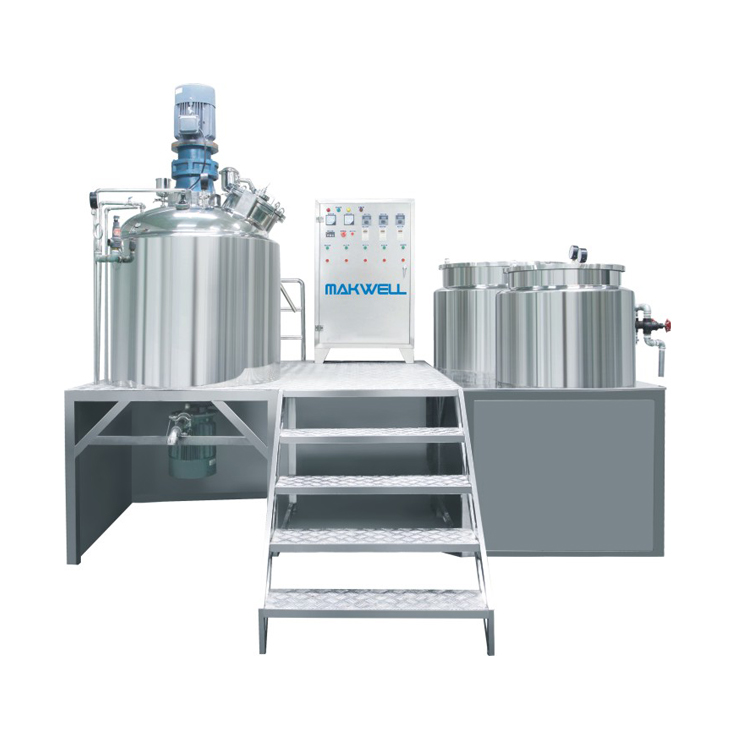
MAKWELL manufacture vacuum emulsifying mixers that can homogenize and emulsify ingredients to create the best quality final products. They are suitable for mixing materials of mayonnaise, sauce, cosmetics, and ointments. These machines are perfect for processing materials with high viscosities and solid content.
A pre-treatment boiler, a vacuum emulsifying mixer boiler, and vacuum pumps make up our emulsifier mixer machine. Additionally, it contains an electronic control system, a tilting mechanism for the mixing pot, and a hydraulic system.
A key feature of these machines is their three blenders, lift cover, and high-velocity blender. They are effective, and the results are smooth and free of bubbles. The CIP/SIP is integrated into the mixers, so it is routinely and automatically cleaned and sterilized. The components that come into touch with the user are from corrosion-resistant SUS316L stainless steel. Stainless steel is used for the exterior shell, while 300EMSH is used for the mirror surface inside.
We are committed to ensuring that all our machines are of the highest quality. Our vacuum, buttons, transducers, and electric control parts are from the highest and best brands. The manufacturing process complies with CGMP requirements at all times. Furthermore, that we guarantee Our emulsifier mixer machines are among the most advanced and high-quality cream-making equipment available everywhere.
A tube filling and sealing machine is a machine that fills tubes with goods such as gels, creams, ointments, gels, and lotions in various industries. An average tube filling and sealing device will include a hopper to store the product, a piston or plunger to distribute it, a means of closing the final tubes, and capping and labeling functions. Many different types of skincare, hair care, personal care, ointments, adhesives, etc., products are produced using this equipment.
How do tube filling machines work?
The hopper’s contents are transferred to a piston or plunger in a tube filling machine, filling the tubes. Tubes are loaded into a conveyor belt or a holding tray, and the hopper is refilled with the product. The product is dispensed into the tubes as they pass the filling nozzle, which triggers the piston or plunger. When finished, the tubes are sealed and usually labeled before being ejected from the machine. After filling the tubes, they may be secured using the capping and crimping mechanisms in certain tube fillers. The electrical systems that regulate these devices guarantee accurate filling and reliable product quality.
What is the design basis?
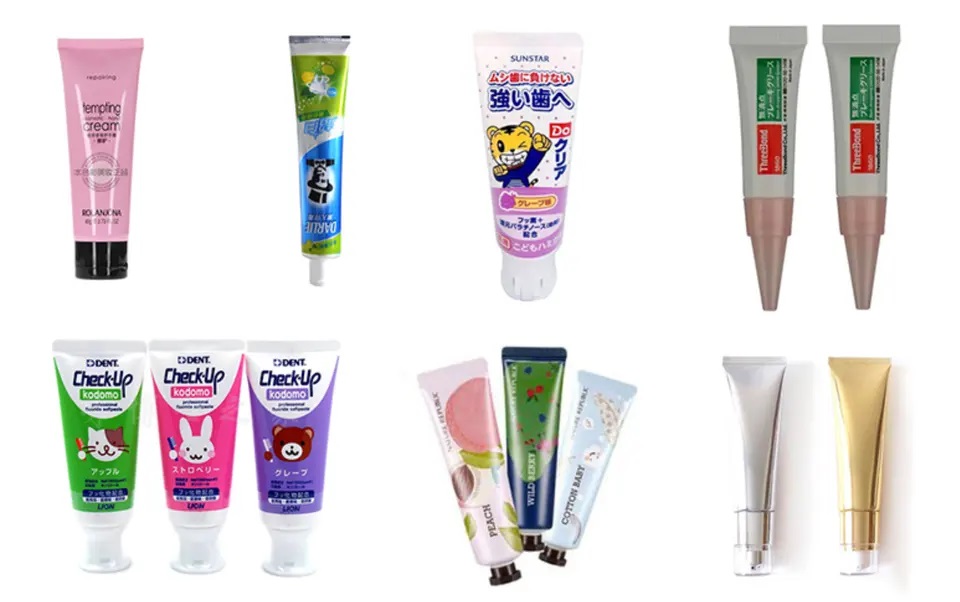
The tube filling machine fills and seals tubes containing semi-solid products, such as laminate tubes, aluminum tubes, and plastic tubes. Cream, gel, and ointment will be automatically filled into laminate tubes, aluminum tubes, or plastic tubes, and the tube ends will be sealed using a heat sealer or crimper.
The tube feeder receives the tubes manually. A single transfer chute will transfer tubes, which will be flipped upside down. The spinning wheel transports the tubes to the dosing station. A movable vessel or vat attached to the filling machine will transfer the semi-solid product or the product material. Depending on the filling machine skid design, filling products must be delivered to the filling machine nozzle by vacuum or sanitary pump.
The product in the tube has a variable volume. The filled tube is then carried to the seal station, where a heat sealer or laminate crimper secures the tube’s bottom. The transport system moves the sealed tube out of the machine downstream.
Tube Feeding
The tube filling machine must be built such that tubes may be ergonomically manually loaded into the magazine and automatically fed into the dosing station. The tube must be fed into the dosing station systematically before being vertically positioned on a designated point. The tube’s open bottom side is facing upward.
Dosing Station
◎ Cleaning the tubes’ inside with a vacuum and an adjustable air blow. ◎ The pressurized air supply to the cleaning station must include a final filter. ◎ A vacuum or a sanitary pump built into the filling machine will transfer product materials from a movable vessel or vat to the heated hopper, leaving a minimal product within the vessel when the filling is complete. ◎ The heated hopper with scraper must maintain product consistency and stability of temperature. ◎ The central dosage volume must be adjustable using the adjuster. The operational terminal must be accessible to change the dosage amount and speed. ◎ If a tube is missing from any dosing station, the dosing station should be able to notify the operator.
Sealing Station
Thermos sealing with high-frequency heated jaws and hot air must fully seal plastic tubes. Designer seals may be customized. Standard, double, and saddle folds require a tube-closing device for laminate tubes and aluminum tubes. In this station, it should be possible to code the outside tube.
What are the types of tube sealing?
Tube sealing choices are vital when selecting plastic tube-filling equipment. Tube fillers may use hot-air, ultrasonic, impulse, or hot-jaw sealing. For reliable, expert tube seals, it is important to fit the kind of squeeze tube with the appropriate tube sealing tools. Because each tube material responds differently, what performs well for a single-layer COEX tube may not work as well for a cosmetic tube made of polyethylene. Choosing the correct tube filling and sealing equipment might be difficult depending on the industry for a particular product, such as cosmetic tubes, personal care tubes, pharmaceutical tubes, or domestic & industrial tubes.
Let’s check out the two primary choices in today’s tube packaging market.
✅ Hot Air Tube Sealing
As far as tube sealing equipment goes, hot-air tube sealing is the gold standard. This technique produces hot air and blasts into the plastic or laminate tube’s open end. The plastic tube wall is warmed by the hot air, making it soft and malleable. The open end is then welded shut using a pair of tube-sealing jaws to pinch the softened plastic.
This tube sealing technology’s key benefit is its quickness. Hot air sealers have the added benefit of being compatible with the widest selection of laminate or plastic tubes. Hot air tube sealing should operate for tubes made of LDPE, MDPE, HDPE, PP, monolayer, and multilayer, with or without EVOH barrier protection. However, one drawback is that each different-diameter tube needs its own specialized hot air nozzle to fill and seal. Because of this, the price of the necessary change components for the tube run will increase.
The cost of format pieces is small when factoring in the manufacturing run size at an increased throughput. If the manufacturing run size exceeds 1,000 tubes, we suggest this form of tube filler.
✅ Ultrasonic Tube Sealing
Using ultrasonic waves to seal tubes is another common practice in modern packaging. Ultrasonic tube sealers that run separately from a main machine are often the best option when dealing with small volumes of tubes. Hot air sealing is not the only option; ultrasonic tube sealing devices can work with existing tube-filling equipment. Ultrasonic tube sealing is the best option for plastic and laminate tubes. Because of the immense heat produced by the vibration at the tube wall, the polyethylene tube material is malleable. The plastic tube’s open end is welded shut by the combined pressure of the sealing horn and corresponding sealing anvil.
Ultrasonic tube sealers are helpful because they are easy to use, do not need special-ordered components, and can efficiently seal despite product contamination in the seal zone, which may occur if a tube is overfilled, for example. The disadvantage is that tube sealing is slower than hot-air sealing. The maximum sealing speed of most ultrasonic tube sealers is 5 UPM.
What are the main parts of tube filling and sealing machine?
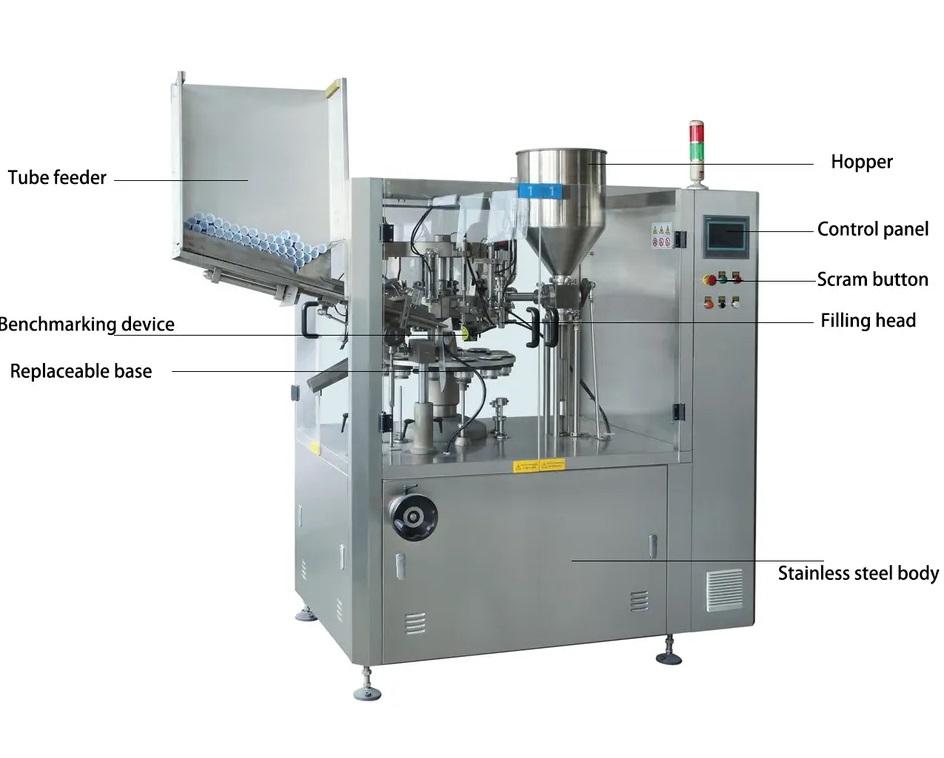
Typically, a tube filling machine will include a hopper to store the product, a piston or plunger to dispense the product, a filling nozzle to fill the tubes, and a device to seal the filled tubes. Additional functions, such as capping and labeling, may be included on certain tube fillers.
Hopper
The hopper stores and supplies product materials into the filling nozzle. It is often designed to hold many products and is generally made of a durable and easy-to-clean material, such as stainless steel. The hopper may also feature a stirring mechanism to help keep the product homogenous and prevent it from settling or separating.
Piston or Plunger
The piston or plunger dispenses the product from the hopper into the tubes. It is mainly driven by a motor or another mechanical device and may be modified to distribute different product quantities. Metals such as stainless steel or aluminum are used to make the piston or plunger because they are robust and can withstand the tension and wear of frequent use.
Filling Nozzle
The part of the machine responsible for filling products into tubes is the filling nozzle. It is usually attached to the tip of the piston or plunger and is made to fit tightly over the tube’s mouth. A flexible gasket or seal may be installed in the filling nozzle to avoid leaking and guarantee precise filling.
Sealing
The machine’s sealing device seals the full tubes after filling the product. Numerous techniques may be used to accomplish this, including thermal sealing, ultrasonic sealing, and mechanical crimping. The sealing is usually customizable to fit various tube types and diameters and is made to provide a solid and dependable seal.
Tube fillers may also include extra characteristics such as sealing and labeling. The capping may entail screwing on a cap or crimping the tube shut, which is used to secure the tubes once they have been filled and sealed. Labels are applied to the tubes using the labeling device, which usually includes details such as the brand, contents, and expiry date. These extra characteristics enhance the final product’s look and presentation.
What is tube filling and sealing machine main applications?
The tube filling and sealing machine has several applications in the personal care, pharmaceutical, chemical, food, and other sectors. It is excellent for products that are packaged in tubes. This machine fills the tube with high-viscosity substances like ointments, creams, gels, or fluids, folds and closes the tube’s tail, then prints codes on the tubes.
What are the types of tube filling machines?
Tube fillers come in various types, mainly defined by how they fill and seal the tubes. The following are a few of the most popular kinds of tube fillers:
✅ Volumetric Tube Filling Machine
This machine uses a volumetric filling approach to fill the tubes with products accurately. Because the dispense amount may be easily adjusted, products with a consistent viscosity and density are perfect for this kind of machinery.
✅ Piston Tube Filling Machine
These machines use a piston or plunger to dispense the product into the tubes. It is typically used for medium to high-viscosity products and can be easily adjusted to dispense different product volumes.
✅ Peristaltic Tube Filling Machine
These tube fillers use a peristaltic pump to dispense the product into the tubes. It is used for products with a low to medium viscosity and is often used for products sensitive to heat or air exposure.
✅ Heat Sealing Tube Filling Machine
These machines use heat to seal the filled tubes. They are for products with a low to medium viscosity and used for products that are sensitive to heat or air exposure as well.
These machines use ultrasonic waves to seal the filled tubes after dispensing them with the product. It is for products with a low to medium viscosity and is often used for products sensitive to heat or air exposure.
✅ Mechanical Crimping Tube Filling Machine
These machines use a mechanical crimping mechanism to seal the filled tubes after dispensing them with the product. This type of machine is typically used for products with a low to medium viscosity and is often used for products that are sensitive to heat or air exposure.
Each type of tube filler has unique features and capabilities, and the most suitable type for a particular application will depend on the product’s specific requirements and the production process.
What are the advantages of using a tube filling machine?
A tube filler has several applications in various industries. Improvements in effectiveness and output are key advantages. These machines can correctly and rapidly fill many tubes, which may boost productivity and decrease turnaround times. Because of their ability to distribute the substances precisely and controllably, tube fillers may also improve in ensuring consistent quality and accuracy of the final result. This method may guarantee that the final goods are up to par and help cut down on waste.
The versatility of a tube filling and sealing machine means that it may be used to package various items and can be a plastic or aluminum tube filler. These machines are often built to be adaptable to handle a wide variety of goods and tube diameters. This can boost your market competitiveness by expanding the type of products you can make.
As a bonus, most tube fillers can use less training to use and are simple to maintain. Also, this equipment is often built to last, with few upkeep and maintenance needs. Tube filling machines may help businesses save time and money by increasing output while lowering waste and fixing rates.
How to choose a tube filler?
Consider several factors when choosing a tube filling and sealing machine to ensure that it satisfies the demands of the product and production operation. While selecting a tube filler, keep the following in mind:
The Density and Viscosity of the Product
Tube fillers come in different shapes and sizes to accommodate a wide range of product densities and consistencies. Products of medium to high viscosity are often filled using piston-based or peristaltic filling machines. In contrast, those of homogeneous thickness and density are better suited to volumetric or gravimetric fillers.
Tube Dimensions and Properties
It’s important to consider the types and dimensions of the tubes used with a filling machine before choosing one. Because different filling machines are designed to handle different tube sizes and materials, it’s essential to ensure the one you choose is appropriate for the tubes you wish to use.
Filling and Sealing Techniques
When selecting a machine, examine the filling and sealing processes used by the tube filler. Different devices adopt distinctive filling and sealing processes, and the best approach depends on the product’s unique specifications and the manufacturing process.
Production Output and Rate
It’s essential to consider the output and manufacturing speed. The ideal machine can reliably and quickly fill and seal the specified number of tubes with no degradation in quality or precision.
Operation and Maintenance Simplicity
When choosing a tube filling and sealing machine, you should think about how easy it is to use and keep up. The ideal machine would have user-friendly controls, need little in the way of routine maintenance, and have few opportunities for breakdown.
Budget and Pricing
Get a tube filler after carefully considering your available funds. The best machine would be functionally and economically efficient while comfortably fitting within the current budgetary limits.
Before deciding on a tube filler, it is advisable to assess the specific demands of the product and the production process and to pick one that is both well-suited to your needs and offers a high degree of value.
MAKWELL Tube Filling Solutions
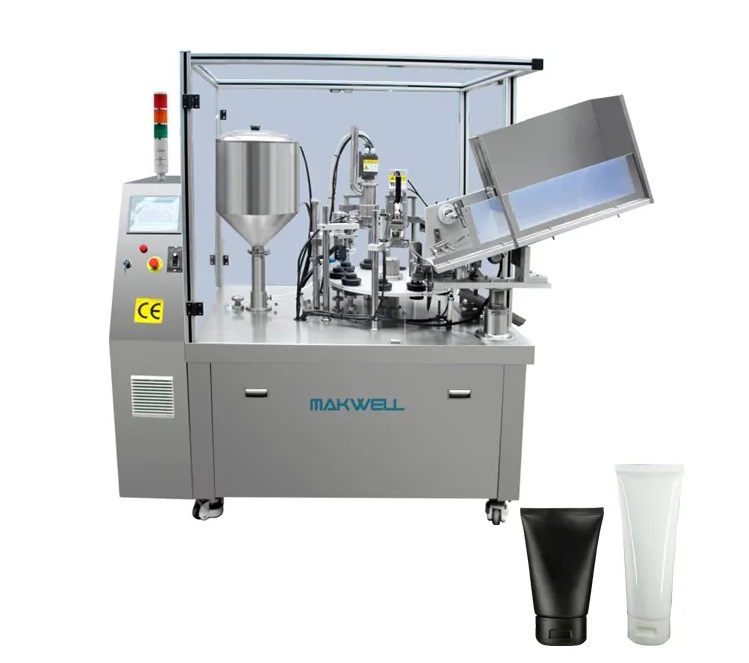
Our tube filling and sealing machine is designed to fill items into cylindrical tubes of different materials (metal, laminate, and plastic) and then seal the tubes. To meet the demands of the various industries that use tubes for packing, we offer many kinds of tube filler machines, such as the linear tube filling machine and the rotary tube filling machine, which are available in capacities ranging from 35 to 150 tubes per minute. Our tube filler machine can fill a broad range of viscous and semi-viscous substances, such as gel, shampoo, ointment, cosmetics, toothpaste, cream/gel, glue, chocolate, sealant, mayonnaise, etc.
We offer the most up-to-date models of tube filler machines with thoughtful features to make installation, replacement, and upkeep as simple as possible. Isn’t it time to get started? Now is the time to message us and learn more!
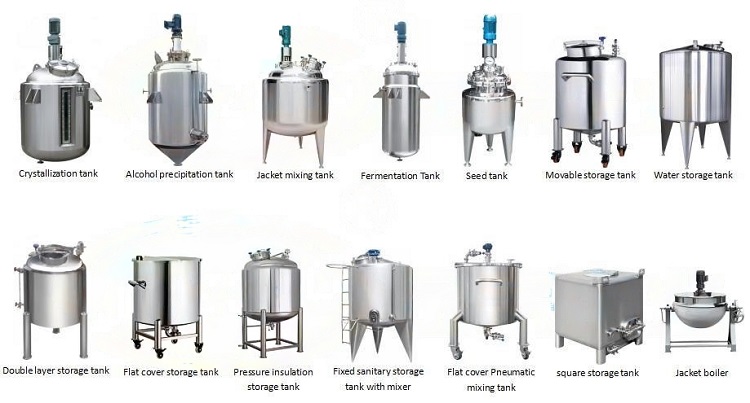
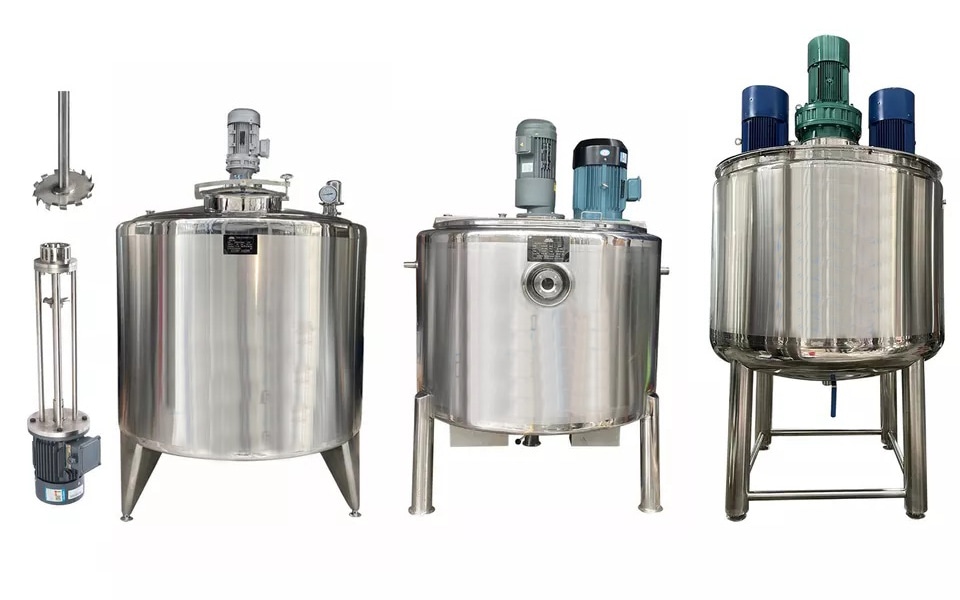
We manufacture custom mixer tanks for a variety of industries. In terms of production, a well-designed mixer tank can have a significant impact on the process and output. Whether you need cosmetic flange tops or general mixing tanks, you can trust us to build them to perfection.
A mixer tank may be constructed from a variety of materials. Stainless steel is our ideal type. It is durable, dependable, sanitary, and exceedingly simple to clean. It is the best material for blending anything from liquid meals to cosmetics and medications.
Application Types
We can construct and design the ideal mixer tank regardless of your needs. Let us know whether you want an open or closed-top tank. The list also includes vacuum and pressurized tanks. In addition to our portable tanks, we also construct fixed tanks according to the needs of our clients.
Whether you need jacketed, dish-bottom, or conical tanks for your mixtures, we have them all. We can provide a range of manway, agitation, and baffling configurations to match your requirements.
Factors We Consider in Mixer Tank Design
Mixing tanks are very specialized pieces of machinery with specific functions. There are several reasons why it’s essential to get the design right:
✅ Safety and Health To start, all safety rules must be followed by mixer tanks. If you use a tank that doesn’t fit your needs, you might not be able to handle health and safety problems as well as you could.
✅ Production Excellence Any material you mix in your tanks must meet your quality standards. The best design ensures that the quality is consistent from batch to batch. In contrast, if your tank is badly made, it might severely limit your performance.
✅ Tank Dependability Mixing substances in a tank often influence the tank’s design. Mechanical failures and other issues may occur if a tank’s design is unsuitable for the function it is supposed to do. The right design of a tank may considerably lessen these risks.
✅Manufacturing Efficiency Efficiency in operations has a big impact on profitability. A proper structure may improve your mixing capacity, boosting production and lowering per-batch expenses.
You will want trustworthy mixing tanks. The production line employees rely on them to survive the demands of daily labor. They must be durable and last for many years. They should be straightforward to operate, even for inexperienced personnel, and easy to clean up.
With the suitable mixing tank layout, a significant impact may be created. Don’t put your productivity at risk by using tanks that are not designed to your requirements. Instead, work with us and develop a solution that meets your needs.
What Makes MAKWELL’s Mixer Tanks The Best?
As you do so, take in mind the following three characteristics of a tank manufacturer we can offer:
✅ UL/ASME Approved
The primary organizations establishing our sector’s standards are Underwriters Laboratories (UL) and the American Society of Mechanical Engineers (ASME). We are a UL- and 3A-certified manufacturer in terms of the first. That means we adhere to a set of rules guiding everything, including the layout of control panels inside a specific setup.
In line with ASME regulations, they regulate the specifications for building stainless steel tanks. Every single stainless steel tank we make is up to code. Many of the tanks we build are unique models tailored to the needs of a single client. Whether it’s a one-of-a-kind design or a mass-produced product, we strictly adhere to ASME standards.
✅ Installation Expertise
Making a stainless steel tank that can compete with the best in the world is one thing. Transporting the tank to the customer’s location and installing it are different concerns. Have any of the other manufacturers you’ve previously worked with provided installation? Installation is included in our regular service.
When it comes to installation, nobody surpasses our professionals’ skills. With their thorough experience with the structure of each tank, they can decide how to install it successfully. What does and doesn’t work is known to them. In addition, they may guarantee that the installation complies with all relevant federal, state, and local regulations.
✅Production Capacity
As a manufacturer with over 15 years of experience, we recognize the significance of satisfying our customers’ expectations for on-time delivery. In addition, customers want timely delivery regardless of the job size. Maintaining a substantial amount of manufacturing capacity is crucial. We are a company that can consistently produce mixer tanks, given their size and complexity.
MAKWELL As Your Mixer Tank Provider
The key point is this: We are a company that specializes in developing mixing tanks for industrial production equipment. As a manufacturer, we diligently adhere to all industry and regulatory standards and provide you with equipment made to the highest quality standards. Also, we have the manufacturing capacity to meet your expectations right away.
To our great joy, we have established ourselves as a significant participant in the storage mixer tank business for stainless steel. We’re glad to claim that our ability to build high-quality tanks that comply with or exceed all relevant regulations and customer has clarified benefited businesses of all sizes.
Having reliable mixer tanks is crucial for such businesses. Nonetheless, we know that you will only put your faith in a company that can provide the goods as promised. Feel free to put us through our paces. Feel free to give us a chance to prove that we should be your go-to source for fermentation tanks, brite tanks, and CBD extraction jars.
Manufacturers of mayonnaise rely heavily on mayonnaise production lines to keep up with the increasing demand for a condiment in modern culture. Producing mayonnaise in massive amounts or on an industrial scale is doable with the help of a trustworthy mayonnaise machine. The mayonnaise making machine, also known as a vacuum emulsifier, pasteurization machine, and mayonnaise filling machine, are all significant examples of mayonnaise machines.
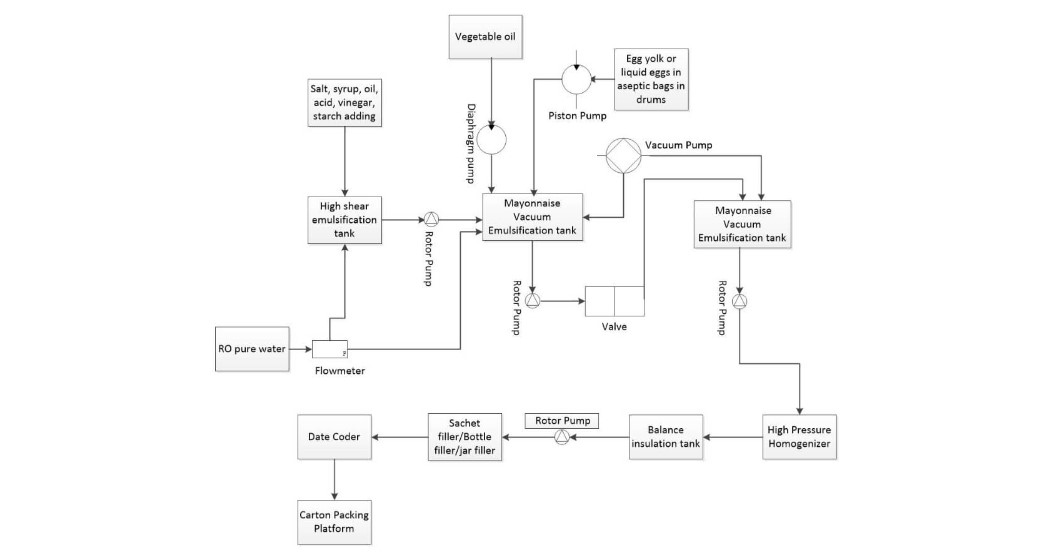
Mayonnaise Production Line Flow
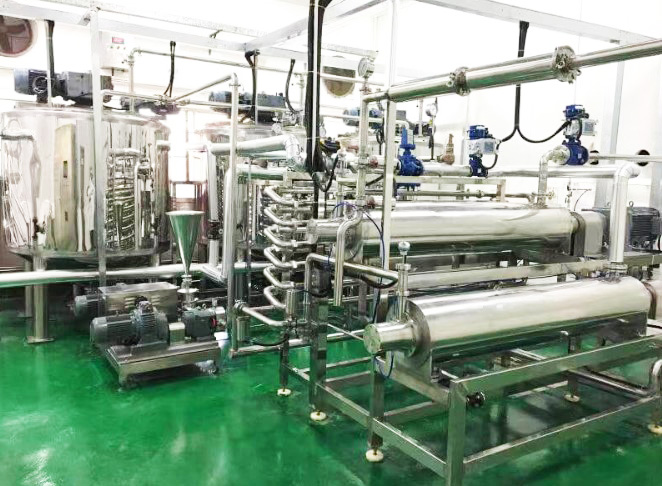
All of the ingredients, like sugar, vegetable oil, vinegar, salt, lemon acid, and starch, will be emulsified and mixed in a high-shear emulsification tank before being sent through a rotor pump to a vacuum mixing tank. In the same way, the mixture of vegetable oil and egg yolk or liquid egg will be put into the mixing and emulsifying tank. Then, we’ll mix everything well over the next 20 to 30 minutes. We suggest a cold, vacuum-sealed method for mixing. At this point, we have the mayonnaise. We can make it smoother and taste better by homogenizing it and then filling it into sachets, bottles, or jars for an easy sale.
Mayonnaise Production Line Essential Machines
Mayonnaise Making Machine: Vacuum Emulsifier
Mayonnaise’s primary equipment is the vacuum emulsifier, which has the following qualities:
✔ Mixing, dispersing, emulsifying, homogenizing, vacuuming, heating, and chilling can all be in a single system.
✔ Effectiveness volumes are available between 100 and 2000 liters.
✔ Emulsifying heads installed on the top of the tank, with frequency conversion control on all mixers, create an internal process of emulsifying and homogenizing the liquid.
✔ This triple-walled tank may be used for either cooling or heating purposes by introducing a cold or hot medium.
✔ The lack of air and bubbles during the whole process of mixing and homogenizing in a vacuum system can make the final products last longer.
✔ SUS304 or SUS316L tanks are compatible with loading cells, which makes it easy to control the amounts of all ingredients.
✔ The mayonnaise machine has a maintenance hole, inlet, outlet for materials, a sample valve, a CIP cleaning ball, and an inlet and outlet for both cold and hot media in the emulsifier.
✔ The high-shear mixer acts as an anchor for stirring, thoroughly and effectively blending the oil with the other components.
✔ A production-efficient agitator system is advisable in the mixing tank. It must be possible to change the shear rate without affecting the flow. Quick emulsification requires high shear, while a coarse emulsion during oil input requires low shear.
Mayonnaise SSHE Pasteurization Machine
After vacuum emulsification, the mayonnaise is heated and cooled using the SSHE or Scrape Surface Heat Exchanger. Characteristics of the SSHE include: ✔ Excellent heat conduction. ✔ Compatible with materials with a high viscosity. ✔ Consistently scraping the surface to prevent sticking. ✔ The entire machine is built from SUS304/316L material and features CIP. ✔ Steam and hot water are heating mediums, and chilled water or glycol is the cooling media. ✔ Per cylinder, the heat exchange surface ranges from 0.08 to 1.40 m2.
Mayonnaise Filling Machine
After vacuum emulsification, this mayonnaise machine fills mayonnaise in small containers like jars, bottles, cans, or sachets to last longer—vacuum sealing for glass jars and metal cans. PET bottles are sealed with aluminum foil or liquid nitrogen after filling.
What You Need To Know About Mayonnaise Production Line
1. To keep the oil and water from separating when making mayonnaise, you need a mayonnaise machine for emulsification. We use vacuum emulsification equipment to do this. The high-shear mechanism of the multifunctional mixer makes it possible to make tiny oil droplets, stop microbubbles from getting stuck, and stop flocculation and precipitation. The mixer uses vacuum technology to include product materials below the liquid’s surface. This makes the emulsion come together quickly, with less clumping and less mixing with air and foaming.
2. Because the proteins in liquid egg yolk break down at temperatures above 65 degrees Celsius, the whole process of blending and making an even mixture must happen at a cool temperature of 5 degrees Celsius or less. When egg yolk is heated, it thickens, which makes it lose its ability to keep ingredients from separating.
3. Plant-based emulsifiers are also added to ensure the finished product is thoroughly mixed. The final texture of mayonnaise depends on how much oil and starch are in the mixture.
4. The raw materials processing technology of the mayonnaise machine can handle the liquid egg mixture and egg yolk necessary to manufacture mayonnaise. Because it is connected to a control system that maintains accurate ingredient weights and ideal storage conditions, automatic weighing equipment is dependable.
5. The design of the sanitary system guarantees that the mayonnaise machine mixer is wholly emptied between batches. This reduces waste, prevents product loss, and shortens the time it takes to clean. The effective cleaning-in-place (CIP) design of the sanitary mixer also makes it possible to improve the mixing quality and cut down on processing times.
6. Mix-proof valve installation is in place all along the manufacturing line to stop products from getting into the cleaning line and causing contamination or waste.
7. Small bottles and pouches may be filled with the finished mayonnaise on the line, which has a capacity of 500LPH to 5000LPH.
8. Because the process of making mayonnaise must be in a cold environment, ingredients like egg yolk or liquid egg must be pasteurized and kept in aseptic containers or cold places.
9. Some companies also pasteurize the mayonnaise after mixing the ingredients in a vacuum. Because the final products have a high viscosity, the SSHE pasteurizer will heat treat them.
10. Mayonnaise contains between 0.3 and 0.7 % acetic acid and has a pH of around 4.0. When vinegar and salt are added to water, the acetic acid level increases dramatically, making the water very resistant to the growth of microbes. So, the mayonnaise’s shelf life may still be about 2-6 months, even if it’s vacuum cold, emulsified, and packed without sterilization.
11. The emulsification and filling of the mayonnaise machine are both under vacuum conditions, which helps to prolong the product’s shelf life.
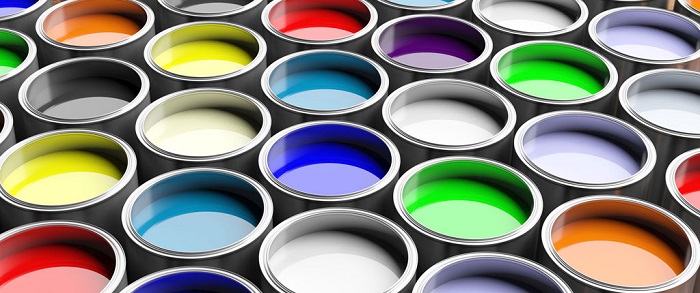
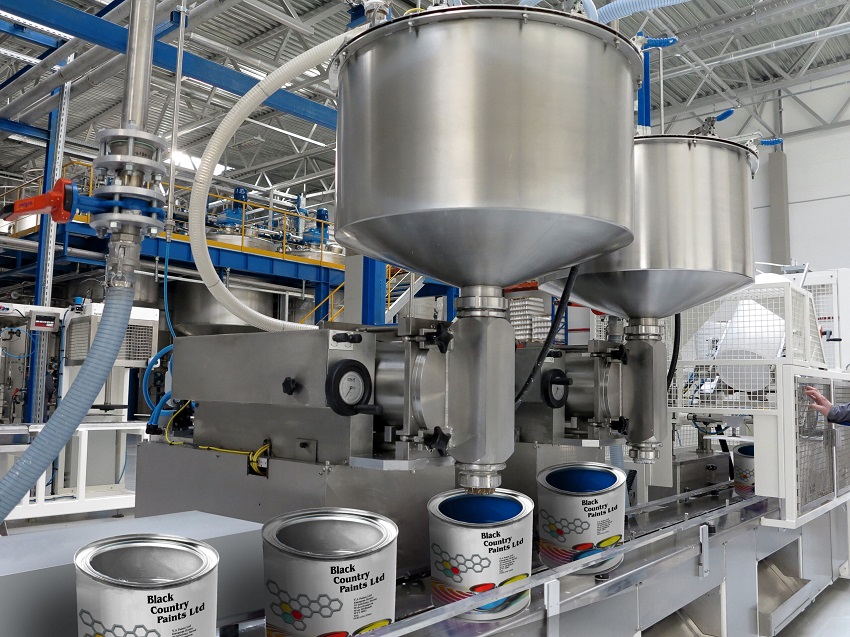
A paint filling machine mainly fills various paint products. Paints are thin covering of colored liquid s, liquefiable, or solid mastic. It protects, colors, and textures surfaces with many colors. Most paints are oil- or water-based; -based paint cleans differently than water-based paint. Water – and oil-based paints dry differently at different temperatures. Many exterior paints/primers must be applied at 10 °C (50 °F).
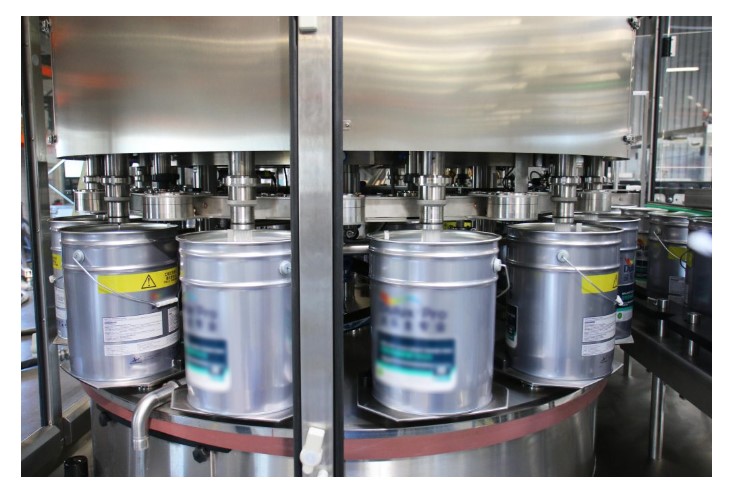
Changes in paint marketing have an impact on paint filling equipment. Because paint is thick and includes abrasive particles and pigments, piston fillers are the industry standard. Because paint is often in metal cans, piston fillers usually integrate with can handling systems. Though, paints are now available in plastic bottles and pails. While pump fillers satisfy some of the growing industry’s demands, piston fillers are still helpful for the high production of a restricted size range of paint cans and bottles.
Nail polish, varnish, water or solvent-based paint, any varnish or packaging: we have everything. Our machines fill any nail polish or paint products. They are fast, reliable, and easy to maintain. Our paint filling machine is durable and manufactured of high-quality materials to fill paints into your preferred container. The dosing of the equipment is precise and waste-free, plus the chemical-resistant gaskets.
There are several filling machines from which to choose when bottling paint.
The paint industry, like our paint filling machine , is constantly growing. We manufacture the best paint filling equipment to help you meet your production targets.
It takes speed and accuracy to pack and fill paint into containers of any size. If spills and drips happen because of poor filling, the product may need to be sent back and repackaged. Paint filling is a high-volume job that requires speed and efficiency above all else. When filling paint, an automated machine can do the work quickly and accurately, both critical for filling.
_
Paint Filling Machine Options
With two product lines for different sizes, our paint filling machine can meet almost any paint filling requirement. Our equipment for filling paint containers falls into two main groups:
✔ 50ml to 5L ✔ 5L and above
Several machines are available to you in each of these classes. You may customize your paint packaging machine by choosing from the following features and options:
✅ Lids and caps ✅ Weight-filling for precision ✅ Monobloc filling, capping, and labeling machines ✅ Space-saving solutions ✅ Flow control and smaller tanks maintain flow independent of viscosity. ✅ An explosion-proof structure maximizes safety.
We can add or remove any of these features to fit your needs, whether you want a fully automatic or a semi-automatic paint filling machine.
Paint Filling Process
Paint filling is an integral part of the production process as it requires a lot of work and needs to be done with great accuracy and quickly. When filling paint, remember that there are many different models to pick from and that each may be altered to match the particular needs and goods.
According to the kind of doing, the following categories apply to paint-filling technologies:
✔ Gravimetric Filling ✔ Volumetric Filling
Also, the degree of automation of the machinery may vary with the specifics of the production facility. More automated filling systems are frequently preferred in high-output plants.
Gravimetric Filling
Gravimetric filling machines need scales to put the right amount of products in each container. A scale controls the filling process by tracking how much product is filled into each container from the doing unit. The gravimetric method carefully fills cans, pails, drums, and other containers that will be available by weight.
Advantages ✅ The filling of paint using gravimetric equipment is a typical example of a product often sold by weight. When it comes to controlling the weight of your product, a digital display on all gravimetric filling machines and semi-automatic equipment is the way to go.
✅ Using this equipment, products with viscosities ranging from very thick to extremely thin may all be filled. Its technique is simple and needs minimal maintenance. It has low maintenance costs and can fill abrasive goods. Considering how much wear and tear the factors will cause is important for the latter.
Volumetric Filling
The volumetric filling is much faster than gravimetric filling, which is a huge plus for increasing output. Volumetric filling units control the filling rate by using a valve to measure how much liquid is added to the container. As their name suggests, their main job is to fill items like buckets and cans.
Volumetric filling applies in many industrial projects to fill paint or similar goods as it fills quickly and accurately. Volumetric filling units can now dose more accurately because of new precision dosing units that can be easily changed depending on the product. The volumetric filling is commonly used in projects that are medium to large.
Applicable Types of Paints
Paint filling and packaging machines may be designed and built specifically for your product, such as;
Standard paint containers range in size from 50 ml to 5 liters, which piston fillers can fill and pints and quarts as well. Elastomers do not apply in paint piston fillers because the roughness of the paint would quickly wear them down and make the paint look bad. We also use minimal hoses, which are often stainless pipe, so that cleaning up between batches is easier. Due to the many flammable solvents and other ingredients in paint, piston filling machines for paint must be either fully pneumatic or built to meet the electrical requirements for a Class I Division 1 hazardous site.
Paint Filling Process Automation
Industrial filling machines have flexible automatic levels to fit specific manufacturing processes better. All factories typically fill small and medium-sized amounts using semi-automatic equipment. More automated equipment is for large and medium-sized quantities. These differentiating characteristics are present in the best paint and coating filling automation:
✔ Automating any operational variable, including, but not limited to, filling amount or weight, dosing rate, transport rate, container quality check, and rejection of faulty containers. ✔ The ability to change the format of a container entirely automatically, even on high-output volumetric filling equipment ✔ The need for automatic cleaning systems for dosing units and hoppers is especially high for volumetric filling devices.
Let’s take a look at some of the perks you may add to the filling procedure to make the entire process a breeze to automate.
✔ Pail Denesters ✔ Lid Dispenser ✔ Container Conveyor ✔ Pipe Cleaning System
Makwell is a frontrunner in the design and manufacture of paint filling equipment. Whether they are pails or other containers, we can provide you with the best tools for filling and capping them. We are a top producer of paint and related products thanks to our experience Dealing with a range of liquids, including those with unique qualities, such as explosive liquids.
Makwell has extensive experience filling sauces and dressings. You can choose from various liquid filling methods, such as volumetric, gravimetric, flow filling, hot filling, room temperature filling, etc. Taking advantage of our constant equipment updates, with filling a mach efficient filling, strict compliance, and high adaptability.
If you manufacture sauces, an automated filling machine or filling line is a smart investment. The advantages are improved filling accuracy, fewer human errors, more cost-effective and reliable filling, less product waste, increased capacity, and more. Get the perfect sauce -filling equipment for your product to optimize your operations, save time and money, and ultimately generate value.
Sauce Filling Machine Types
High-Viscosity Sauce Piston Filler
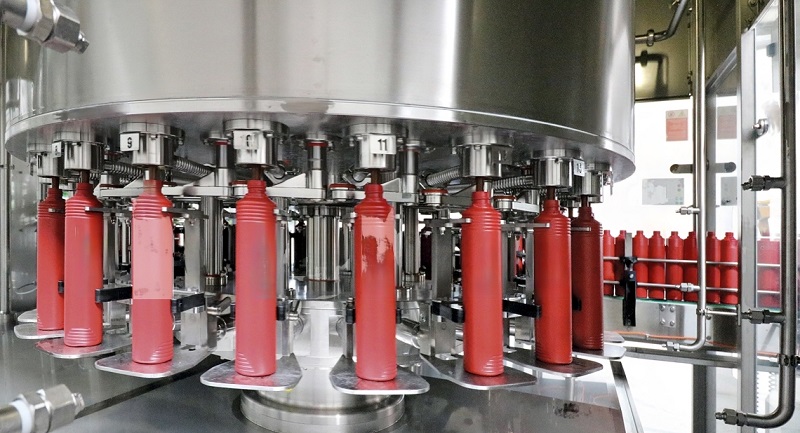
High-viscosity piston filling is the best choice for very dense materials like sauces. Using the volumetric filling principle, the piston-filling machine uses varying degrees of automation to accurately and quickly fill the sauce into containers, such as cans or bottles. The number of nozzles on a sauce piston filler directly relates to its production capability.
Sauce Bottle Filling Machine
Automatic and semi-automatic versions of the sauce bottle filling machine are available. When using the automated sauce bottle filling device, the user places the empty bottle on the conveyor belt, automatically moving the bottles to the filling machine. The bottles must be manually inserted into the semi-automatic sauce filler.
We also include a filling setting time on the equipment, which you may adjust on the touch screen to suit your demands. Simply place the empty bottles on the conveyor belt in the appropriate order for the machine’s number of nozzles to start filling them. full, they are taken out and changed for new ones before the process can continue. The user must manually take the filled bottle out of the machine using the semi-automatic sauce bottle filler. Empty containers will be automatically replaced with filled ones by the machine.
Hot Sauce Bottling Machine
This will focus on our piston-type hot sauce bottling machinery since most commercially available sauces contain high solids. To meet your facility’s precise space and operational requirements, we can customize our automated sauce filling machine, which can hots any fill between 2 Hot sauce bottling machine’s mixing hopper and high-temperature help ensure that each glass bottle is filled precisely and that there is no liquid stratification occurring during the filling process.
Sauce Bag/Pouch Filling Machine
Use the automatic sauce bag filling machine to pack sauces into ready-made pouches. This machine uses a PLC control system to automate the bag-filling procedure. The desired liquid is filled into a premade bag and transported on a conveyor belt. The following are The steps for filling a sauce bag:
✔ A conveyor belt collects and releases sauce bags. ✔ Opens pocket ✔ Put the premade bag below the hopper and fill the product into the bag to the stated amount. ✔ The mouth of the bag is sealed by applying heat and cooling heat. ✔ Empty packaging replace the filled ones at the end of each cycle.
Sauce Filling Machine Selection Applications
Filling machines for sauces are flexible to a wide range of sauced products.
Tomato Sauce/Ketchup Filling Machine
Using these handy filling devices makes it simple to fill and seal ketchup in cans or bottles. These ketchup filling machines allow tomato sauce consistency and volume to be changed.
Pasta Sauce Filling Machine
Food manufacturers risk losing their ability to sell their products in stores if the packaging of delicate goods like spaghetti sauce is compromised. A quality sauce filling machine is the only method to ensure consistency in pasta sauce packing.
Chili Sauce Filling Machine
Although filling thick liquids like chili sauce may be challenging, you won’t have to worry about losing time or money if you have the right tools. Sauces may be packaged in a variety of ways, including mason jars, jars, soft pouches, and As a result, chili sauce companies may choose the perfect chili sauce filling machine for their unique packaging needs.
BBQ Sauce Filling Machine
Because of its thick consistency, BBQ sauce calls for specialized machinery designed to fill bottles quickly and accurately. We can customize our services to your requirements, including advising you on the best BBQ sauce filling equipment to use.
Jam Filling Machine
Pectin, fruit juice, and sugar are essential components, and most jams need cooking. Once the jam is ready, it is typically kept in an airtight container. Jam often has the same quantity of sugar as fruit. By combining the two ingredients, a gel is created. Our jam filling machine may accommodate the ever-changing jam market; We design the best filling machinery available to control your jam and meet your production goals.
Peanut Butter Filling Machine
The popular food spread known as peanut butter is made by pulverizing dry-roasted peanuts into a paste. Salt, sugar, and emulsifiers are common additions to enhance taste and consistency. We provide a machine for filling products with peanut butter as well as other packaging -related accessories.
Honey Filling Machine
For applications requiring honey filling, powerful machinery designed to handle sticky liquids is necessary. We offer a selection of honey filling machines, bottle cleaners, conveyors, labelers, and cappers to help with these operations. With continuous precision and speed, our honey equipment can handle a broad range of honey package designs. Our honey filling technique will enhance productivity and decrease downtime for your company.
Manufacturers use a wide variety of containers to store and deliver sauces. You will need a sauce bottle filling machine if your sauce will be sold in bottles or cans; if it is filled in bags, you will need a bag wrapping machine. Before purchasing sauce filling equipment, it is also essential to consider the packing container’s size and capacity. A sauce filler should be flexible enough to fit a broad range of bottle shapes and sizes.
Sauce Viscosity/Thickness
The perfect sauce packaging machine would consider the viscosity of the final product before investing. The effectiveness of machines made expressly for filling sauces varies depending on the sauce’s thickness. No matter the consistency of your sauce, we have a filling machine that, as can handle We offer both piston and self-flow filling systems.
Sauce Filling Machine Cost
Before spending money on a sauce filling machine, evaluate your requirements. When you know what you need, you may eliminate unnecessary tools and focus only on the ones that will complement the packaging of your product the best. Contact a sauce filling machine manufacturer like us To learn more about the specifications and cost of the machine you’re considering and to have it customized to meet your requirements.
Level of Automation
It’s critical to first determine the needed daily or hourly production before choosing between a semi-automated or fully automatic sauce filling machine. If your production capacity is limited, use semi-automatic equipment;
Sauce Filler Benefits
Customizable Solutions
It offers customized solutions to your specific packaging concerns. Investing in high-quality sauce filling equipment may help guarantee the quality of your product lasts. Buying the appropriate sauce filler for the density of your product is critical for an efficient packaging operation.
Save Labor and Boost Efficiency
You may choose a semi-automatic or fully-automatic sauce packing machine, depending on your needs. The accuracy, productivity, and cost savings from using high-quality sauce filling equipment are well worth the initial investment.
Safe Operations
To protect workers, effective sauce filling requires the use of machines. With the help of automatic sauce filling machines, there is no better method to ensure the safety and efficacy of a manufacturing run.
Ketchup is a non-Newtonian fluid, as its viscosity changes with the application of force. It is categorized as a shear-thinning fluid because its thickness decreases as the shear stress rises. Therefore, choosing a suitable ketchup filling machine is crucial.
✔ Choose your ketchup filling machine suitable for the filling product material’s viscosity, foaming, instability, gas concentration, etc.
✔ Go for a wide range of equipment. When we speak about the process’s scope, we mean that it can be adaptable to a variety of production needs. Extending the range of operations allows for more effective use of the equipment and the many tasks that may be completed with a single machinery unit.
✔ Choose a sauce filler with high filling accuracy. According to national regulations, filling errors are allowed to be at most 1%. Thus, if the machine claims the error number is between 0.5% and 1%, you may purchase the filling machine with great trust.
Ketchup is fairly fluid, does not foam, and has a high viscosity. Filling equipment often options for more budget-friendly piston filling machines.
MAKWELL Piston Ketchup Filling Machine
Our automated linear piston filling machine is a highly flexible piston filler that can quickly and correctly fill a range of goods, from high-viscosity paste or cream to low- or high-viscosity liquids, with or without chunks or particles.
Filling Quality
✔ Our ketchup filling machines are built with a 304 stainless steel frame and use linear piston technology.
✔ PLC control and touch screen HMI are included as standard, guaranteeing dependable, repeatable control with little human involvement.
✔ High-precision, heavy-walled metering cylinders deliver products with an accuracy of up to +/- 0.2%.
✔ When compared to a pneumatic system, the servo motor drives screw movement with more speed and accuracy.
✔ Anodized aluminum and food-grade stainless steel provide a hygienic environment for both production and consumption.
✔ Motorized conveyor and indexing package for integrated container handling and placement, plus many more features.
✔ No container, No fill prevents waste and product spills by detecting missing or misplaced containers.
✔ A dual-stage fill actuator and a special variable, independent speed control, provide accurate “no-spill” control for top-off applications or filling complex goods.
Filling Process
The primary drive conveyor serves as a staging area for empty bottles before they reach the piston filler. Optical sensors count the bottles as they enter the filler to make sure the correct quantity of bottles. The pneumatic bottle clamping system secures bottles into place once they are in place. This ensures bottles are correctly positioned under each filling head to avoid under or over-filling.
Sauce piston filling equipment can precisely measure and fill liquids of various thicknesses. Each device has a minimum of one volumetric piston. The product is drawn from the container or hopper and placed into the product cylinder during the fill or release cycle, which is known as the intake stroke. A set of stainless steel valves that allow quick, precise, and reliable filling are lowered into the bottles to start the filling process. The downstroke begins when the product cylinder reaches the maximum fill level. As the piston rises, the substance is ejected from the cylinder and into the container. The filled bottles continue to move along the conveyor for the sealing procedures.
Filling Capacity
Our piston ketchup filling machine can fill containers ranging in size from 50 ml to 5000 ml. The piston-height cylinders and diameter are adjustable to meet the bottle-capacity needs of the production. Piston cylinders are available in various capacities, often 50-50ml , 100-1000ml, and 500-5000ml. The Dual lane option may double output without requiring more room in the assembly line, and it comes in various nozzle counts (2, 4, 6, 8, 10, 12, and 16) to meet a wide range of manufacturing needs.
Ketchup piston fillers enable clean, drip-free filling and increase accuracy for your product lines. It eliminates the possibility of leaks, drips, and overflows in food filling lines. Our ketchup filling machine is configured to constantly deliver exact amounts of sauces , ketchup, stews, batters, meat/sauce mixtures, and pastes. As a result, these ketchup piston solutions provide the best product fill accuracy with the least amount of product damage.
A mixing tank is the best vessel to use for combining or mixing many substances into one. Several different materials may be used to build mixing tanks, including steel, plastic, glass, and even hard rubber. Mixing tanks are often built out of stainless steel because of their longevity and minimal maintenance needs. Copper is seldom used in large proportions while building a mixing tank because of how corrosive it is.
Mixing tanks, which are a common fixture in most industries, are often used to prepare ingredients for use in manufacturing. Before being used to create a variety of various goods, enormous amounts of raw ingredients are combined in a large mixing tank. Ingredients like flour , yeast, and water would be moved from small containers into a larger mixing tank in a bakery, for instance.
A mixer or beater devices are often seen within mixing tanks to help with the mixing process. Some of these tanks resemble huge cement mixers due to the paddles on their sides. The paddles collect the ingredients from the bottom of the tank and place them on top as it rotates. Other mixers have beaters that are far bigger than those on a hand mixer. The beaters spin the ingredients while also incorporating air into the mixture.
Most liquid-only tanks have plumbing lines going into and out of them. A liquid may be injected directly into the tank when it is needed. The bases of tanks are connected by pipes, so when the liquids are blended to the proper consistency, they are delivered to the next station. Several of these tanks get clean water consistently from a permanent conduit so they can sustain themselves. These pipe connections are powered by a central vacuum system that runs from a remote motor or system to each of the mixer tanks.
Some compounds may not react well when kept close together. You may purchase huge quantities of each component without being worried about the likelihood of hazardous chemical reactions by keeping the chemicals separate and just mixing them in a mixing tank when they are ready for use. As As a result, workplace safety for you and your coworkers has improved, and manufacturing costs have gone down.
Stainless Steel Mixing Tank Applications
Since it was first used more than a century ago, stainless steel’s range of applications has greatly increased. We have put up a list of some more important uses for stainless steel mixing tanks as part of our attempts to make the most of your resources.
Cosmetics
In the cosmetics sector, cross-contamination and the growth of microbiological pollutants are serious risks. When consumers use the products, these microorganisms have the potential to be harmful, resulting in allergic responses and skin irritation. this, and one of them is making sure that tanks are filled and cleaned. Storage tanks made of stainless steel are simple to maintain and don’t corrode, which may taint goods.
Pharmaceuticals
Another sector that has to be on the lookout for product contamination is the pharmaceutical business. Cross-contamination may, at best, make a medicine useless and, at worst, change the product’s intended dose or result in infection. This is in addition to the possibility of an allergic response. This increases the need for adequately cleaning tanks.
Stainless steel provides other advantages for the pharmaceutical business as well. When it comes to processing materials, there is a strong need for nonreactive surfaces due to the sorts of chemicals applied in medicines. Because of this, stainless steel is a great choice for mixing tan and other production-related tasks.
Chemicals
The chemical industry, whether a company produces laundry detergent or ethanoic acid, has some of the roughest and most corrosive ingredients and procedures of all the applications we have identified for the stainless steel mixing tank. For the quality of the product and the manufacturing process a whole, stainless steels non-reactivity and corrosion resistance are crucial. You would have to spend more money and lose productivity replacing tanks made of other materials, more readily corroded materials more often.
Stainless Steel Mixing Tank Benefits
The materials for the composition of mixing tanks have the power to make or ruin a processing operation. Both product design and material selection have advanced throughout time. Tanks made of stainless steel are now among the most popular options, and for good reason. With this , here are a few advantages of mixing tanks made of stainless steel.
Corrosion-Resistant
The elements that make up stainless steel and how they react to their surroundings make it very resistant to corrosion. This is important when working with an acidic chemical because it will corrode other metals faster and give your product a bad metal smell. Because this corrosion has bad effects, stainless steel storage tanks are a good investment not only when processing products but also for storage.
Easy to Clean
Your product could nevertheless develop some unpleasant flavors even if it doesn’t come into touch with rust. If you don’t keep your tanks clean, the flavor of your product can decrease; therefore, it’s important to use a material that can be quickly Disinfected. Stainless steel is non-corrosive, allowing a wider range of cleaning agents to be used to it, making it not only easy to clean but also incredibly adaptable.
Cost-Effective Solution
And steel is much cheaper than other metals that could be used for mixing tanks, like copper. In general, copper costs 25% more than stainless steel. Also, stainless steel is likely to last longer with less work because it is easy to clean and doesn’t react as strongly to contaminants that might enter from the outside.
We’ll explain the liquid filling machine working principle to guide you in picking the best option for adding to your production line and increasing efficiency and productivity.
In fact, there are several liquids with varying qualities. To fill a bottle with a beverage or toothpaste, you have to use a different method. Filling small containers for cosmetics and medicines differs from filling large drums for chemicals.
Liquid Filling Machines
The most crucial difference between machines is how much automation each one needs. For instance, a big factory that makes a lot of products needs more advanced technology than small businesses to cope with the demands.
Before sending bottles to the next production step, automatic filling equipment fills them with the least amount of human contact possible. The machine may be set up at different speeds, capacities, and container kinds. Semi-automatic machines, which move containers into and out of the filling station, need human input.
Operators of manual machines must position the containers and control the filler using a handle. Then dispense the filled containers. These machines need no electricity and are especially suitable as bench-top equipment for small enterprises.
One more difference is if a machine is inline or rotary. Inline fillers are economical and fill containers as they move down a conveyor in succession. They are adaptable and simple to modify, making them suitable for a variety of goods and containers. Rotary machines are Faster and may include bottle cleaning and capping technologies, but they are more costly and tailored to specific products and containers.
Liquid Filling Machine Working Principle
In general, liquid filling machines follow the same principles no matter what type they are. With an automatic system, the conveyor moves containers through the machine for filling before continuing to the next step. However, the filling method used varies according to the nature of The liquid content, the container, and the level of precision required.
While the principle of filling is to deliver the proper quantity of liquids into containers, this is also the trickiest step in the procedure. More than any other step, this will decide what machine a company requires.
Some liquids are clear and flow easily, while others are thick and bubbly or even have floating particles. The type of liquid and the container also affect the best way to measure and ensure the machine fills the right amount of liquid into the containers.
Piston Filler
The best solution for thick liquids and pastes is a piston filling machine. With a stroke and discharge system, they have a valve system that operates. The piston fills the container by pulling products from the cylinder. These volumetric systems are widely used in devices that are only partly automatic, precise, and can handle a variety of liquids. They may also be easily enhanced by adding extra filler heads.
Pump Filler
These devices often apply for thick liquids and have a pump that sucks the liquid from a cylinder and fills it into the container. Pump fillers use a “pulse timing” method to figure out how much to fill by counting the number of times the gear turns . The product is pumped into some systems with a time-based fill for a set amount of time. This method is less accurate than pulse timing, though.
Pump filling systems are quicker than piston filling systems, which makes them suitable for filling big containers where precision is not as critical. However, piston filling systems are more exact. Other pumps use lobes or peristaltic motion to regulate product flow by compressing rubber tubes.
Overflow Filler
Overflow fillers fill bottles to the correct level, even if the volume may change slightly. This often happens with clear containers because it makes the product look even and nice. The system fills the container until it is full, and any extra product flows back into the storage tank so that it doesn’t go to waste.
Gravity Filler
Gravity filling fills the container by using the weight of the liquid. The liquid is typically supplied into the container over time from a tank above the filling heads. When the timer goes off, a valve underneath the filling head opens. This allows the proper fluid volume into the bottle before closing the valve. The liquid should flow readily, have a stable viscosity, and include no particles that may become trapped in the heads in an ideal condition.
Bottom Up or Isobaric Pressure Fillers
Bottom-up fillers work by lowering the nozzle through the opening of the container until it reaches the bottom. When it does, the liquid is poured out until the desired level is reached. This makes the method great for manufacturing liquid foam. The isobaric filling is best for carbonated products. A diffuser spreads the liquid evenly along the walls of the container, which keeps the carbonation from escaping. The CO2 in the bottle keeps the pressure constant while the nozzle lets out any extra gas.
Check Weight Filler
For big containers, a check weight machine is the best option. The platform provides measures the liquid’s weight as it fills the container.
Auxiliary Machines Working Principle
Other machines are essential in the manufacturing process, particularly for automation lines. Conveyors connect the various systems and come in multiple sizes, forms, and materials. They ensure that bottles transfer from one stage to the next at regular intervals. They must be constant and dependable.
The process starts by loading containers onto an unscrambling table. The table will then feed the containers into the machine at set intervals. Other machines, on the other hand, have fully automatic container dispensers.
To remove dust and other pollutants, some systems wash the containers before they enter the machine. Others use hydrogen peroxide or a comparable substance to sterilize bottles in advance to prevent food from spoiling due to microbial infection.
Conveyors transport the containers down the manufacturing line for sealing, capping, and labeling or gathering them on an aggregating table for further treatment by machine or personnel.
The next step for most containers is to pass through a capping machine. However, some liquid-filling devices also cap the containers. Following that, some systems apply labels to the containers, while others shrink wrap or place them in cartons to prepare them for the packaging process.
Conclusion
Liquid filling machines are accessible for a wide range of liquid types, container sizes, and shapes. Suitable equipment combines with additional stages such as capping and packing to boost production to create a full liquid filling line.
To take your company to the next level, work with an expert with professional experience with companies from various industries. Please get in touch with us if you’d like to learn more about how we can help you create the proper liquid filling technique.
Commercial manufacturers use liquid filling methods to pack liquids into various types of containers. The cosmetics, pharmaceutical, food, and beverage industries are just a few industries that profit significantly from liquid filling processes. Here are some of the most used with methods for filling today:
____________________________
1. Atmospheric Filling Method
Atmospheric pressure liquid filling methods or methods that use air pressure and relies on the weight of the liquid in the packing container. The full-filling mechanism is now operational. A liquid level regulates the filling in the atmospheric pressure filling technique. The process is as follows:
1.The liquid flows into the container through the inlet pipe, while the exhaust pipe releases the air. 2.When the right amount of liquid is in the container, the liquid feeding stops, and the irrigation stops automatically . liquid from the system by letting it out through the exhaust pipe. The system is now available for the next filling and emptying.
Filling under atmospheric pressure often applies to low-viscosity, carbon dioxide-free, and odorless liquid products; white wine, juice, soy sauce, vinegar, milk, etc.
____________________________
2. Isobaric Filling Method
Isobaric liquid filling methods fill the container first with the compressed air in the storage tank’s upper air chamber. This way, the tension in the storage tank and the container are almost the same. The liquid runs into the container because of its own weight in this closed system. It can also blow up or inflate liquids. The steps it takes to work are;
1.Pressure is equal to inflation. 2.Gas intake and release. 3.Liquid stop/pause. 4.Remove the pressure. To prevent bubbles and a sudden reduction in bottle pressure that might impact the precision of the dosage, let the residual gas in the bottle outgas.
____________________________
3. Vacuum Filling Method
Vacuumliquid filling methods suck out the gas within the container for filling by using the pressure differential between the liquid filling and the exhaust outlet. The pressure differential might cause the product to flow faster than equal pressure filling. It is ideal for putting liquids into small -mouth containers, dense materials, or large-capacity containers. On the other hand, overflow collection and product recirculation devices are essential for vacuum filling systems.
Various differential pressure-filling technologies have been developed due to the many kinds of vacuum creation.
A. Low Gravity Vacuum Filling
The container must maintain a certain level of vacuum with proper sealing. Low vacuum levels stop overflow and backflow during vacuum filling and keep gaps and spaces from filling incorrectly. If the container doesn’t meet the vacuum setting, no liquid will flow from the opening of the filling valve. And filling will stop automatically if there is a hole or crack in the container.
The liquid in the reservoir can flow into the bottle through the fine sleeve valve. You can use the pipe in the middle of the sleeve valve to let the air out. Gravity filling begins when the pressure in the bottle matches the low vacuum in the top half of the reservoir through the venting pipe. This happens when the container is sent to rise beneath the valve, and the valve spring opens under pressure. The filling stops by itself when the liquid level gets to the vent. This method is excellent for filling wine or alcohol bottles because it doesn’t make much noise and doesn’t need to be aerated. The wine doesn’t leak or back up, and the amount of alcohol stays the same.
B. Pure Vacuum Filling
When the filling system pressure falls below atmospheric pressure, the sealing block of the filling valve goes toward the container, and the valve immediately opens. Because the container connected to the vacuum chamber is in a vacuum, the liquid is sucked into it quickly until it is complete. A significant volume of liquid is often poured into the vacuum chamber, overflows, and is subsequently recycled.
Vacuum filling process flow:
1. Vacuum the container 2. Inlet and exhaust 3. Preventing inflow 4. Return the liquid. The residual liquid in the exhaust pipe returns to the storage tank through the vacuum chamber.
The speed of filling is faster with vacuum filling, and the product doesn’t come in contact with air as much, which helps the product last longer. The fact that it is completely closed also makes it harder for active ingredients to get out of the product.
The vacuum approach efficiently fills liquids with high viscosity, like oil and syrup. It is also suitable for filling liquids that shouldn’t come into contact with vitamins in the air, like vegetable juice and fruit juice, as well as toxic liquids like pesticides, chemical liquids, and many others.
____________________________
4. Pressure Filling Method
Pressure liquid filling methods are the inverse of the vacuum liquid filling method. The product is under positive pressure as it is at a greater pressure than the surrounding air. Filling liquids or semi-liquids is possible by either pressing a gap at the top of the storage box or pushing the product into the filling container using a pump. The pressure technique retains the pressure above atmospheric pressure at both the product’s and the vent’s ends. The pressure is more significant near the conclusion of the product, which means keeping certain beverages ‘ CO2 concentrations low.
This pressure valve is excellent for filling non-vacuumable goods. For instance, the amount of alcohol in alcoholic drinks decreases as the vacuum level increases. Hot beverages, such as 90-degree fruit juices, would quickly evaporate if vacuumed. like jams and hot sauces.
The vacuum homogenizer mixer is a vacuum emulsifier homogenizer system for manufacturing processes. In the small- or large-scale cosmetic, pharmaceutical, food, and chemical industries, this covers viscous emulsion, dispersion, and suspension.
Our vacuum homogenizer cream mixer stands out from the competition because it uses the vacuum’s many key features to maximize mixing and product handling efficiency. By reducing the mixing environment to a vacuum, not only may aeration, which destroys mixing blades, beed but vo idv free final product mixes.
How does a vacuum homogenizer mixer work?
The process of using a vacuum homogenizer mixer is straightforward. The first step is to add the ingredients to the mixing tank. The emulsifying mixing tank has fixed impellers with holes to ensure complete mixing. While in use, the blades spin both forward and backward at varying rates.
Forward mixing starts high-speed mixing, while reverse mixing starts low-speed mixing. The front blade transports the material down by the reverse blade. Our vacuum-emulsifying homogenizers come in a variety of capacities and speeds to meet your specific mixing unit’s needs.
The two opposing forces will constantly load and mix the materials. Eventually, the materials will be pushed to the middle by centrifugal force. This will apply over and over again until the ingredients are thoroughly mixed, spread out, and blended. Then, the inside The wall quickly transfers the heat from the jacket to each part of the product materials.
With the help of the vacuum pump, it forces the air out of the mixing tank. Then the equipment runs perfectly without any air. The safety vacuum sensor will maintain the pressure of the liquid at a constant condition. With this, the process will have little to no extra air.
What are its working processes?
De-Aeration or Air Removal
De-aeration helps cut down on product failures by sealing up any air pockets. This often happens during the production of epoxy-based composites.
Deoxidation or Oxygen Removal
Deoxidation is the technique of removing oxygen from a mixing system to stop delicate materials from degrading and unexpected chemical reactions from occurring while mixing the ingredients. Also, oxygen might encourage microbial development, which could mix with the chemicals.
Vacuum Drying
When there is low pressure and a vacuum, heat is present. The heat drives moisture and solvent away. Using a vacuum, we can quickly change the physical state of a batch from slurry to paste and from paste to granules or dry powder.
Retrieving Solvents
With a vacuum, solvents are readily condensed and collected. This keeps them from polluting the air both within and outside the facility. The processor may then recycle or dispose of the solvents in accordance with environmental regulations.
Solid or Liquid Infusion
With the sub-surface valve in the vessel, you may feed liquids and light powders into the batch while it is under vacuum. This quicklyens the mixing process, mainly because it soaks particles fast.
Increase Density
After stirring and deaerate in a vacuum, a batch will be denser than before. Often, this helps you blend better and save money on shipping. The final product’s physical qualities are typically enhanced by densification as well.
Stripping Vacuums
Lower the temperature of your batch material through evaporation. This is especially helpful when the batch material gets so thick that it no longer stays in contact with the vessel wall and no longer transfers heat to the cooling fluid through the vessel wall.
What are the advantages of using a vacuum homogenizer mixer?
Less Waste and Improved Hygiene
A scraper made of Teflon or a nonstick coating includes in the vacuum homogenizer mixer. This substance is simple to clean, difficult to dissolve in all solvents, and resistant to high heat. The scraper collects material wastes that can be recovered without disrupting the operation.
Low to No-Air Mixing
All the mixing system parts work together to make a closed loop that keeps any possible sources of contamination from getting in. When bubbles form in a liquid and could affect the blades, cavitation doesn’t happen when there isn’t much or any air coming into the system. This will ensure that your vacuum homogenizer mixer lasts a very long time.
Adaptability
We provide mixers that can withstand a wide range of workloads and viscosities. Extreme circumstances can’t stand a chance against the scope of pumps and processing systems. Provide precision doing, complete processing, and accurate analysis.
Get rid of voids
Higher drying efficiency at lower temperatures.
What are the general applications of a vacuum homogenizer mixer?
Food Processing
We pay attention to food safety while offering equipment for making high-quality food. Some of the most complex parts of processing foods and beverages are mixing liquids with different viscosities and dissolving nutrients and sugar. Ensuring physical and nutritional properties are mixing The process is clean, and securing that all food rheology specifications are met.
Brewing and Distillery
Meat and Poultry
Flavor Emulsions
Confectionery
Ingredients
Edible Oils
Pet foods
Cereals
Dairy
Pharmaceutical
In nearly every stage of pharmaceutical manufacturing, the preparation of suspensions and handling and processing of cohesive powders are necessary.
Assay of Pharmaceutical Products
Pharmaceutical Syrups
Ophthalmic Solutions
Cream & Ointments
Sterile Processing
Tablet Coatings
Vaccines
Cosmetics and Toiletries
Mixing is a tricky part of making cosmetics and personal care products. Getting the right amount of hydration for thickening and suspending agents may be challenging, such as keeping emulsions stable, keeping the process clean, breaking up solids, mixing liquids with different, visco mixing thickeners. It is also essential that after mixing, cosmetics keep their color, smell, and other physical qualities.
Toothpaste and Dental Whitening
Cream Emulsions and Lotions
Shampoos and Conditioners
Moisturizing Body Wash
Pigment Dispersion
Liquid Foundations
Cosmeceuticals
Antiperspirants
Hair Dyes, Gels
Deodorants
Mouthwash
Sunscreens
Perfumes
Creams
Sprays
Soaps
Chemicals
Pesticides and Insecticides
Solvents and Lubricants
Mold Release Agents
Paints and Varnishes
Paints and Pigments
Specialty Chemicals
Drywall Compound
Asphalt Emulsions
Rubber Solutions
Fabric Coatings
Ink Dispersions
Paper Coatings
Agrochemicals
Printing Colors
Drilling Muds
Fungicides
Pigments
Lube Oils
Polishes
Biofuels
Toners
How does Makwell maintain quality control?
All mixers adhere to FDA-enforced CGMP standards. The optimum design, inspection, and control of manufacturing processes and procedures are all part of CGMP, which is essential for quality control in manufacturing facilities.
Compliance with CGMP guidelines ensures manufacturing processes’ integrity, durability, and excellence. Effective quality management systems, reliable operational procedures, and proper review of product quality deviations are all part of CGMP.
Because of its tried and tested reliability, emulsifying equipment applies in many industries, such as those that deal with food, pharmaceuticals, cosmetics, and chemicals. The question is, how can a vacuum emulsifier ensure that all the ingredients are mixed quickly and evenly when making a large amount? What makes it widespread in manufacturing facilities?
High-Shear Homogenizer for Fast, Effective Emulsification Mixing
This is where the high-shear mixer works. Shear and energy dissipation rates are substantially higher than in more standard mixing containers. As a result, the mixer may homogenize and emulsify liquids as well as disperse and dissolve particles in liquids. Famous components, such as pectin, may dissolve in the powerful mixing technique, which takes just a short amount of time.
Automatic Production Level Control
The vacuum emulsifier has the choice of a weighing system or a liquid-level control system. Product inlet/outlet and level control work together to guarantee that the proper amount of fluid circulates through the system. If the liquid level has become too high or too low, it may be brought back to the optimal level using the load cell and frequency-regulated outlet pump. The blend’s powder composition also fluctuates throughout production (sugar, lactose, stabilizers). No matter how much powder is added to the mixer, the vacuum emulsifier’s emulsification stirring technique assures a reliable outcome.
Frequency Conversion Speed Vacuuming to Save Water, Ecology, and Economics
The stirring paddles of the vacuum emulsifier and high-shear homogenizer have speeds regulated through frequency conversion. The frequency converter lets the motor operate at the process-appropriate speed, saving energy and preserving the environment. In addition, the closed vacuum may reduce the emulsification system’s water and energy consumption by 50% and 70%, respectively, compared to the market competition model, controlling operational expenses.
Vacuum-Sucking: Clean Liquid and Powder Feeding
One of the favorite features of emulsifying equipment is that it has vacuum suction, which is used to keep the speed of the process constant. There is a vacuum buffer tank; if the vacuum is lost, the machine will turn off immediately. By doing this, we prevent backflow and bottlenecks that could stop production.
Automatic Closed System for Safe and Clean Manufacturing
The system is fully sealed to keep the product clean, so there is no chance of contamination. Mainly, the emulsifying mixer is adjustable to meet EHEDG and 3A standards and works well in a clean environment.
Degassing also extends the product’s shelf life by preventing bacteria from growing in the final product’s environment.
Is It Better to Have Fast Emulsifying Equipment?
Vacuum emulsifiers are used as part of the mixing system of industrial equipment to mix solids and liquids, liquids and liquids, oil and water, disperse and homogenize, shear grind, and do other tasks. The name “emulsifying equipment” comes from the fact that it can make things mix together. When the two phases are combined together, they separate into emulsions of oil in water and oil. At least two factors must occur for emulsification to happen:
First, the mechanical cutting does an excellent job of spreading ingredients out. At the same time, both the water phase and the oil phase in the fluid medium are broken up into small pieces. The water phase and oil phase then mix and penetrate each other to form an emulsion.
Second, an effective emulsifier serves as a link between the molecules of oil and water. With the help of electric charge and the attraction between molecules, the oil-water emulsion can be stable for as long as needed.
The shearing strength of the emulsifier determines the refining. Blade sharpness and hardness, stator gap, relative blade speeds, particle size limitations, and other factors are among the factors that need examination.
Because particle size is greatly influenced by the sharpness and hardness of the blades, the clearance of the stator, and the allowed base values, the relative speed of the blades, defined as the circumferential speed of the rotor assuming that the stator is stationary, is an essential consideration.
Further, if the speed is high, the fluid density of the cutting or impinging radial flow will be higher, which will cause a severe dilution effect, and the same is true if the speed is low. But the speed of the line should be as fast as possible. When it gets to a very high value, it tends to stop the flow. This means there is very little flow, much heat, and a buildup of material, all of which should be kept an eye on.
Today, using industrial emulsifier machines has become increasingly common. The fact is that it can provide you with a practical, economical way to handle substances that need mixing and emulsification. A vacuum emulsifier mixes liquids, solids, and powders in industrial applications. Depending on the needs of various industries, emulsifiers apply in many ways.
Structure
An industrial emulsifier or vacuum emulsifier can shear, homogenize, emulsify, and stir materials. The emulsification tank uses a high-shear homogenizer and a lot of different ways to stir. The main parts of the emulsifying machine are the emulsification tank, water phase tank, oil phase tank, vacuum system, heating and temperature control system, and electrical control system. It has a flexible working head, an adjustable speed and frequency conversion system, and a temperature control system. These give you more options and flexibility in handling product materials.
A well-built vacuum emulsifier can mix and emulsify two or more oil and water phases more effectively than traditional stirring and mixing equipment. Our industrial emulsifier can meet all the needs of industrial emulsifying requirements. The operating system has the option of PLC control, which gives much freedom during production. The button control system is applicable only when needed, when the process is simple, which is better value for money.
Functions
Vacuum mixing environment.
When the lid opens, the liquid is poured into the top of the emulsification pot. With an easy-to-open lid, you can add ingredients, making feeding convenient.
The scraper on the frame stirring means that there is no dead angle. You may also regulate the frequency of the homogenizing shearing and the frame stirring.
A high-shear homogenizer powered by German technology homogenizes the mixture.
The emulsification pot’s inner, middle, and exterior layers are of stainless steel, separated into two opposing layers of space. Both the outer layer and the inner interlayer oil are heated and cooled.
To easily clean the inside of the pot, an electric lift is paired with a manual emptying of the pot body.
On the control panel, you can set the maximum and minimum temperatures, the amount of stirring and homogenization (speed control through uniform frequency conversion), and the time settings.
The pot’s lid has a light and a mirror for cleaning, making it easy to check the pot’s condition.
To meet your needs, we can create industrial emulsifier designs that are economical to operate and easy to maintain. We have divided our emulsifying mixers into several series in line with specific industry needs. In addition to the standard series, custom series are also available, giving you a wider range of options from which to choose. For more information, please get in touch with us!
Advantages
User-friendly. Start the process using the control panel. Easily adjust and set functions like speed, temperature, and the lifting and lowering of the lid.
Material transport is possible through pipelines, with minimal material loss and environmental damage.
With a compact size, make your workspace more efficient and organized.
High manufacturing standards for safety. When machinery works quickly in a closed system, industrial accidents may be less likely to happen.
The mechanical transmission system is not close to where the operators work.
Maintenance tasks are simple.
Is the vacuum emulsifier efficient at mixing?
Our vacuum emulsifier has a full system that can do a number of emulsifying tasks. Efficiency is high when working with materials that need complex procedures. This is especially important when working with materials that are made in large batches, where efficiency is much needed.
In general, our vacuum emulsifier system applies in the food, cosmetic, pharmaceutical, personal care, and chemical industries to perform industrial operations such as;
Emulsification
Homogenization
Consistent and even dispersion
Particle size shearing
Multiphase substance defoaming
Stirring
Our industrial emulsifier machine works by using the ultra-high-speed moving stator and rotor homogenizer. Agitator to shear, disperse, homogenize, emulsify, and mix the liquid materials that need mixing and stirring.
Standard Emulsification Mixer vs. Makwell Vacuum Emulsifier
Because a typical emulsification mixer is only used for one purpose, many other pieces of equipment are needed to finish the job. The steps in the process are heating, dissolving, stirring, homogenous emulsification, cooling, and getting rid of the foam. When these things come together, they often cause many problems. Materials are easily contaminated during multiple transfer processes, and materials are also lost. Traditional mixing tanks may not have enough mechanical kinetic energy and shear force, which can lead to large particles, uneven stirring and dispersion, bubbles, and an uneven texture, which makes it hard to guarantee quality.
Emulsification equipment greatly affects the quality of products in many different industries. So, you have to be careful when picking out emulsifier equipment. Our vacuum emulsifier uses German homogenization technology. It is a machine for mixing and stirring that has many different functions and is very well integrated. It can avoid the problems that come with traditional emulsification mixers. And finish the process of emulsifying and homogenizing high-end goods with high efficiency, cleanness, and low power use.
We are a manufacturing company specializing in designing, producing, and selling mixing, filling , and packaging equipment. We have highly skilled staff in the fields of fluid homogenization, emulsification, dispersion, mixing, and other mixing equipment. We also provide non-standard customization ranging from a single machine to an entire production system. Integrate sophisticated mixing and stirring technology continuously, focus on innovation, and supply our consumers with high-value-added solutions. The equipment is adaptable to your procedure and demands in the sectors of energy , chemical industry, food, biomedicine, and so on. Please contact us for additional information about vacuum emulsifiers!
In paint marketing today, there are dynamic changes affecting packaging machinery choices. Because paint is thick and contains particulates and colors, a piston filler is traditionally the mainstay of the industry. The piston paint filling equipment is part of larger can-handling systems and is not a stand-alone device. This is because the paint has always been sold in metal cans. But now, paints are available in plastic pails and bottles because of changing conditions. Very small samples of different colors are also offered in bottles to help in the selling of paint. Piston fillers are still the standard choice for the high production of paint cans and bottles, addressing the demands of a changing industry.
Makwell Paint Filling and Packaging Solutions
Paint Filling Machine
Our piston paint fillers with 500ml-5L pistons can handle paints in standard sizes from 50ml to 5L, as well as pints and quarts. Paint is abrasive, so piston fillers for paint don’t have elastomers because they would wear out too quickly and get into the paint. Hosing is also kept to a minimum and is usually made of stainless steel to make it easier to clean between batches. Because many paint supplies include solvents or other flammable chemicals, the paint filling equipment must be entirely pneumatic or classify to hazardous electrical regulations.
With two product lines for different sizes, our paint filling equipment can meet almost any paint-filling requirement. Makwell paint-filling solutions are available in two main groups:
50ml to 5L
5L and above
We offer you machines in each of these categories. Your paint-packaging device can have the following features and options:
Explosion-proof building for the highest level of protection
Fill by weight to get the most accurate results.
Options for lids and caps.
Paint monobloc machines, which can do the filling, capping, and labeling in one device.
Smaller tanks and flow control ensure a steady flow, no matter how thick the liquid is.
Choices for a small footprint for when space is limited.
Fill round, square, and odd-shaped bottles made of plastic and glass, etc.
We can customize any of these features to fit your needs. We can provide you with either a fully automatic or a semi-automatic paint filling equipment.
What Types of Paint Can Our Machines Fill?
We can design and construct unique paint filling and packaging equipment for your fluid or viscous goods. We can fill many types of paints such as;
Coatings
Sealants
Resins
Paints
Glues
Inks
As a filling machine manufacturer of paint filling, we create and develop paint filling equipment for paints and other similar product materials. Regardless of your pail sizes and shapes, we can supply you with the most efficient equipment to fill and cap your containers. Our experience with various types of liquids, even explosive liquids and our ability to manufacture high-quality equipment make us a reliable provider of paint and other similar products.
Liquid Packaging Machines: Other Types
Many types of liquid packaging equipment are essential for efficient packaging lines for paints and coatings. Cappers, labelers, bottle cleaners, and conveyors are beneficial to a production line.
Rinsing/Washing Machines
Before filling your bottles with paint or coating, it’s best to make sure they are clean so that any possible contaminants don’t oxidize or change the stability of the paint or coating inside. Dust and other particles that can cause a product to go wrong can be taken care of by bottle cleaners.
Capping Machines
After filling in the paint filling equipment, and containers are full of products, they need caps to keep contents from spilling out and getting dirty. Capping machines can place the lids on many different bottles and containers, fitting the size and shape of each one. Depending on the type of cap, you may want to use a spindle capper, chuck capper, snap capper, or automatic vertical wheel plugger. Cappers may also include accessories, such as cap elevators, sorters, and pre-feeders, to increase efficiency.
Labeling Machines
A labeler is an essential component of packaging systems. Labeling machines can apply labels of various materials, such as transparent, Mylar, and paper, to each container. In most situations, labeling machines are adjustable to accommodate a variety of shipping containers, with labels showing custom text, logos, and graphics.
Makwell Designs and Builds Filling Machines and Packaging Equipment For Paint
Speed and precision are critical when filling and packing paint into containers of any size. Speed and efficiency are essential in a high-volume production like paint filling. With these requirements, our paint filling systems can offer filling and packaging precision and speed necessary for the paint packaging industry.
We can provide economical and versatile packaging options to suit your paint-filling needs. Our equipment is easy to use, wastes no product and is fast and hygienic. They are durable, constructed from high-quality materials to fulfill various packaging types, and resistant to harsh chemicals.
With 15 years in the manufacturing industry, our liquid filling machines ensure adaptability to the changing demands of the paint industry. We manufacture the best suitable machinery to satisfy your paint filling requirements while also meeting your production targets.
Filling Machines and Packaging Equipment to Boost Efficiency and Profit
Automatic liquid filling machines can greatly boost productivity in liquid packaging lines. Product losses are from fill levels that are not accurate. Without this equipment, the filling process wouldn’t be reliable enough to stop such losses.
Filling machines and packaging equipment for liquid products such as paints are now more trustworthy than ever. Thanks to technological advancements for increasing automation and digitalizing many of its elements. The best fillers and packagers are even built to be completely customizable and user-friendly.
Conclusion
Using liquid fillers and other liquid packaging equipment in your facility may be all you need to keep your process running smoothly and keep your business going.
Is there anything you need to know about paint filling? Isn’t it great to know we’re only an email away? Feel free to reach out to us now , and we will be happy to answer any questions you have about paint packaging!
Using Emulsification Equipment, Combine Oil and Water to Produce an Emulsion, and Emulsifiers for A Stable Mixture
An emulsion is a mixture of fluids that usually don’t mix, like oil and water. It is possible by breaking up one of the fluids into tiny droplets. Oil in water or aqueous phase (o/w) or water in oil (w/o) are two common emulsions. Other complex systems, such as oil in water in oil (o/w/o), may also exist.
Mayonnaise, salad dressings, and sauces are emulsions. Most emulsions need emulsifiers to stop small droplets from sticking together and getting bigger. When the interfacial area gets smaller, the thermodynamic energy of the system goes down. Emulsifiers prevent droplets from merging.
Emulsifiers
Hydrophilic lipophilic balance (HLB) tells us which way emulsifiers tend to lean. Less than 6 prefer emulsions of water in oil, while 8 prefer emulsions of oil in water. 7–9 are wetting agent values.
Food emulsifiers and detergents share a molecule with water-loving and oil-loving parts. Ionic parts are often found in hydrophilic portions. Most of the time, a fatty acid is at the end that attracts oil and is lipophilic. There are both artificial and natural emulsifiers. Soy oil has a phospholipid molecule called lecithin. While egg yolk has lecithin and cholesterol, which improve emulsions of oil in water and water in oil. Mayonnaise and other sauces usually use egg yolk as an emulsifier, but because it serves two purposes, it can be hard to make.
Food emulsifiers can also be proteins, gums, esters of fatty acids, and poly hydroxyl substrates like lactic acid, sucrose, and polysorbates. Transesterification and molecular distillation make food emulsifiers. Different kinds of fatty acids have other qualities.
Mayonnaise is made at room temperature using vegetable oil. Other sauces may require little heating since the oil phase is often solid butter. Note that heating destroys egg yolk.
Foods use emulsifiers in many different ways. Stearoyl lactylates and mono- and di-glycerides stop starch from breaking down into sugar, preventing baked goods from becoming stale. Emulsifiers make chocolate less thick, so there will be less cocoa to use. This saves money and calories. Emulsifiers make it easier for cakes to come out of pans.
Sucrose esters as fat replacers in frying treats. Fat replacements are non-digestible and can affect the digestive system when used this way.
The stability of an emulsion depends on several factors. The amount of emulsifiers, the difference in density between the two phases, and the size of the droplets (usually between 1 and 10 m is best). Because the components set viscosity and density, the only thing changeable during processing is the size of the droplets.
Emulsification Process
The emulsification process is the breaking up of oil droplets that aren’t connected in the main liquid phase. Emulsions are suspensions of two liquid streams that would typically separate when mixed.
One must first be broken down into millions of tiny droplets to combine two immiscible chemicals. This is possible using the emulsification equipment. These droplets may be suspended or in other materials using an industrial mixer. The dispersed phase consists of the droplets, whereas the continuous phase consists of the other liquid.
Oil-in-water (O/W) and water-in-oil (W/O) are both types of emulsions. To make oil-in-water emulsions, the oil must be the phase that is spread out, and the water must be the phase that stays the same. The phases are the other way around for emulsions of water in oil. But these things won’t stay mixed for long without emulsifiers. It’s best to use emulsifying equipment like shear mixers and high-speed agitators to keep substances from separating.
Emulsification equipment reduces the size of the droplets or particles of the secondary oily phase so that non-soluble liquids can stay in a mixture of liquids with the same consistency. High-shear mixers or propellers may do this. Emulsifying machines reduce the size of droplets to less than 1 micron and make fine emulsions that last a long time. For these emulsification processes to work, you need high pressure over mechanical shear, but moderate flow rates can be used to scale up.
Emulsions are dynamic liquid forms that are prone to separation. Each piece of equipment mixes and shears fluids to make the droplets of a discontinuous phase smaller and stop them from separating. The point of emulsifying liquids is to keep an oil phase or other fluid that doesn’t mix with water in suspension by making the droplets small enough that they don’t separate. Surfactants help the final mixture stay together for a long time, but emulsifying equipment is a must-have.
Our emulsifying equipment can reduce the size of droplets by a lot, down to less than 1 micron, and they don’t have any moving parts. Having shear parts that don’t rotate makes it easier to repeat and scale up. Our emulsifying equipment is well-known for producing excellent emulsions in various industries, where a product’s quality and potential to last a long time can be crucial.
Cosmetic, Food, Cosmetic, and Pharmaceutical Emulsions
Emulsions are present in many of our favorite foods and sauces, including mayonnaise and salad dressings. Shampoos, creams, conditioners, and lotions are all emulsions used in the cosmetics industry. Emulsions also produce vitamins, supplements, and other bioactive chemicals in the medical field.
Oil-in-water emulsions are better acceptable for internal use products. This is why most food sauces and dietary supplements are oil-in-water emulsions. On the other hand, creams and lotions are for external use and perform best with water-in-oil emulsions.
What Are The Different Emulsion Regulations?
Food, cosmetic, and pharmaceutical emulsions must follow WHO’s Good Manufacturing Practices (GMP). These rules are suggested but are not enforced.
In the United States, the FDA sets rules for pharmaceutical emulsions. With the help of regional regulatory bodies in EU member states, the European Medicines Agency (EMA) puts EudraLex into place all over Europe. EudraLex is where you can find all the laws and drug rules in the European Union. Most restrictions for making drugs in the ASEAN area align with the PIC/S principles, but each country handles marketing approvals independently.
Note: packaging regulations in several nations mandate that labels on items identify whether they are for internal or external usage. For thick emulsions, you should also use wide-mouthed bottles and explicitly specify on the label that the product has to be vigorously shaken before use. Furthermore, avoid cooling emulsions, as doing so might lead to their demulsification.
The Programmable Logic Controller, or PLC, is a computer that controls and runs machines and processes used in manufacturing. It is a digital electronic system for an industrial setting, such as in bottle filling system. PLC has a programmable memory for storing user-specific instructions for tasks like logic, sequencing, timing, counting, and basic arithmetic. It can also control different machines or processes by taking in and sending out digital or analog signals. An industrial control system can easily include both the PC and its parts. So , basically, a PLC is a computer that controls specific tasks.
CPU
An input module’s job is to change signals that come in into signals that the PLC can process and send to the central control module. While the output module does the opposite. This changes the PLC signal into a signal that the actuators can understand. The main control unit uses the program stored in the memory to figure out how to handle the signals.
In the bottle filling system, PLCs can automate a wide range of functions. These are often manufacturing industrial processes where the cost of developing and maintaining the automation system is high. Compared to the total cost of the automation and when system upgrades are expected over the system’s operational life.
PLC Advantages
Calculating and displaying are computer specialties
Experts program the computer
PLC controls and regulates logic functions
Non-specialists program PLCs
PLCs are industrial-grade
When manufacturing a large number of products in the bottle filling system, a microcontroller-based design works well. Cost-effective in power supply, input/output hardware, testing, and certification. The operator does not need to modify the control.
Programmable controllers are used for motion, automotive, positioning, and torque control. PLCs may feature a single-variable feedback analog control loop called a “PID controller.” Like a PID loop that may control a manufacturing process’s temperature.
The bottle filling system process uses a PLC primarily with the following hardware parts;
IR sensors
Conveyer belt
Solenoid valve
Water tank
DC gear motor
Conveyer belt
A conveyor belt is a loop of material that spins around two or more pulleys. One or both pulleys are motorized, moving the belt and material. The drive pulley is driven, but the idler is not. Belt conveyors handle materials, like moving boxes within a facility, and bulk material handling, such as transporting grain, coal, ores, etc.
Automated distribution and warehousing use conveyors. Belt conveyors are the most flexible and affordable motorized conveyors. Regular and irregular-shaped goods, big or tiny, light and heavy, may be moved straight on the belt.
With a belt conveyor, you can move things in a straight line, up or down a hill, or in any other direction. One end of the belt is wrapped around each roller, and when an electric motor turns one of the rollers, the belt moves the product along the bed’s strong metal frame. Many belts are often pushed over rollers instead of beds when there are many belts to move. Rollers can carry heavy loads because they reduce the friction caused by more weight on the belt.
IR Sensors (Object Sensors)
IR sensors may be used inside when ambient light levels are low. It can measure high-speed industrial items and tachometers. Because the sensor is ‘blind’ between pulses, ambient light ignoring sensors that emit 40 Khz pulse signals is not applicable in such conditions .
The sensor face, which is the front of the sensor, lets infrared light. Sensors are usually part of an integrated circuit. It may have one, two, or four pyroelectric “pixels” of the same size and shape. Some sensor pixels can be wired to send opposite signals into a differential amplifier. In this setup, the PIR measurements cancel each other out, so the electrical signal gets the average temperature of the field of view. An increased IR energy across the whole sensor cancels itself out, so it won’t make the alarm go off. This makes it less likely that the device will show false changes when exposed to light flashes or field-wide illumination. Even if the light was always bright, the sensor could still be filled with light, making it unable to get any more information. Also,this differential arrangement cuts down on common-mode interference. This makes it harder for electric fields near the device to set off. But that setup can’t measure temperature with a differential pair of sensors, so it is only available for motion detectors.
Solenoid valve
A solenoid valve is a liquid or gas valve controlled by an electric current that flows through or stops the flow of a wire coil. It works like a light switch, but instead of controlling electricity, it controls the flow of air or water. Solenoid valves can have two or more ports. A valve with two ports can turn on or off, while a valve with three ports can switch between two outlets.
The most common type of fluidics control is a solenoid valve. It can mix, dose, shut off, and distribute fluids. Solenoids can switch quickly and safely, are very reliable, last a long time, work well with different materials, require little control power, and are small. Solenoid valves have a solenoid and a valve. The solenoid turns the electrical energy into mechanical energy, which opens or closes the valve.
DC Gear motor
An electric motor drives the conveyor belt, changing the energy from electricity into mechanical energy. Most electric motors make force by combining magnetic fields and conductors that carry electricity. Generators like an alternator or dynamos do the opposite, turning mechanical energy into electrical energy. Some electric motors can also be used as generators, like a traction motor on a car, which can do both jobs.
A DC motor is made to work with DC electricity. The brushed and brushless types of DC motors are by far the most common. They use internal and external commutations to change the direction of the current in the windings as the motor turns. There are electric motors everywhere! Almost all of the mechanical motion you see is from an electric motor or an AC (alternating current) or DC (direct current).
Conclusion
A PLC is a unique computer that controls and runs the machines and processes in manufacturing. With the help of PLC, practical problems can be solved in an industrial bottle filling system. The process involves a conveyor belt that constantly moves under normal conditions. On a moving belt, empty bottles are put. When a bottle is right in front of the sensor, the object sensors will pick it up, and the conveyor belt will stop after a few seconds. When the bottle is right under the solenoid valve, after two seconds, the solenoid valve will open, and the bottle will start to fill. The solenoid valve will stop after a set amount of time, and after two seconds, the conveyor belt will start moving again. This ends the one cycle of the process.
Please send us a message if you want to know more about the bottle filling system. Our team is happy to assist you.
A jam filling line fills and packs thick liquid commercial products, such as sauce, tomato sauce, hot sauce, ketchup, jam, peanut butter, honey, seasoning sauce, paste, and so on. It includes a jam filling machine, a rinsing/ washing machine, a tunnel sterilizing machine, a labeling machine, and a packing machine.
When packaging jam or marmalade, the two most important factors a jam filling line must have are how easy it is to use and how easy it is to keep clean. Food products, especially those with much sugar, need extra care when storing. The equipment must also be well-made and robust. If you need machines to process jam or marmalade in plastic or glass jars, you don’t have to look any further than ours. Even if your jams contain chunks of fruit or have to be at a higher temperature type of filling, our bottling equipment can handle it.
Jam Container Types
Glass wide-mouth bottles, plastic squeeze bottles, and Boston round bottles (usually lug caps) are now the most common types of jam packaging.
Because liquid products vary and are filled in a wide range of containers, liquid filling machines play an important role in many industries. These filling liquid machines apply in a variety of businesses to produce and fill products such as wine, spirits, salad dressings, and soft drinks. A liquid filling machine is also used in the cleaning industry to manufacture items such as floor cleaning solutions, multipurpose cleansers, and laundry detergent. Below are the industries our liquid filling machines efficiently serve;
1. Food
We prioritize cleanliness as it is a critical issue in the food service business, and durability to work with thick liquids and sauces. All of our food liquid filling machines come with quick-disconnect valves, sanitary tubing, pumps, and tri- clamp fittings.
2. Beverages
Our bottle-filling systems are very hygienic and corrosion-resistant. As beverage filling machines handle beverages, they must be safe as well as resistant to spoiled products.
3. Beauty, Personal Care, Health
We can modify liquid filling equipment for products of all kinds, ensuring they are suitable and well organized while protecting them from chemical damage. All cosmetics have their chemical properties, from cosmetics and lotions with a high viscosity to polish removers that are corrosive and more. This means using a separate filling machine for each kind of product.
4. Molten, Candles, Lip Balms
We can scale up or down to fulfill the demands of businesses filling molten products based on their manufacturing requirements. Our specialists manage each step of the design, manufacturing, and installation process. This machine handles products like candle , cosmetics, lip balms, molded and glycerin soaps, deodorants, shoe polish, carnauba wax, and much more. It can range from tabletop molten fillers to fully automated end-to-end inline molten filling machinery.
5. Agricultural and Industrial Chemicals
We are experienced in setting up different bottling equipment and have dealt with industrial and agricultural chemicals. Liquid filling machines for agricultural or industrial chemicals should be corrosion-resistant and capable of handling materials of fco-visibles .
6. Corrosives and Acids
The acids and corrosive filling machines, conveyors, and turntables are HDPE (high-density polyethylene). They are engineered to withstand the stress of a highly corrosive environment where typical metal components would ordinarily break down.
7. Cleaning and Janitorial Products
Help your business meet its janitorial supply needs by collaborating with our skilled sales and technical teams. We plan and implement filling systems for a wide range of cleaning products, ensuring that your manufacturing less of line can run safely and regally The cleaning solution’s viscosity, acidity, or foaming qualities.
Paints, stains, sealants, petroleum, automotive products, medicines, distilled spirits, wine, and much more are just some of the many commercial products for which we manufacture specialized filling machines.
Get in touch with us now to learn more about the industries we cover and how we can customize our liquid filling services to meet your company’s needs. We are a liquid filling machine manufacturer and can provide further information on any of the liquid filling machines featured above.